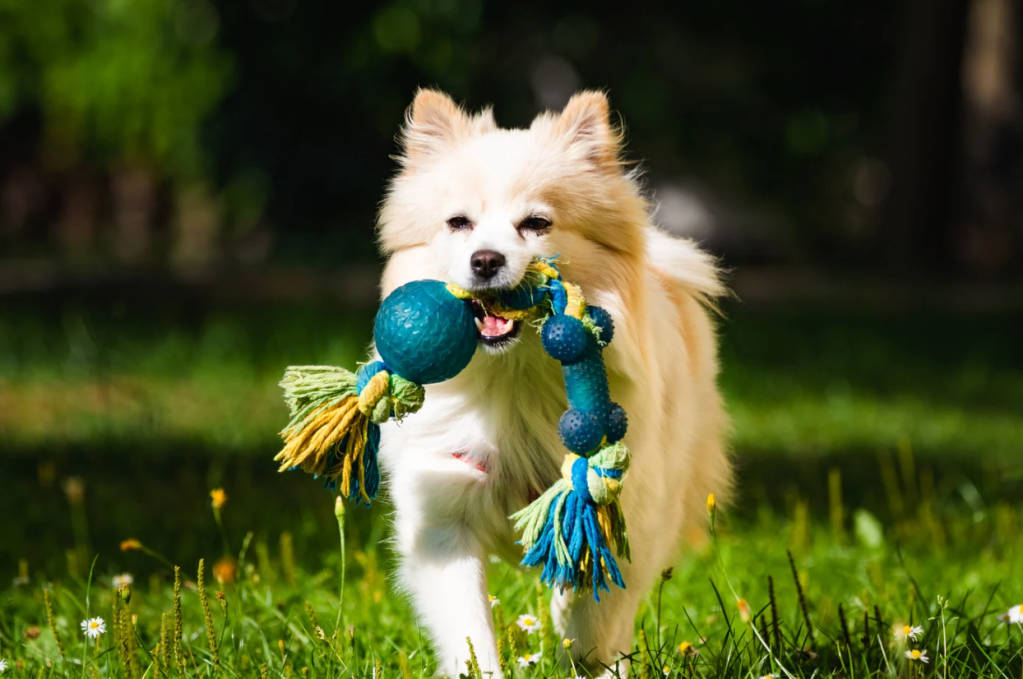
While dogs can’t speak English or any human language, people have developed ways to communicate with their furry friends over tens of thousands of years through evolution and training. If you’re a dog owner, you likely know you have to be careful saying the word “treat” out loud, since you’ve used it while giving one to your dog, creating an association between the object and the sounds you’re making.
However, a Hungarian and Austrian study found that some dogs were able to learn new words for objects they’d never actually seen before. In fact, these “gifted” dogs learn new words much like human toddlers.
“In this study, we demonstrated that a small group of Gifted Word Learner dogs, which possess an extensive vocabulary of object labels, can learn new labels by overhearing their owners’ interactions,” wrote lead author Dr. Shandy Dror and her colleagues in the study. “Moreover, we show that these dogs can acquire novel object-label mappings even when the labels and objects are not presented simultaneously. Taken together, these results suggest that Gifted Word Learner dogs possess sociocognitive skills functionally parallel to those of 18-month-old children.”
In other words, the study found that some dogs, known as “Gifted Word Learners,” were able to learn words for objects by eavesdropping on conversations between their owners, even when the object wasn’t present or the discussion wasn’t directed at the dog.
The experiment involved 10 gifted dogs in two situations: one in which owners introduced two new toys and repeatedly labeled them directly to the dog, and another in which owners talked to one another about the toys, such as holding a toy and saying, “This is ball,” without addressing the dog at all. In both scenarios, the dogs heard the names of the new toys for a total of eight minutes each, played with the toys for three minutes with their owners without the toys being labeled, and then had a solo play session with each new toy for up to 20 minutes.
To test whether the dogs had learned the labels of their new toys, the toys were placed in a different room with familiar ones, and owners asked the dogs to retrieve each new toy by name, without hints or eye contact. Even in the initial trials, the dogs retrieved the correct toy 80% of the time in the addressed condition and 100% of the time when they simply overheard their owners’ conversations about the toys.
In a second experiment, researchers challenged the gifted dogs by having owners show them the toys, place them in a bucket, name the toys only when they were out of the dogs’ sight, and then ask the dogs to retrieve them. Despite the temporal separation between seeing the toy and hearing its name, 79% of the Gifted Word Learners successfully retrieved the named toy from the bucket. Two weeks later, the dogs still remembered which label was associated with which toy in the bucket.
That said, the researchers stress that this is an incredibly rare ability, and it’s unlikely that most dogs can learn object names or language this way. Dr. Julie Hunt, a veterinarian at Embrace Pet Insurance, agreed with this assessment, noting that traditional methods for training dogs to learn object names already mimic how humans teach toddlers.
“Word learning in humans suggests that words are learned faster and better if the person introducing the word speaks slowly and clearly, uses hand gestures to support their meaning, and introduces the item at the same time as the label,” Hunt told GOOD. “It’s reasonable to think that this would help dogs to learn language as well.”
Hunt reinforced her point by citing a similar study involving pet cats, which found that they outperformed 14-month-old babies in a word-association trial. She concluded with some basic pet-training advice:
“Owners wanting to help their pet learn language can do so in the same manner that parents help children learn language: engaging with the pet, using clear speech, repeating the word-object pair, and having the object ready at hand when the word is used.”