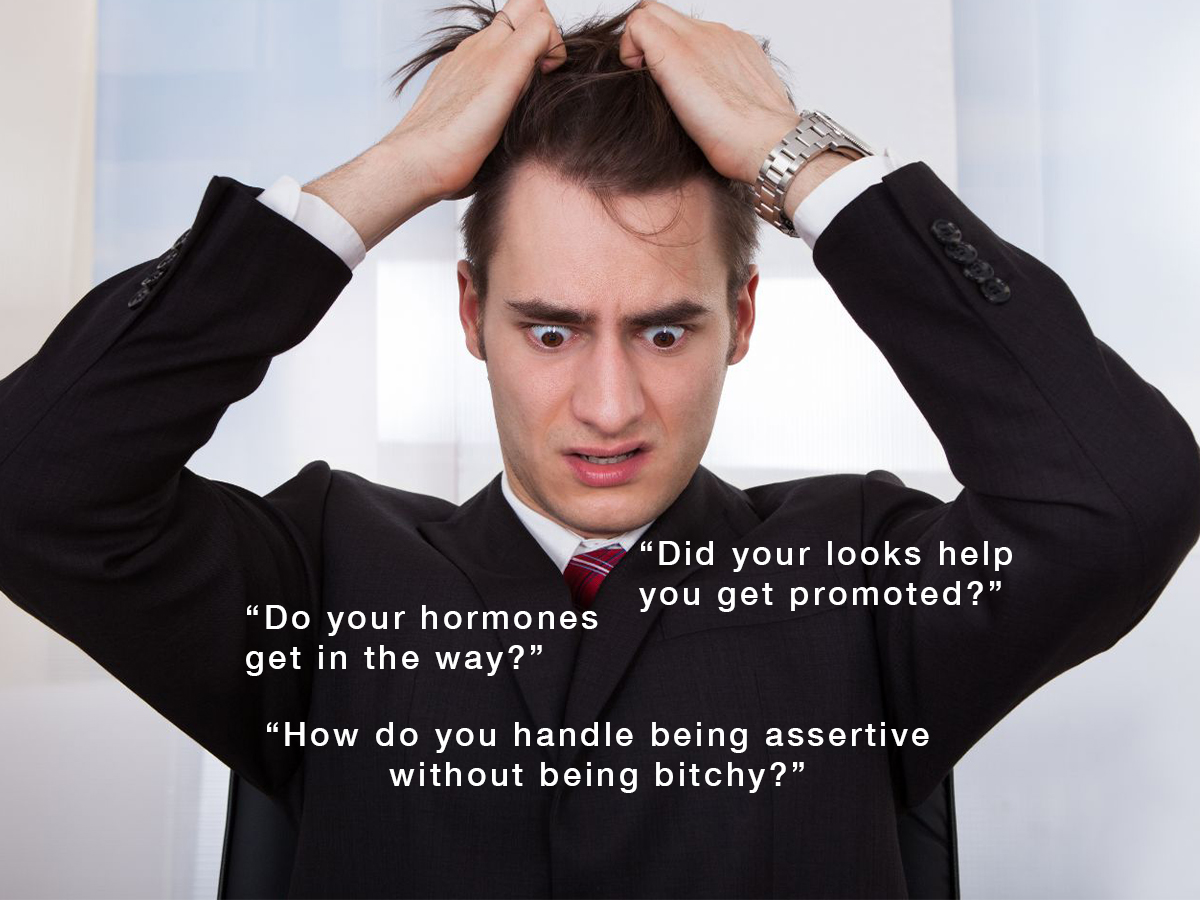
“How much do you think your looks helped you get promoted to your position?” Unfortunately for many women, this isn’t a shocking question. Interviews, performance reviews, and typical professional interactions can reveal a double standard and workplace bias.
In a social-experiment-style reel by lifestyle creator @bol.lifestyle, these questions were instead asked of men. Their discomfort and disbelief reveal why the standards women face regarding credibility are impossible to ignore.
An experiment to reveal a double standard
In the video, men are placed in an interview-style setup and asked a series of questions. Hearing these skewed questions for the first time, their expressions shift quickly from curious to confused and uncomfortable.
Host: Have you ever been asked to just smile and look pretty or smile and say nothing in a meeting with a customer?
One man appears somewhat shocked and uncomfortable. He quickly responds, almost dismissive at even being asked the question, “No.”
Host: Do you think that your looks helped you getting promoted or moving up to your current position?
Another man reflects and appears unable to answer the question.
Host: Looking so good. By the way, I do love the shoes. Are these designer or your particular brand that you really like?
A third man awkwardly smiles and vents some air, almost as if the ridiculous question doesn’t feel fitting at all. He doesn’t answer.
Host: Do your hormones sometimes get in the way?
A fourth man responds, “Hormones?” He awkwardly laughs and adds, “I don’t, I don’t know.”
Host: Do you sometimes wonder whether you’ve been chosen for this position because you’re a man?
Man 2 responds definitively, “No, not because I was a man.”
Host: How do you handle in your job being assertive without being perceived as aggressive or bitchy?
Man 1 tilts his head back and reflects on the question. “That’s uh, that’s a question that I find it very hard to relate to.” He then adds, “Because it’s not a situation I’ve been in.”

Photo credit Canva
Real questions women face
After this first series of questions, the video presents titles claiming: These were real questions asked to our female leaders throughout their careers.
The host goes on to ask the men how they feel about this particular line of questioning. Their response is predictable.
“It really, really, really feels uncomfortable. And I also feel it in my body,” said Man 3.
“When hearing these things still happen, it makes me also feel that, hey, maybe I am more privileged than I thought I was,” added Man 1.
At the end of the interview, the men seemed a little upset and surprised by the double standard. They collectively hoped for change, and some suggested they themselves were responsible for helping things get better.

Photo credit Canva
People advocate for change
People seemed to really respond to the video. With over 6,000 comments, there was a consensus confirming the experience and advocating for change.
“Men, our male privilege is real. How we use it is up to us, and hopefully we use it to protect and improve the experience of the women in our workplace.”
“If you have sons, please prepare them to improve the way the world treats women.”
“The man that felt it in his body… welcome to the life of a woman”
“Perhaps the greatest privilege is never having to notice your own privilege.”
“Oh my God. I have heard ALL of these questions. And more.”
“Well done. We have to show a different way and we can do it with grace! We have to do it different.”
“It’s not what we perceive , it’s what is .”
“THIS experiment should be undertaken in workplaces all over the world…”

Photo credit Canva
It’s not about finger-pointing
It can be easy to get lost in finger-pointing. Although at times the comments might feel like a pile-on, the success of the video lies in its simple setup. It takes a familiar experience and shifts the perspective so that people might hear it a little differently.
Certain assumptions or expectations can become so normalized that people, maybe mostly men, stop noticing them altogether. Is it possible for workplace conversations to be more thoughtful, fair, and aware than they have been or, in some circumstances, still are?
The intent of the video seemed less about provoking a fight. It demonstrated that some basic reflection and small shifts of awareness can lead to better experiences for everyone. There’s a familiar proverb that comes to mind: walk a mile in my shoes. These men seemed to gain some real perspective from the opportunity.