Perfectionists get things done, right? They’re more detail-oriented, meticulous, and effective than the rest of us—or so we’ve been led to believe. But new research out of the University of North Carolina at Greensboro, published in the open-access online journal PLOS ONE, has upended that longstanding myth: When put to the test, perfectionists don’t actually work harder than the rest of us. They just agonize more internally about the outcome.


For every deadline achieved, what you don’t see in a perfectionist is the complicated critical self-talk that accompanies his or her every move. Rachel Randall, an editor in Ohio who has identified as a perfectionist for as long as she can remember, says, “Perfectionism is an awareness that everything I do is a reflection of me, not just professionally, but as a person.” While her colleagues and boss likely see only the productive side of her that gets things done, internally, she tells herself, “I beat myself up a lot over simple things. Mistakes that anyone could make.”

[quote position=”right” is_quote=”true”]I overwhelm myself with the need to have everything just right, creating more work for myself.[/quote]

Negative self-talk is a common behavior of perfectionists, according to psychologist Robin Hornstein, Ph.D., of Philadelphia, who says, “Perfectionists have a drive that is beyond most people’s capacity, including their own.” This naturally leads to beliefs such as, “It can be better than this,” “I am not good enough,” “I cannot make this happen,” and “I am bad.” These kinds of thoughts don’t necessarily lead to working harder than others.

The UNC study bears this out. Based on past research that suggests adaptive perfectionism is associated with higher effort, researchers hypothesized that people who self-described as perfectionists would exhibit increased effort on the task. They recruited 111 college students to take the MPS (Multidimensional Perfectionism Scale) and a self-paced task where they received a small cash reward for each correct answer. The participants were hooked up to an electrocardiogram device to test their cardiac activity as they performed their tasks.

What they found was that those who scored highest for perfectionism did not also demonstrate increased cardiac effort in any category. All participants’ heart rates showed similar levels of effort. While it’s hard to make a concrete assessment of this limited test, it does appear to suggest that underneath the façade of working harder, perfectionists are working neither more efficiently nor harder than others.

Hornstein attributes this to the critical thought processes that perfectionists engage in, which can also lead to procrastination. “There is so much pressure that there may be either periods of lethargy or paralysis or rituals that have to be done to get the work done,” says Hornstein.

Marinda Romesser, a professor in Florida, sees her perfectionism as getting in the way of her work. “I overwhelm myself with the need to have everything just right, and don’t seem to realize that I am creating more work for myself than what needs to be there.” After she becomes overwhelmed, she says, “then I have a melt down and I shut down.”

https://twitter.com/user/status/794963804274720768

https://twitter.com/user/status/757311958253178881

Procrastination is familiar to Laurel H., a Washington-based writer and editor, as well.Though she describes herself as a “tenacious worker bee” whose employers are often sorry to see her leave, “if I’m nervous about a work assignment, I tend to procrastinate until I’m close to missing a deadline. I often obsess over tiny details, so almost everything I do takes longer than it should,” she says.

Oscar Bartos, a graphic designer, feels that he is “half-assing it a lot of the time” because “perfectionism, procrastination, and self-doubt are all intertwined.” This has had a big impact on his career in that he feels he has ended up in jobs “that are design-related but require fairly little creativity.”

Underlying this intense need to get everything right—to make sure that others don’t “see” any signs of their perceived failure—all the perfectionists we interviewed also described suffering from anxiety and/or depression, as well. Hornstein says that may be due to the fact that what drives perfectionists “is not coming from an inflated self-esteem. Rather it emerges from a sense of being ‘less than.’”

[quote position=”left” is_quote=”true”]Perfectionism, procrastination, and self-doubt are all intertwined.[/quote]

Though there are probably as many sources of perfectionism as there are perfectionists, Hornstein names family stress; a history of failures that are interpreted as a failure of the self, rather than a failed attempt; and trauma and abuse. Each perfectionist may have a different path to healing. All of our interviewees either have had therapy or currently attend some form of therapy, and several have tried medications. Hornstein recommends trying those approaches, as well as any sort of meditation or spiritual practice that is useful—along with simply replacing negative self-talk with more positive. “If your normal go-to is, ‘I suck at this,’ replace it with ‘I can do this,’ or ‘I can try,’” she says.

While there may be no cure for perfectionism, Randall says she reminds herself “that I’m human and I can and will make mistakes.” Romesser is trying a new anxiety medication and using cognitive behavioral therapy to retrain her brain. Bartos has had some success being “creative on the spot” in more spontaneous situations, and Laurel H. concludes, “I’ve accepted that experiencing failure is part of being alive, but the real turning point was realizing that the fear of failure is worse than failure itself.”


  • Licensed therapist says these 3 steps stop rude people from hijacking your mind
    Woman exhausted by man's poor behavior.Photo credit: Canva

    Licensed therapist Jeffrey Meltzer offers three steps for dealing with rude people. In his helpful TikTok post under the name therapytothepoint, he suggests helpful tactics that go far beyond setting simple boundaries.

    Rude people are almost impossible to avoid, and the instinct to snap back or make a passive-aggressive remark can be strong. Meltzer shares some practical mental health advice that can lead to a calmer resolution.

    It Begins With Emotional Regulation

    Some individuals might believe that other people are responsible for how they make us feel. Meltzer suggests that self-regulation is an important first step to dealing with disrespectful people. Despite instincts to retaliate or escalate the situation, staying calm is more effective.

    Meltzer proposes that reciprocating aggression will only embolden a rude person and even justify their poor behavior. Instead, calmness and controlling our emotions will disrupt the pattern. Meltzer explains, “You might feel angry, embarrassed, disrespected, but calmness is about your behavior, despite the internal chaos you may be having. At the end of the day, emotional regulation is your strength, and reactivity gives your power away.”

    A 2024 study in the National Library of Medicine found that people’s ability to reappraise a stressful event in a more balanced way was strongly linked to greater resilience and better recovery from stress. The strategy helps people stay calmer by changing how the brain interprets the event.

    life hacks, behavior, Jeffrey Meltzer, sarcasm, emotional regulation
    A woman is rudely interrupted on the phone.
    Photo credit Canva

    Passive Aggression Is NOT a Solution

    An easy response might be the simple eye roll, sarcasm, or a retaliatory personal dig. Meltzer points out that these are only ego attempts to win an unwinnable situation. “Instead, be straightforward. I’m open to talking about this, but not like that. It’s hard for me to connect when you speak to me that way.” Meltzer explains that these tactics bring clarity and remove the defensive guard of said rude individuals.

    A 2026 study in Psychology Today reported that passive-aggressive behaviors worsen relationship dynamics and fail to resolve disagreements. Criticism, ostracism (ignoring others), and sabotage all undermine cooperation and relational success.

    frustrating, passive aggressive, solutions, mental health
    A man blows a dandelion in a woman’s face.
    Photo credit Canva

    Role play works

    Practice makes perfect has value in dealing with rude people. “You don’t magically become composed under pressure; you train for it.” Meltzer continues, “Practice with a friend. Practice with your therapist. Have them be rude. Respond calmly. Respond assertively. Respond clearly. Because in real life, you don’t rise to the moment, you fall to your level of preparation.”

    A 2024 study in the National Library of Medicine revealed that an individual’s level of assertiveness can be trained. The strategy of preparation reduced feelings of stress, anxiety, and depression.

    meditation, annoying people, strategies, peace of mind
    Interrupting a meditation.
    Photo credit Canva

    Stay Calm, Be Assertive, and Practice

    The solutions offered by Meltzer seem to resonate. Several people reveal their own struggles when facing similar predicaments. These are some of their comments:

    “Practice with a therapist? Why didn’t I think of that”

    “You don’t rise to the moment you fall to the level of your preparation. I’m gonna memorize that.”

    “I’m waiting for you to write a book about all your amazing insights”

    “I can handle them but i internalize later n let it ruin my day”

    “The real skill is knowing when to ignore and when to address it. Not everything deserves your energy.”

    “Rudeness is a weak man’s imitation of strength. Just say that to them and if they continue, walk away with a smile.”

    Meltzer advises that the best way to handle rudeness begins with how we respond. Diffusing a situation helps maintain peace of mind. Remaining composed helps control our own reactions. In the end, rehearsing for success allows us to stay confident when difficult situations arise.

  • Love educator shares how awkward flirting can be turned into a romantic superpower
    A couple flirts on the dance floor.Photo credit: Canva

    In a recent TED Talk, love coach Francesca Hogi shared how even your awkward flirting can be a superpower. Sometimes mistaken as off-putting, flirting actually offers a powerful gateway to real human connection.

    By reframing flirting as an act of curiosity, she explains how anyone can kickstart attraction and open the door to lasting love. In an impassioned presentation, Hogi demystifies flirting and explains why building attraction matters.

    Flirting can be a superpower

    Hogi explains that for 12 years she’s been helping people fall in love as both a matchmaker and a coach. “As a love professional, I can assure you that many dating problems can be solved with flirting,” Hogi says. “If you’re single, it helps you to connect and fall in love. If you’re partnered, it helps you to reignite or maintain the spark of chemistry that brought you together in the first place.”

    Many might have concerns about their ability to flirt. Will they be received well, or are they even doing it right? Hogi explains, “I’ve got good news for the introverts out there. You don’t have to be extroverted to be a magnet for connection. In fact, I believe that introverts have a secret advantage when it comes to flirting because your efforts at being more open feel more genuinely inspired by another person and therefore special.”

    She shares that flirting can give you confidence and courage. She also acknowledges that feeling awkward is normal. “Confidence with flirting comes from knowing yourself, your intentions, reading the room, discerning other people’s reactions, and adapting accordingly,” she says. “Sometimes it’s going to be awkward, sometimes it’s going to be embarrassing, and that’s okay.”

    flirtation, connection, mental health, good vibes, sexuality
    A couple enjoys flirting.
    Photo credit: Canva

    Healthy flirting

    “Flirting gives you more agency over human connection,” says Hogi.

    She then describes the two foundational principles of healthy flirting. The first is presence: being in the moment and avoiding distractions like a phone or the surrounding environment. The second is enthusiasm. Getting the right vibe while being enthusiastic goes a long way toward mastering the art of flirting. These principles have a strong effect on other people.

    Hogi explains that expressing positive intentions has a large impact on outcomes:

    “You have the ability to leave other people feeling good for having interacted with you…Even your unspoken appreciation for a shared moment of connection, no matter how brief, can often be felt. Lean into being the version of you who leaves other people with a smile on their face and notice how much more magnetic you become.”

    community, expression, humor, self-confidence, self-esteem
    A flirtatious interaction.
    Photo credit: Canva

    Hogi inspires the crowd

    People seem quite taken with Hogi’s energy and charisma. Some of the comments expressed admiration for her vibe and flirtatious delivery on stage. Hogi was sharing her own version of flirting as a superpower:

    “Even this presentation feels like shes flirting…especially her laughs”

    “She is such a good public speaker, ten minutes of speech with no filler words whatsoever”

    “Flirting is a way making one feel seen and acknowledged.”

    “Where were you, Francesca, when I needed these words? Like, 40 years ago? Never too late, right?”

    “Had me clapping in the end! She’z good”

    “I feel better about my flirting abilities after watching this now.”

    “She’s good , reading her body language generally teaches me more about flirting than learning it itself”

    gender, attraction, laws of attraction, social skills, personality traits
    A vintage photo of a couple flirting.
    Photo credit: Canva

    The power behind a flirtatious connection

    Flirting can have a powerful effect on both the initiator and the person on the receiving end. It isn’t necessarily about romance or sex. It helps build and strengthen relationships in everyday life.

    A 2025 study on ResearchGate analyzed where and how people flirt. The results suggested that people who flirt can improve with practice. The best flirting involved humor, confidence, and social skills. A 2026 study on ScienceDirect found that flirting can be an effective way for people to express their personality and individual differences. While personality traits and sex were linked to how often and how skillfully people flirted, these influences had only modest effects on overall outcomes.

    Hogi suggests flirting requires nuance and a little bit of courage. Practice prepares you for any occasion. “Attentiveness, compliments, playfulness—there’s nothing complicated about these actions, yet they have the potential to spark and sustain connection over time,” she says. “That’s a true superpower we can all tap into.”

    Hogi and the research suggest flirting isn’t just a trivial social game. It’s a meaningful way to express personality, build connections, and boost self-confidence. Flirting isn’t shallow. It doesn’t need to involve manipulation or outcome-obsessed action. These small everyday acts of courage embolden human connection and reveal individual superpowers in all of us.

  • Retired U.S. Navy chief explains how to end discipline anxiety with wholesome ‘butler’ trick
    (LEFT) A cluttered closet. (RIGHT) Chase Hughes.Photo credit: Canva and YouTube

    During an interview on The Diary of a CEO podcast, retired U.S. Navy chief Chase Hughes explained how to end discipline anxiety. Using a simple perspective shift, often referred to as the “butler” trick, he describes a method of “prioritizing the needs of our future self.”

    Hughes shares that understanding discipline is one of the fastest ways to change everything in our lives. We might wish discipline would arrive like a lightning bolt of motivation. However, Hughes suggests the solution lies in our relationship with discipline and the perspective we take on it, which ultimately relieves our anxiety.

    End discipline anxiety

    Hughes begins by explaining the importance of understanding what discipline actually is: “I define discipline as your ability to prioritize the needs of your future self ahead of your present self.” He goes on to explain that a simple reframing can change the link between discipline and anxiety.

    “If I can start looking backwards with gratitude, [it] is the fastest way to make discipline dopamine-generating,” Hughes says. “I want past-tense me to be a source of dopamine for present-tense me. Cause most of us look back with regret. ‘I shouldn’t have drank that much. I shouldn’t have mouthed off at the family reunion. You know whatever it is, I shouldn’t have overslept.’”

    discipline, butler tick, anxiety, service, community
    A butler ready to be of service.
    Photo credit: Canva

    The butler trick for discipline

    Instead, it’s possible to prioritize long-term endeavors over short-term desires. In the full YouTube video of the interview, Hughes describes the butler trick as a way of treating your future self as someone you can serve today, just like a butler. The concept of looking forward with concerned awareness and backward with gratitude can help release the connection between anxiety and discipline. This reframing and release of negativity help people better motivate themselves and manage their present circumstances.

    A 2025 study in SAGE Journals found that future self-orientation directly impacts discipline-related outcomes. This trick can lead to meaningful behavior change. By reframing our relationship with the past, we directly affect our relationship with discipline and procrastination. A 2023 study published by Springer Nature found that procrastination and self-control significantly influence attitudes toward time. How someone relates to time ultimately shapes whether discipline feels easy or overwhelming.

    Butler trick, discipline, time management, consistency, habit loops
    A woman realizes she is late.
    Photo credit: Canva

    Thoughts on the butler trick

    Viewers seemed universally impressed by the solution Hughes offers in the butler trick for discipline. Here are some of their thoughts:

    “I love it when Past Me has done something great to support Future Me. Sometimes it’s all I got, but it’s enough.”

    “This is the best advice on discipline I’ve ever heard in my life”

    “He’s giving you the blueprint for ultimate self care”

    “Be methodically organized and make your life less complicated and more suitable to your needs.”

    “I’ve heard everything can be looked at as a learning opportunity. Selfless gratitude + learning seems like a strong combo.”

    “Be my own butler. Love this!”

    self-discipline, self-mastery, perseverance, determination, butler trick
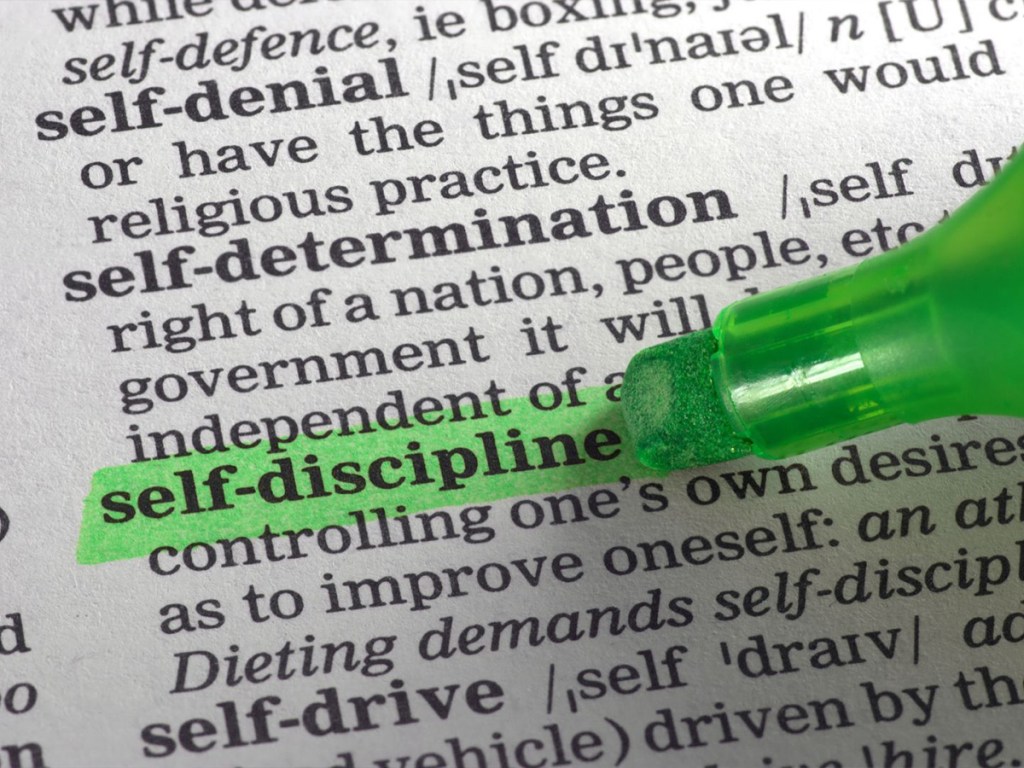
    Self-discipline is defined as controlling one’s own desires.
    Photo credit: Canva

    Discipline changes everything

    Hughes underscores the value discipline has in changing our lives:

    “Discipline is kind of the gateway drug to everything else in authority, and it’s the gateway to composure. But getting your discipline modified is one of the fastest ways to make everything else change.”

    Discipline can mistakenly be associated with punishment and rigid routine management. With Hughes’ framing, it might be better described as stewardship. Instead of battling the present, you can serve the future. The butler trick can help us all be more thoughtful toward the person we are becoming.

    You can watch the full interview with Chase Hughes on The Diary of a CEO podcast below:

Explore More Health Stories

Well-being

Love educator shares how awkward flirting can be turned into a romantic superpower

Well-being

Retired U.S. Navy chief explains how to end discipline anxiety with wholesome ‘butler’ trick

Health

Experts say you can ‘talk’ to someone using your eyebrows regardless of language or culture

Health

How birdwatching makes your brain stronger and healthier