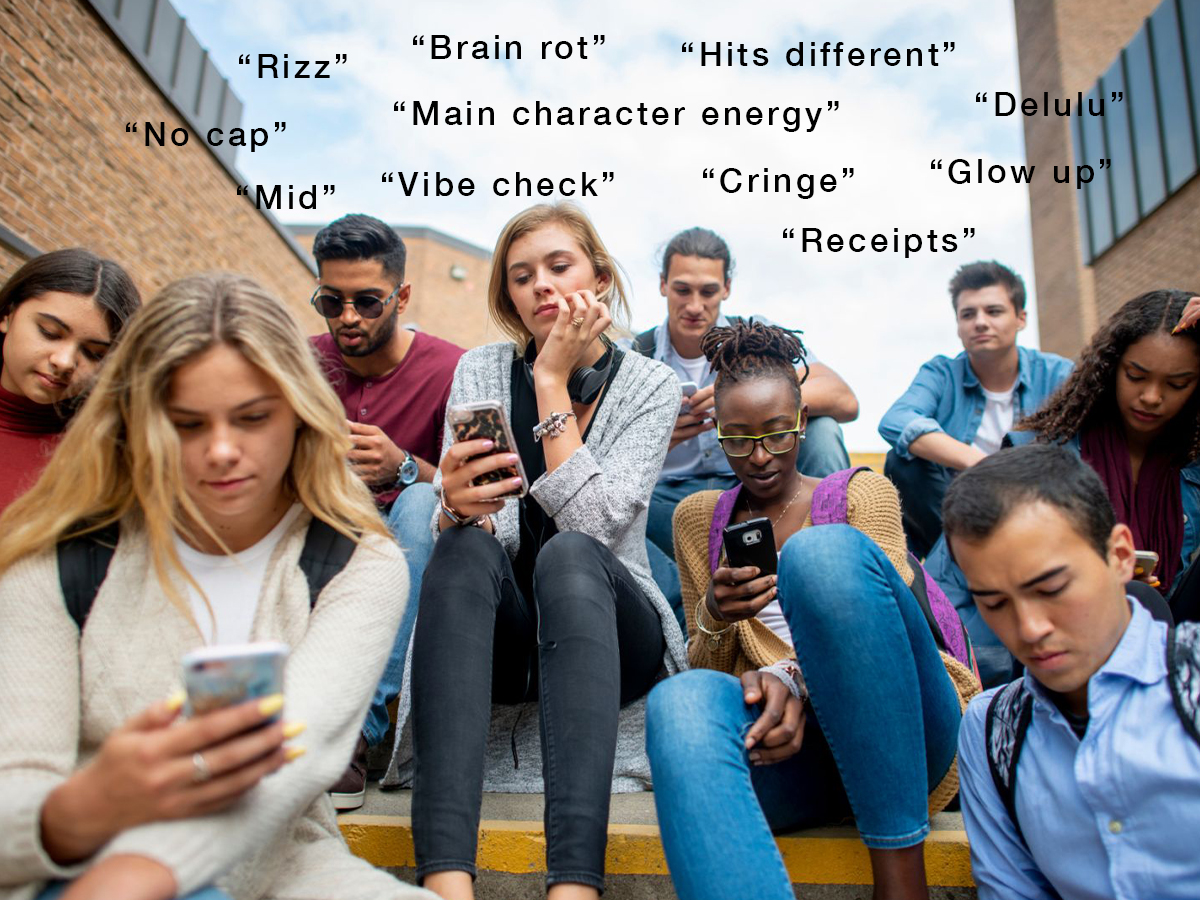
Phrases like “that’s mid” or “no cap, sus” are common forms of slang used by Gen Z. Even when words might be technically familiar, conversations with teenagers can feel like there’s a real barrier to entry.

According to Duygu Balan, a psychotherapist and mother of a teen, Gen Z slang is harder for many adults to decode because the language is emotionally layered and evolves rapidly online. In a recent story for Psychology Today, Balan explained that slang serves as a social signal separating one generation from the previous one, but digital culture has accelerated the process.

emotional slang, digital language, social media slang, youth language
A woman is confused at her computer.
Photo credit Canva

Slang evolving in real time

Every age group develops informal language to signal belonging and shared cultural understanding. But the way slang spreads and functions today has changed dramatically.

Digital platforms like TikTok, Instagram, Discord, YouTube, and Snapchat have language transforming in real time. A phrase can appear in a viral post, be remixed by thousands of users, and shift definition within days. By the time it navigates to general consumption, the meaning might have evolved again.

Speed is only part of the story

The way slang quickly changes is only part of the story. What makes Gen Z slang even harder to decode is that it often compresses emotional meaning into short phrases. These terms do more than describe something. They signal how it feels.

In fast-moving digital environments, where attention spans are short and communication happens through texts and memes, this kind of conversation becomes incredibly efficient,” shared Balan.

A 2024 study in Springer Nature Link explained that with shrinking attention spans and the evolution of reaction-based commentary, complex messages are conveyed through shorter expressions.

Gen Z slang compresses emotional reactions

Young people use digital shorthand to express emotion quickly. Social media relies on fast interpretation, and specific slang allows people to share tone, identity, and attitude instantly.

Many of these phrases are used to compress complicated feelings such as discomfort, anxiety, longing, sadness, and skepticism into bite-sized constructs that can be communicated in seconds,” Balan adds.

Irony plays a major role in Gen Z slang. Expressions can blur sincerity, making it difficult to tell what is meant literally and what is meant playfully. A phrase can carry real emotional weight framed as a joke, allowing the speaker to maintain distance.

The phrase “brain rot” captures how it feels when the mind becomes overly stimulated. “Delulu” is short for delusional, and it’s a playful way to describe a person’s hopeful thinking. Another common slang term, “low-key,” allows someone to agree without fully committing.

Trying to interpret these terms can take time and patience since context means so much with them.

These phrases are not meant to be clearly translated, so they aren’t. They stem from experiences that someone who wasn’t born with an iPhone in their hand will never fully understand,” explains Balan.
slang psychology, complex feelings, compressed ideas, social media
Gen Z plays for the camera.
Photo credit Canva

Slang that signals peer approval

Historically, slang remained consistent long enough for people outside a generation to eventually understand. Today’s slang is far more situational, shaped by online culture and social context. Words like “radical” once meant something was cool. Meanwhile, a term like “sick” not only signals it’s good, but also conveys social meaning, such as admiration from peers.

This helps explain why adults often find Gen Z slang harder to decode. The challenge is not only vocabulary, but the combination of context, irony, emotional layering, and rapid evolution. Slang words now mean looking past the surface of the reference and paying more attention to the weight of the feelings underneath.

  • A Cornell study says smart people are less likely to hide behind corporate buzzwords
    Photo credit: CanvaA man meditates at the center of a work meeting.

    If you ever sat through a business meeting where someone calls out, “We need to circle back and socialize this cross-functionally,” and thought, “You could have just said let’s talk more before deciding anything,” congratulations: science is on your side.

    A new study from Cornell University suggests that people who are less impressed by corporate jargon may actually think more clearly and make better decisions. Cognitive psychologist Shane Littrel introduced something called a Corporate Bullshit Receptivity Scale (CBSR), which is exactly as amazing as it sounds.

    business meeting, leadership, critical thinkers
    A woman leading the business meeting is unimpressed.
    Photo credit Canva

    Strongest thinkers in the room

    The study, published in the Journal of Personality and Individual Differences, examined how workers responded to vague corporate language intended to sound impressive. The research revealed that people who rate jargon-heavy phrases as especially “profound” or “informative” also tended to score lower on analytical thinking and workplace decision making.

    In other words, the people most impressed by phrases like “all hands on deck” and “this is mission critical” probably aren’t the strongest thinkers in the room. Anyone who’s ever rolled their eyes during a meeting full of corporate buzzwords and thought, “This is nonsense,” the findings are validating.

    confusion, terminology, clarification, jargon
    A boring meeting.
    Photo credit Canva

    Why some people are impressed by buzzwords

    The CBSR scale was created to measure how easily people are impressed by polished but meaningless corporate language. In a story for the Cornell Chronicle, Littrell described this workplace talk as “a specific style of communication that uses confusing, abstract buzzwords in a functionally misleading way.” He added, “Unlike technical jargon, which can sometimes make office communication a little easier, corporate bullshit confuses rather than clarifies. It may sound impressive, but it is semantically empty.”

    What’s perhaps more troubling is that coworkers, the most susceptible to the BS, rated supervisors higher. They also reported improved job satisfaction and were more likely to spread it themselves. A reality that helps explain why this language survives.

    Every profession has terminology that serves a purpose. Doctors or engineers use specialized language because precision matters. However, language designed to sound strategic only makes the feebleminded happy, according to the study.

    frustration, translation, professionalism
    Receiving a frustrating email.
    Photo credit Canva

    The study validates relatable frustration

    The Cornell study validates a frustration that many workers have struggled with throughout their careers. People can tell the difference between someone trying to explain something and someone trying to sound important.

    A 2022 study in Springer Nature Link found that clarity improves comprehension. Experts who truly grasp a topic are far better at translating it. The people who communicate the most clearly are often those who understand what’s going on the best.

    The World Economic Forum shared a survey of 1,000 American workers, which found widespread irritation with corporate buzzwords. More than a quarter of the workers reported hearing corporate jargon every day. People generally found these interactions more annoying and less professional.

    celebrating, research, clarity, honesty
    Celebrating at work with a High 5.
    Photo credit Canva

    Potential benefits of implementing CBSR

    Implementing tools like CBSR may help companies recognize communication habits that aren’t working. It offers a measurable way to examine how incorporating shorthand speech affects decision-making. In theory, the scale could encourage workplaces to prioritize clarity over sounding impressive.

    If organizations become more aware of how often buzzwords replace direct communication, they can reduce misunderstandings while building trust between employees and leadership. Language influences the perception of leadership. When the critical thinkers secretly revolt over current expectations and practices, that’s probably a real problem.

    For people exhausted by an endless procession of buzzword-filled meetings, the research suggests that the annoyance probably comes from valuing plain English and practical thinking. Simply put, sometimes the smartest response is asking people to say what they really mean.

  • 17 everyday things we do now that the future will find utterly bizarre
    Photo credit: CanvaA doctor holds a roll of toilet paper
    , , ,

    17 everyday things we do now that the future will find utterly bizarre

    An online community imagined looking back from the year 2075, and their predictions about our current “primitive” habits are surprisingly convincing.

    Hindsight is 20/20, but foresight is a little more complicated. Just as we look back at the Victorian era—with its arsenic makeup and child labor—and shudder, future generations will undoubtedly look back at 2025 and wonder, “What were they thinking?”

    A recent thread on r/AskReddit posed a fascinating thought experiment: “What’s something normal to us in 2025 that by 2075 will be seen as barbaric?”

    The thread exploded with over 4,500 upvotes, generating a mix of hopeful medical predictions, environmental critiques, and harsh truths about our social norms. Here are 17 of the most compelling things we do today that might horrify the history students of tomorrow.

    future predictions, 2075, barbaric habits, Reddit AskReddit, societal change, medical advancements, factory farming, child influencers, future tech, cultural shifts
    A factory farm with rows of crops Canva

    The “Primitive” Hygiene & Diet

    1. Wiping with dry paper The concept of chopping down forests to dry-wipe our bodies baffled many users.

    “They cut down trees just to wipe themselves?!” one user imagined a future citizen asking. Another, u/Dramatic-Avocado4687, was blunt: “Wiping our asses with toilet paper.” The Future: High-tech bidets becoming the global standard.

    2. Factory farming This was a top answer. The industrial scale of animal agriculture was predicted to be looked upon with deep shame.

    “The worst hell on earth that humans have ever created,” wrote u/w0ke_brrr_4444.

    The Future: Lab-grown meat that is indistinguishable from the real thing, without the suffering.

    3. Eating animals entirely Some users went a step further, suggesting that 2075 society might be entirely vegetarian.

    “We don’t care because we don’t see it,” u/Zetsubou51 noted about our current disconnect from food sources. “Factory farms are awful for the animals and the people that work in them.”

    future predictions, 2075, barbaric habits, Reddit AskReddit, societal change, medical advancements, factory farming, child influencers, future tech, cultural shifts
    An empty hospital room Canva

    The “Dark Ages” of Medicine

    4. Chemotherapy While it saves lives today, “poisoning the whole body to kill a tumor” will likely look crude to future doctors.

    “We still poison the whole body with chemo and hope the cancer dies first,” noted u/Vocalscpunk.

    The Future: Targeted genetic therapies that delete cancer without making the patient sick.

    5. Drilling into teeth Dentistry involving drills and metal rods might be viewed the way we view Civil War amputations.

    u/nomiis19 offered a hopeful alternative: “Pull the tooth, get injection, grow a new tooth.”

    6. Ignoring women’s pain The medical industry’s historical dismissal of women’s pain was a major point of contention.

    “Not giving anesthesia with placing IUDs,” wrote u/tt_DVM2011. u/ThatRoryNearThePark shared a personal horror story: “Worst pain of my life… couldn’t sit upright for at least 48 hours.”

    7. Medical bankruptcy The idea that getting sick could make you homeless is a concept many hope will be extinct.

    “Medical bankruptcies and for-profit healthcare leaving people to die if uninsured,” wrote u/SarlacFace.

    8. Orthopedic hardware

    “Orthopedic surgery with drills, rods, and screws?” asked u/Orthocorey.

    Future surgeons might view our titanium pins and screws as barbaric carpentry rather than medicine.

    future predictions, 2075, barbaric habits, Reddit AskReddit, societal change, medical advancements, factory farming, child influencers, future tech, cultural shifts
    Trash floating on the surface of the ocean Canva

    The Environmental & Social Reckoning

    9. Single-use plastics We wrap fruit in plastic, drink from plastic, and wear plastic.

    “Plastic everywhere, all the time,” wrote u/letthisbeanewstart. u/MarkNutt25 added that “plastic textiles” and microfibers will likely be viewed as an environmental disaster we willingly wore.

    10. Burning fossil fuels Burning liquefied dinosaurs to move cars will likely seem inefficient and dirty.

    u/loftier_fish offered a grim reality check: “If the answer isn’t ‘using fossil fuels,’ there will be a lot fewer humans to deem anything barbaric in 2075.”

    11. Humans driving cars We let imperfect, distracted, tired apes pilot two-ton metal death machines at 70 mph.

    “Driving yourself will seem barbaric,” predicted u/CranberryCheese1997. The Future: Fully autonomous transport networks that eliminate traffic accidents.

    12. Fast fashion The cycle of buying cheap clothes to wear once and throw away was called out by u/rabbity_devotee for filling landfills and exploiting labor.

    13. Animal entertainment

    “Drugged dolphins in resorts and whales at SeaWorld. Barbaric,” wrote u/w0ke_brrr_4444. Future generations may view zoos and marine parks the way we view old-timey circuses.

    The “What Were We Thinking?” Lifestyle

    14. Child influencers Putting children on the internet for profit before they can consent was a major ethical concern.

    “Hopefully, monetizing your children for social media will seem barbaric,” wrote u/TheWorstWitch.

    15. The 40-hour workweek

    “Working a 9-5 just to survive? Barbaric,” said u/DeathofSmallTalk1. Though u/EvaMayShadee cynically noted, “We’ll probably be working 60-hour weeks by then.”

    16. Doomscrolling Spending our one wild and precious life staring at a glowing rectangle.

    “Spending multiple hours, every day, scrolling mindlessly on social media,” predicted u/cornylilbugger.

    17. The optimistic twist Finally, one user suggested that we might be the civilized ones compared to what is coming.

    “By 2075, we’re gonna be way more barbaric… we’ll fight over everything once food gets scarce,” u/NapoleonDonutHeart warned.

    Let’s hope the optimists win this round.

    This article originally appeared earlier this year.

Explore More Civic Life Stories

Society

Teens aren’t as disengaged as you may think: What adults get wrong about adolescents’ civic contributions

Civic Life

17 everyday things we do now that the future will find utterly bizarre

Civic Life

A millionaire went homeless to prove he could make $1M in a year. He lasted 10 months.

Civic Life

Chris Hemsworth made ‘one lifestyle change’ amid Alzheimer’s diagnosis that we all need to commit to