
Anxiety plagues the mind with stress, fear, and overthinking for many people. Many well-meaning friends could see you looking anxious and just tell you to relax and calm down. “Calm down”? Easier said than done. However, one former monk has a different piece of advice. When you feel anxious, instead of calming down, amp it up.

Mindfulness expert and ex-monk Cory Muscara recommends that people take their anxiety and reframe it into excitement. Muscara claims that a stressful or an anxiety-inducing experience creates physiological energy and bodily responses (increased heart rate, blood pressure, etc.) that is similar to excitement. By imagining the stressful situation going extremely well and creating more positive imagery, the mind could shift that anxiety feeling to one of excitement without changing much of how your body physically reacts. This could be an easier way for people to reduce their anxiety compared to trying to calm themselves down, both in mind and body. This isn’t just holistic advice as there is scientific evidence showing that mentally shifting from anxiety to excitement can benefit anxious people.

Muscara’s pathway to mindfulness has been interesting. As a college student, he got into meditation in order to impress his then-girlfriend. After the relationship ended, he spent six months in a monastery in Burma living in silence and meditating for over 14 hours each day. After his excursion, he got a master’s degree in positive psychology and went on to write a book titled Stop Missing Your Life: How to be Deeply Present in an Un-Present World.

Second opinions from experts

Muscara isn’t the only person that thinks corralling your anxiety and altering it into excitement is a functional method. The professionals that reached out to GOOD see its benefits.

“Changing your outlook and attitude by shifting from negative foresight to positive foresight is a common technique in the realm of performance psychology and anxiety management technique,” said licensed therapist Luis Fraire. “Similar to shifting your perception of the physiological symptoms from nervous ‘bubble gut’ to excited ‘butterflies,’ all have benefits if the individual is capable of exerting that amount of self control through awareness and regulation.”

“Typically, anxiety is thought of as something that needs to be resolved,” said licensed psychotherapist John Puls. “However, anxiety is a normal physiological response to trying something new and uncomfortable. It is totally possible to harness some of that anxious energy to propel you forward.”

“Reframing anxiety as excitement allows you to accept the feeling of being anxious rather than avoiding it,” said psychotherapist Eliza Davis. “When we learn we can use anxiety as a positive feeling or a motivator it becomes less threatening, increases confidence and resilience.”

Turning anxiety into excitement isn’t one-size-fits-all treatment

While shifting your mindset from anxiety to excitement can help some folks manage it, there may be situations in which a person’s anxiety needs other techniques or treatment. If anxiety isn’t being handled healthily, it could lead to other problems.

“When you reframe anxiety as excitement, this allows you to gain some mastery over the experience,” said Puls. “The only downside is that if the anxiety isn’t resolved, it can lead to further mental health distress or even a panic attack.”

“The cons arise when an individual is unable to practice that level of self-control and no shift in perspective or outlook could overpower worry or other anxiety symptoms,” said Fraire. “It is also important to highlight that some worry or forecasting of negative outcomes can serve as a protective factor that aids in preparation and self preservation. You don’t want to oversee an obvious barrier that could have easily been avoided, or endanger yourself due to toxic positivity.”

@melrobbins

This is where your anxiety comes from ❤️‍? ? in bio for the full episode, titled: “The Toolkit for Healing Anxiety, Part 1” #melrobbins #dailyinspiration #mindsetmotivation #podcast #podcastepsiode #podcastclip #melrobbinspodcast #anxious #anxiety #healanxiety #anxietytok ♬ original sound – Mel Robbins

So when you find yourself nervous or anxious about something, try imagining the greatest outcome and see if the excitement helps out. However, if you find yourself continually shifting anxiety into excitement or find that it isn’t helping, you may want to seek professional guidance and therapy in order to get the help, techniques, and tools you need for your own success. Whether or not it’s better to calm yourself down or to amp yourself up, good things will be possible.
  • Canadian scientists create magnetic robots that can dissolve kidney stones in days
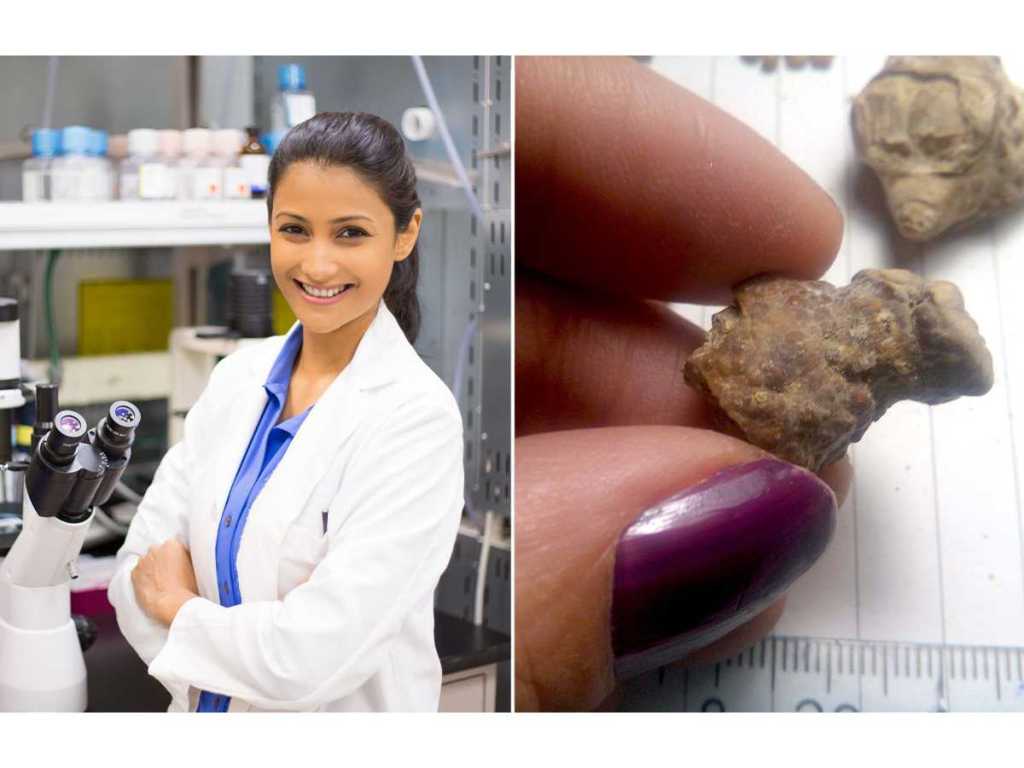
    Left: A scientist in a lab. Right: Kidney stones.Photo credit: Canva and Jakupica/ Wikimedia Commons

    If you didn’t know, kidney stones are far more common than you might think. And the current treatment options aren’t great. But Canada may be coming to the rescue.

    Researchers at the University of Waterloo have developed a breakthrough treatment for kidney stones that uses robots as small as a grain of rice to target the stones.

    Dissolving kidney stones using tiny robots

    According to the university, soft, flexible robotic strips are magnetized and maneuvered into place using magnets attached to a robotic arm. Each strip, small enough to pass safely through the urinary system, is infused with an enzyme called urease. Once placed near a uric acid kidney stone, the urease quickly dissolves it.

    The study, published in Advanced Healthcare Materials, reported that the stones shrank by about 30% within five days. The remaining fragments can then pass naturally through the body, eliminating the need for surgery.

    “There is currently no good treatment method available for this type of kidney stone,” said Dr. Veronika Magdanz, an assistant professor of systems design engineering at the University of Waterloo. “Patients are typically prescribed painkillers and oral dissolving medication that provides slow relief over the course of weeks or months. And in urgent cases, when stones block the urine flow, they must be surgically removed.”

    Before testing on humans, the researchers need to evaluate the safety of the magnets and how the strips move in urine. They also plan to continue refining the control system and use real-time ultrasound imaging to accurately position the strips near kidney stones. They believe this targeted approach could help reduce risk factors and lower costs.

    “Our goal is to provide an effective alternative to existing treatment methods,” Magdanz said. “We hope accelerated stone dissolution will relieve the pain faster and help patients pass stones quicker.”

    robots, magnets, robotic arm, rice, magnetic strips, tecnology, new science, magnetisim
    Left: A robotic arm. Right: Rice grains. Photo credit:u00a0Canva

    Kidney stones are a global urological condition

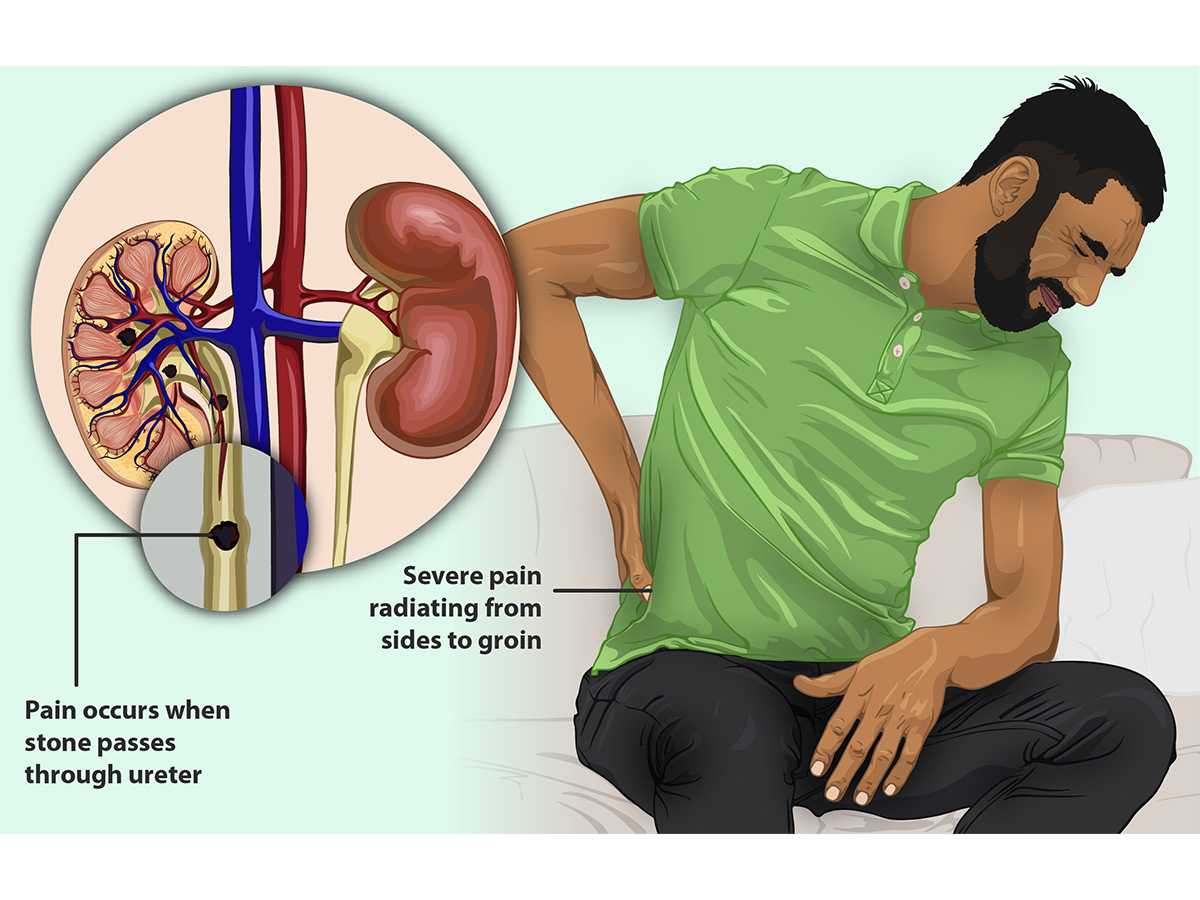
    A 2024 study published in Springer Nature Link described kidney stones, or urolithiasis, as solid deposits of mineral salts and crystals that form in the kidneys or urinary tract. Different types of stones can cause pain, obstruction, infection, and recurrence if not properly prevented or treated. Individuals at higher risk tend to have more concentrated urine, lower urine volume, or decreased urinary pH.

    A 2025 study published in the National Library of Medicine found that as many as 13% of the North American population experience kidney stones. This costly medical condition has been on the rise, particularly among men, since 2000. Advances in laser, AI, and robot-assisted surgeries have helped reduce complications and improve patient outcomes.

    healthcare, surgery, stone dissolution, groin, pain radiation, graphics, non-surgical, medicine distribution
    A diagram onu00a0kidney stones. myupchar/ Wikimedia Commons

    The innovative approach developed by researchers at the University of Waterloo could offer a safer, non-surgical way to treat kidney stones and other urinary system conditions with pinpoint accuracy.

  • How a 22-year-old George Washington learned how to lead, from a series of mistakes in the Pennsylvania wilderness
    A young George Washington was thrust into the dense, contested wilderness of the Ohio River Valley as a land surveyor for real estate development companies in Virginia.Photo credit: Henry Hintermeister/Public domain via Wikimedia Commons
    , ,

    How a 22-year-old George Washington learned how to lead, from a series of mistakes in the Pennsylvania wilderness

    George Washington’s first command ended in defeat, surrender and an international crisis that changed him forever.

    This Presidents Day, I’ve been thinking about George Washington − not at his finest hour, but possibly at his worst.

    In 1754, a 22-year-old Washington marched into the wilderness surrounding Pittsburgh with more ambition than sense. He volunteered to travel to the Ohio Valley on a mission to deliver a letter from Robert Dinwiddie, governor of Virginia, to the commander of French troops in the Ohio territory. This military mission sparked an international war, cost him his first command and taught him lessons that would shape the American Revolution.

    As a professor of early American history who has written two books on the American Revolution, I’ve learned that Washington’s time spent in the Fort Duquesne area taught him valuable lessons about frontier warfare, international diplomacy and personal resilience.

    The mission to expel the French

    In 1753, Dinwiddie decided to expel French fur trappers and military forces from the strategic confluence of three mighty waterways that crisscrossed the interior of the continent: the Allegheny, Monongahela and Ohio rivers. This confluence is where downtown Pittsburgh now stands, but at the time it was wilderness.

    King George II authorized Dinwiddie to use force, if necessary, to secure lands that Virginia was claiming as its own.

    As a major in the Virginia provincial militia, Washington wanted the assignment to deliver Dinwiddie’s demand that the French retreat. He believe the assignment would secure him a British army commission.

    Washington received his marching orders on Oct. 31, 1753. He traveled to Fort Le Boeuf in northwestern Pennsylvania and returned a month later with a polite but firm “no” from the French.

    Dinwiddie promoted Washington from major to lieutenant colonel and ordered him to return to the Ohio River Valley in April 1754 with 160 men. Washington quickly learned that French forces of about 500 men had already constructed the formidable Fort Duquesne at the forks of the Ohio. It was at this point that he faced his first major test as a military leader. Instead of falling back to gather more substantial reinforcements, he pushed forward. This decision reflected an aggressive, perhaps naive, brand of leadership characterized by a desire for action over caution.

    Washington’s initial confidence was high. He famously wrote to his brother that there was “something charming” in the sound of whistling bullets.

    The Jumonville affair and an international crisis

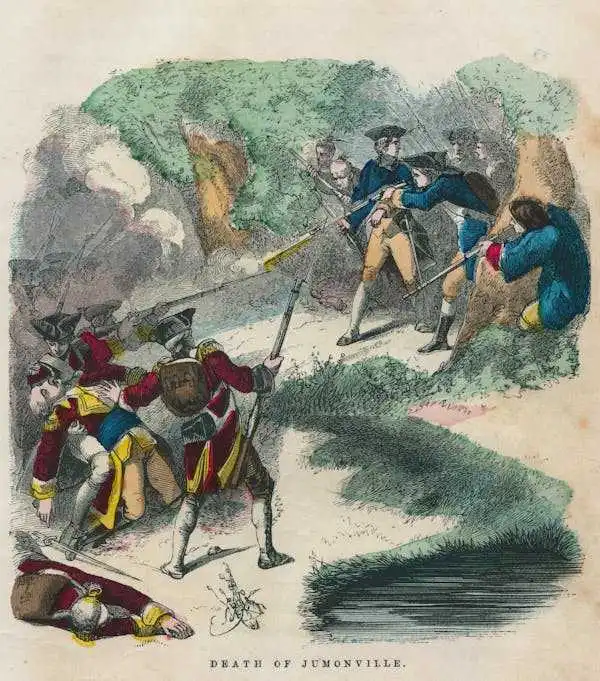
    Perhaps the most controversial moment of Washington’s early leadership occurred on May 28, 1754, about 40 miles south of Fort Duquesne. Guided by the Seneca leader Tanacharison – known as the “Half King” – and 12 Seneca warriors, Washington and his detachment of 40 militiamen ambushed a party of 35 French Canadian militiamen led by Ensign Joseph Coulon de Jumonville. The Jumonville affair lasted only 15 minutes, but its repercussions were global.

    The Jumonville affair became the opening battle of the French and Indian War. Interim Archives/Archive Collection/Getty Images

    Ten of the French, including Jumonville, were killed. Washington’s inability to control his Native American allies – the Seneca warriors executed Jumonville – exposed a critical gap in his early leadership. He lacked the ability to manage the volatile intercultural alliances necessary for frontier warfare.

    Washington also allowed one enemy soldier to escape to warn Fort Duquesne. This skirmish effectively ignited the French and Indian War, and Washington found himself at the center of a burgeoning international crisis.

    Defeat at Fort Necessity

    Washington then made the fateful decision to dig in and call for reinforcements instead of retreating in the face of inevitable French retaliation. Reinforcements arrived: 200 Virginia militiamen and 100 British regulars. They brought news from Dinwiddie: congratulations on Washington’s victory and his promotion to colonel.

    His inexperience showed in his design of Fort Necessity. He positioned the small, circular palisade in a meadow depression, where surrounding wooded high ground allowed enemy marksmen to fire down with impunity. Worse still, Tanacharison, disillusioned with Washington’s leadership and the British failure to follow through with promised support, had already departed with his warriors weeks earlier. When the French and their Native American allies finally attacked on July 3, heavy rains flooded the shallow trenches, soaking gunpowder and leaving Washington’s men vulnerable inside their poorly designed fortification.

    Washington was outnumbered and outmaneuvered at Fort Necessity. Interim Archives/Archive Collection/Getty Images

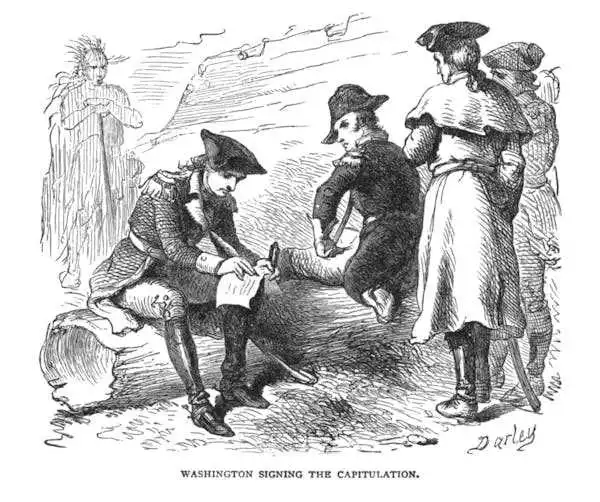
    The battle of Fort Necessity was a grueling, daylong engagement in the mud and rain. Approximately 700 French and Native American allies surrounded the combined force of 460 Virginian militiamen and British regulars. Despite being outnumbered and outmaneuvered, Washington maintained order among his demoralized troops. When French commander Louis Coulon de Villiers – Jumonville’s brother – offered a truce, Washington faced the most humbling moment of his young life: the necessity of surrender. His decision to capitulate was a pragmatic act of leadership that prioritized the survival of his men over personal honor.

    The surrender also included a stinging lesson in the nuances of diplomacy. Because Washington could not read French, he signed a document that used the word “l’assassinat,” which translates to “assassination,” to describe Jumonville’s death. This inadvertent admission that he had ordered the assassination of a French diplomat became propaganda for the French, teaching Washington the vital importance of optics in international relations.

    A log cabin used to protect the perishable supplies still stands at Fort Necessity today. MyLoupe/Universal Images Group/Getty Images

    Lessons that forged a leader

    The 1754 campaign ended in a full retreat to Virginia, and Washington resigned his commission shortly thereafter. Yet, this period was essential in transforming Washington from a man seeking personal glory into one who understood the weight of responsibility.

    He learned that leadership required more than courage – it demanded understanding of terrain, cultural awareness of allies and enemies, and political acumen. The strategic importance of the Ohio River Valley, a gateway to the continental interior and vast fur-trading networks, made these lessons all the more significant.

    Ultimately, the hard lessons Washington learned at the threshold of Fort Duquesne in 1754 provided the foundational experience for his later role as commander in chief of the Continental Army. The decisions he made in Pennsylvania and the Ohio wilderness, including the impulsive attack, the poor choice of defensive ground and the diplomatic oversight, were the very errors he would spend the rest of his military career correcting.

    Though he did not capture Fort Duquesne in 1754, the young George Washington left the woods of Pennsylvania with a far more valuable prize: the tempered, resilient spirit of a leader who had learned from his mistakes.

    This article originally appeared on The Conversation. You can read it here.

  • Behavioral expert explains why people should regularly treat themselves after starting a new workout
    Left: A woman eats a donut. Right: A man eats a chocolate bar. Photo credit: Canva

    Forming a workout routine and figuring out a long-term reward for your efforts is much easier than sticking to it for most people. Ideally, planning and executing a workout plan can work for a while if you establish rewards for yourself, but many folks still end up quitting exercise anyway. Do rewards even work at all? A habit expert has an explanation for why so many people continue to struggle.

    Habit expert and journalist Charles Duhigg explains in a video that rewards can help form good habits, like an exercise routine, but only when they’re immediate and when there’s time to fully enjoy them.

    Duhigg says that when most people start exercising, such as going for a run, they often have to compromise their usual schedules, meaning they have to shower more quickly or shorten breakfast. As a result, while exercise offers long-term benefits, the brain tends to care less because of the immediate short-term hassles.

    “I’m actually punishing myself for exercising, and my brain pays attention to that punishment,” he says.

    Duhigg says that for rewards to be effective when forming an exercise habit, they need to be immediate and paired with enough time, space, and resources to fully enjoy them. Otherwise, the brain won’t feel satisfied and may feel shortchanged if the reward is rushed or serves as a poor substitute for what you actually want. The brain also struggles to care about the long-term benefits of exercise weeks or months down the line, which is why distant rewards tend to be weaker motivators for sticking with a workout routine.

    Duhigg, along with other studies, says that rewards do help “at first,” but over time, as a habit forms, most people begin to experience the rewards as intrinsic rather than extrinsic. For example, if you decide that your reward for a morning workout is a piece of chocolate when you’re just starting out, you may eventually reach a point where you complete the workout and even forget about the chocolate altogether. You’re then motivated by the benefits of the exercise itself, such as feeling stronger or experiencing endorphins, because the habit has become firmly established as part of your regular routine and daily life.

    “In the beginning, the nervous system needs an external reason to engage in an activity: a pleasant or regulating reward that makes an activity ‘worth it,’ which makes the discomfort of it more tolerable,” licensed therapist Chloë Bean tells GOOD.

    Bean adds, “Over time, the reward can shift from external to internal, which is the goal. When the body has repeat experiences of an activity that ends in relief, increased energy, or calm, your body starts to associate the habit with feeling ‘good.’ At that point, the work out or activity is no longer something you have to push through to get a reward, it’s the felt sense afterward that becomes the reward.”

    @unifiedptandyoga

    I forgot to mention avoid burn out as well

    ♬ original sound – Sammy | DPT, RYT

    So if you’re starting a new workout routine, don’t feel bad about rewarding yourself early and often to help you stick with it. Over time, you’ll end up feeling better on every level.

Explore More Editorial Stories

Editorial

Canadian scientists create magnetic robots that can dissolve kidney stones in days

Editorial

How a 22-year-old George Washington learned how to lead, from a series of mistakes in the Pennsylvania wilderness

Editorial

Behavioral expert explains why people should regularly treat themselves after starting a new workout

Editorial

10 ways people recovered from losing their ‘dream job’ and saw they were actually better off