Hands over the heart in prayer pose. A little bow of the head. A gesture of respect. An acknowledgment of our shared humanity. And no touching.

As people the world over are choosing to ditch the handshakes and hugs for fear of contracting the coronavirus, namaste is becoming the perfect pandemic greeting.

As a scholar whose research focuses on the ethics of communication and as a yoga teacher, I’m interested in how people use rituals and rhetoric to affirm their interconnectedness with one another – and with the world.


Namaste is one such ritual.

I bow to you

Originally a Sanskrit word, namaste is composed of two parts – “namas” means “bend to,” “bow to” or “honor to,” and “te” means “to you.” So namaste means “I bow to you.” This meaning is often reinforced by a small bow of the head.

In Hindi and a number of other languages derived from Sanskrit, namaste is basically a respectful way of saying hello and also goodbye. Today, namaste has been adopted into the English language, along with other words from non-English sources. Many words, when borrowed, keep their spelling but acquire new meanings. This is the case with namaste – it has shifted from meaning “I bow to you” to “I bow to the divine in you.”

For many American yoga teachers, beginning most likely with Ram Dass in the 1960s and 1970s, namaste means something like “the divine light in me bows to the divine light within you.” This is the definition of namaste I first learned and have often repeated to my students.

In the words of the popular American yoga teacher Shiva Rea, namaste is “the consummate Indian greeting,” a “sacred hello,” that means “I bow to the divinity within you from the divinity within me.”

Deepak Chopra repeats a similar definition on his podcast “The Daily Breath with Deepak Chopra“: namaste means “the spirit in me honors the spirit in you” and “the divine in me honors the divine in you.”

Namaste has a sacred connotation. When you bow to another, you are honoring something sacred in them. When you bow to another, you are acknowledging that they are worthy of respect and dignity.

I bow to the divine light in you

However, there are critics who say that global yogis have taken namaste out of its context. Some claim that the greeting has been infused with a religious meaning that doesn’t exist in Indian culture.

I see things differently. Many common salutations have religious roots, including adios, or “a Dios,” to God, and goodbye – a contraction of “God be with you.”

Most Indian religions agree that there is something divine in all individuals, whether it’s a soul, called the “atman” or “purusha” in Hinduism, or the capacity for awakening in Buddhism.

As I argue in my forthcoming book, “The Ethics of Oneness: Emerson, Whitman, and the Bhagavad Gita,” this idea, of bowing to the divine in others, also resonates with a deep spiritual inclination in American culture.

Beginning in the 1830s and 1840s, the influential philosopher and essayist Ralph Waldo Emerson, in dialogue with a number of other thinkers, invented a form of spiritual practice that encouraged Americans to actively address the divine soul in others every time they spoke.

Of particular note is that Emerson often used the metaphor of light to imagine this inner divinity, likely because of his great admiration for the Quakers, whose Christian denomination holds that God lives inside of us all in the form of an “inner light.”

The definition of namaste as “the divine light in me bows to the divine light in you” is very much in the spirit of both Indian religions and 19th-century traditions of American spirituality.

Namaste as an ethical commitment

In today’s global yoga culture, namaste is typically said at the end of class. As I understand, for yogis, saying namaste is a moment of contemplating the virtues associated with yoga – including peacefulness, compassion, and gratitude and how to bring those into one’s daily life.

I asked Swami Tattwamayananda, the head of the Vedanta Society of Northern California in San Francisco and one of the world’s leading authorities on Hindu ritual and scripture, how he felt about Americans like me saying namaste.

He responded: “It is perfectly appropriate for everyone, including Westerners like yourself to say namaste at the end of your yoga classes.” He also reiterated that namaste means “I bow down to you” – in the sense that I bow down to the divine presence in you.

One need not be a Hindu, or a Buddhist, or a yoga teacher to say namaste. Namaste can be as religious or secular as the speaker desires.

What matters most, I believe, is the intention behind the word namaste. When you bow to another, the question to consider is this: Do you truly recognize them as a fellow human being worthy of dignity, bonded in shared suffering and a shared capacity for transcendence?

This recognition of our interconnectedness is what namaste is all about – and exactly what we need during the pandemic.

This article was originally published by The Conversation. You can read it here.
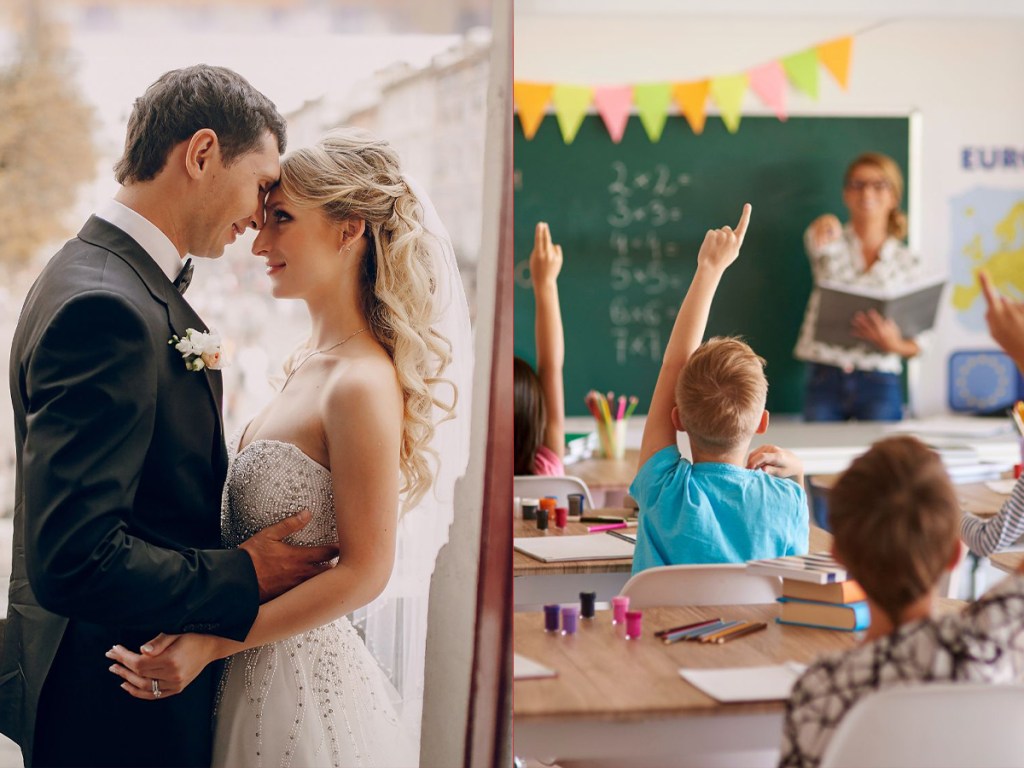
  • Second-grade teacher asks her students for marriage advice. Here’s their 7 best responses.
    A married couple (left) and students raise their hands (right). Photo credit: Canva

    Children form strong worldview opinions at a very young age. Naturally curious, their thinking and insights can lead to blunt but brilliant relationship advice.

    Klarissa Trevino, a second-grade teacher, had a fun idea: to ask her students for advice ahead of her marriage. In a TikTok post, she shared some of their favorite responses, which they were genuinely thrilled to share.

    @itsklarissat

    This was so cute to do with them before I came back as a “MRS” after spring break 🥹🤍 *TEMPLATE is NOT mine its from TPT #teachersoftiktok #weddingadvice #lifeofateacher

    ♬ original sound – ✶𝓵𝓸𝓾𝓲𝓼𝓮✶

    Teacher hands out worksheets

    Trevino wanted to find a way to involve her second-grade students in her wedding, so she printed out worksheets with the prompt, “The marriage advice I give my teacher is…”

    Sharing some of her favorite responses in a TikTok post, Trevino quickly went viral. She told People, “Being able to get a glimpse of their version of marriage and love was very sweet. It made me so happy that they have homes that have shown them the true meaning of it.”

    One of her favorite responses was, “do not eat each other’s snacks.”

    prompt, professional opinions, snacks, five-star, middle school
    Students write.
    Photo credit: Canva

    Marriage advice from second graders

    This is the best marriage advice these second graders had to offer—some might argue it’s as helpful and supportive as any professional’s opinion. Here are some of their responses to the prompt, “The marriage advice I give my teacher is…”:

    “to be kind and love each other.”

    “care and care for each other! Happy marriage!”

    “do not eat each others snacks.”

    “is to give her flowers.”

    “get her Starbucks evrey day.”

    “to take her on a date/ and go to a five star restraunt.”

    “care for [each other] And Love her. do not hurt her!”

    classroom, teaching, advice,
marriage, students
    Students raise their hands in class.
    Photo credit: Canva

    People are delighted by insightful second graders

    Viewers in the comments were delighted by the second graders’ advice, and some of their own responses were just as insightful as the kids’.

    “Kids are so smart.”

    “The best advice ever..”

    “Imagine how many marriages could’ve been saved if ppl just left eachother’s snacks alone”

    “This is legitimately better marriage advice than you see on TikTok.”

    “You should publish this, because people could really learn a thing or two from your students”

    “I’m teaching the wrong grade!!”

    “These are signs that these kids have wonderful parents and figures in there life’s …. and a wonderful teacher who loves and cares for them”

    elementary school, kids, friendship, meaningful insight, family
    Students pose for a picture.
    Photo credit: Canva

    Studies show that kids have meaningful insights

    These second graders shared straightforward, thoughtful insights. Yet research shows that children offering meaningful perspectives is nothing new. A 2025 study found that kids begin to understand other people’s feelings, beliefs, and even motivations at a very young age. They aren’t boxed in by adult expectations, which helps keep their thinking fresh and profound.

    A 2025 study found that even children as young as four understand far more than we might think. They’re capable of problem-solving and experience “aha!” moments that can make others grin.

    Kids often cut straight to the truth because they’re naturally curious. A 2025 study found that adults underestimate how organized children’s ideas can be. Like adults, kids’ beliefs shape how they act and feel, forming a worldview that is surprisingly detailed, consistent, and stable.

    These young students’ advice may seem simple, but that’s exactly what makes it so powerful. They remind us that kindness and honesty don’t require much effort to make a lasting impact on any relationship. Sometimes the truth comes from the smallest voices, and Trevino understood the value of listening.

  • Teacher spots suspicious bare feet under a school bench, but the ‘lockdown’ scare has a surprising explanation
    A teacher (left) and bare feet (right). Photo credit: Canva

    Teachers are trained to expect the unexpected. One day, Alissa, a history teacher who posts on TikTok under the name @teachinginstyle, looked out the window of her high school classroom and noticed a pair of bare feet hanging from a school bench.

    She knew something wasn’t right. In a split-second decision most teachers hope they’ll never have to make, she locked her classroom door. Then Alissa called the school’s safety number, which nearly triggered a lockdown.

    “One: stranger danger,” she explained in a video. “And two, I have a room full of sixteen-year-olds that I need to keep safe.”

    @teachinginstyle

    STORY TIME ✨ how I almost caused a lock-down at my old school 🔒 HAPPY FRIDAY & SKI WEEK ❤️ #teachersoftiktok #teachertok #teacherlife #teacher

    ♬ Piano famous song Chopin Deep deep clear beauty – RYOpianoforte

    Nearly causing a school lockdown

    A pair of unfamiliar, bare adult feet resting on a school bench is enough to warrant further investigation by any responsible teacher.

    “Outside my classroom, there were these wooden benches. And kids would sit there during break,” she continued. “My class was quietly working, and I glance outside, and I see a pair of bare feet. Like just feet, sticking out from the bench.”

    Wondering whether it was a student and if they were okay, she headed outside to investigate, only to find an unfamiliar adult asleep on the bench. Immediately frightened, she recalled, “Three things come to mind. One: Are they alive? Two: Why is there a random adult on campus? And three: Oh my God, are we going to have to go on lockdown?”

    Alissa locked her classroom door and called the safety number, describing the situation over the phone. It turns out the feet belonged to a substitute teacher. She concluded, “It was a sub—a substitute teacher—taking a nap on the bench, like wanting to get some sun on the dogs (their bare feet). Oops. How was I supposed to know that?”

    education, teachers, school safety, campus awareness
    Teachers pose in the hallway.
    Photo credit: Canva

    A story that’s both chaotic and funny

    Viewers had mixed opinions about Alissa’s story. Some thought she did the right thing, while others were more concerned about the substitute teacher’s behavior. Here are some of the comments:

    “I would do the same…”

    “OK, but as a sub, I could never imagine taking a nap.”

    “not just any nap, a nap on a bench with your shoes off”

    “You are 100”

    “What on EARTH????”

    “there is NOT enough diet coke to handle this..”

    “I think anybody would’ve done the same thing in that situation”

    Training programs, campus safety, crisis, drills, preparedness
    A school building on a sunny day.
    Photo credit: Canva

    Prepared for school safety

    To prepare for the unexpected, teachers must go through training. A 2025 study analyzed a training program designed to help teachers and staff prepare for emergencies. The results showed that participants felt more psychologically prepared and ready to handle a crisis.

    It’s important for students to feel safe and prepared, too. But do the drills help, or do they cause more problems for kids? A 2023 study found that 27% of children said the drills made them anxious. Overall, caregivers still supported the preparation, even though some kids felt uncomfortable.

    bare feet, substitute teachers, school preparedness, lighthearted
    A teacher talks with students.
    Photo credit: Canva

    The substitute teacher’s bare-feet fiasco turned out to be far less dangerous than it first appeared, but it highlights a real challenge teachers face every day. Alissa’s story is a lighthearted reminder of the serious nature of school preparedness, though sometimes there can be a surprisingly simple explanation.

    Anyone with concerns about handling different kinds of disasters can visit the FEMA website, where many free preparedness videos are available.

  • Teacher chaperones a kindergarten field trip and shares 3 moments that perfectly capture how little kids think
    (LEFT) Curious kindergartener and (RIGHT) teacher caught off-guard.Photo credit: Canva
    ,

    Teacher chaperones a kindergarten field trip and shares 3 moments that perfectly capture how little kids think

    A middle school teacher, Mr. Lindsay, chaperoned his son’s kindergarten field trip to the zoo. He explains in his TikTok video 3 funny moments that perfectly capture how little kids think. If you ever need proof that young kids see the world a little differently, just listen to what they have to say on this…

    A middle school teacher, Mr. Lindsay, chaperoned his son’s kindergarten field trip to the zoo. He explains in his TikTok video 3 funny moments that perfectly capture how little kids think.

    If you ever need proof that young kids see the world a little differently, just listen to what they have to say on this field trip. From a silly animal mix-up to a candid family comment, this recap by Lindsay captures why kindergarteners are some of the funniest storytellers on earth.

    Excited To See The Leprechauns

    Lindsay describes the first experience, “A kid walks up to me, and he goes, ‘Mr. Lindsay, I can’t wait to see the leprechauns.’” Lindsay responds that the zoo doesn’t have leprechauns, to which the kindergartener says, “No, I’m serious, the leprechauns. The ones with the spots.” The child was talking about the leopards.

    A pretty cute mistake that commonly occurs with younger children. They often reshape unfamiliar words to fit sound patterns they already know. A 2023 study of speech-sound substitution in the National Library of Medicine explained that the near matches of words can be termed “markedness.” The simple mistakes gradually end after they gain better control of their mouth.

    kindergarteners, funny conversations, childhood, cute mistakes
    Boy plays in a kindergarten playground tunnel.
    Photo credit Canva

    My Stepdad Is Much Younger

    In the second story, a kindergartner walks up saying that he is thirsty. Lindsay suggests getting some water when the kid suddenly stops, stares, and says, “My one dad is 53, but my other dad, who’s my stepdad, is 21.” Lindsay offers a surprised look to the camera after recounting the unexpected honest exchange.

    A 2024 study in Nature Human Behaviour reported that researchers studied kindergarten students to see whether trust would encourage honesty. They found that kids who were shown trust cheated less often. The research suggests that when adults instill trust in young people, they can encourage greater honesty.

    field trip, hygiene, healthy habits, education
    Kids on a field trip walk in a straight line.
    Photo credit Canva

    Gross And Unfortunately Familiar

    In the third story, when he catches one of the kindergartners picking his nose, Lindsay tells the child not to do that. The kid then wipes the booger on the ground and exclaims, “Well, I wiped it on the ground. It’s natural.” Yikes. Lindsay wraps the video saying, “So, not much different than teaching middle schoolers, but some good moments.”

    Kindergarten-aged kids are still learning basic hygiene habits. A 2024 review in the National Library of Medicine found kids were especially vulnerable to infections because of poor hygiene. Teaching healthy practices like hand washing, body hygiene, and oral care in school helped children stay healthier.

    kids, honest communication, trust, stories, school
    Cute little girl smiles.
    Photo credit Canva

    Kids Speak Their Truth

    There were some cute comments from fellow TikTokers who appreciated the stories and added a few of their own:

    “My son started kindergarten in the fall of 2020 so it was it all virtual on google meets. There was a kid in his class that would occasionally pop on camera in a Batman costume and say ‘I’m Batman.’ It was hilarious.”

    “Bless Kindergartner teachers- hardest job of them all!”

    “And this is why I teach kindergarten.”

    “One of my pre-k students came over to me during indoor recess, I thought the kid need help or someone hit him, he was making a face, when I asked ‘What’s wrong’ he gave a serious look and proceeds to tell me ‘I just needed to fart’ it was a nasty one”

    “Yup, sounds like kindergarteners! “

    Kindergarteners may not always know the right thing to say, but they certainly can say the honest thing. It’s a good reminder that teaching young kids means being ready for absolutely anything. Lindsay’s video offers a fun way to remind us.

Explore More Culture Stories

Internet

Teacher spots suspicious bare feet under a school bench, but the ‘lockdown’ scare has a surprising explanation

Culture

Teacher chaperones a kindergarten field trip and shares 3 moments that perfectly capture how little kids think

Internet

13 heartbreaking and hilarious voicemails people refuse to delete

Culture

Overpackers love this simple ‘5-4-3-2-1’ packing rule that makes travel way easier