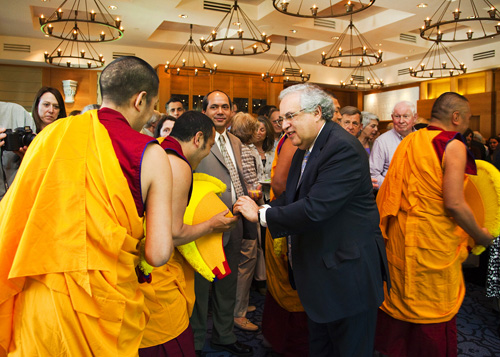
If you spend enough time around Emory University in Atlanta, chances are you’ll see your fair share of Tibetan Buddhist monks. For years, the university has been known for its devotion to the field of Tibetan studies. Affiliated since the early 1990s with the nearby Drepung Loseling Monastery, a spiritual and academic center run by Emory graduate Geshe Lobsang Tenzin Negi, the university has fostered exchanges between students and monks in the Tibetan refugee community in Dharamsala, India, to preserve and learn from Tibetan culture and faith. In 2007, Emory even welcomed the Dalai Lama, head of the Gelug school of Tibetan Buddhism and exiled soul of the Tibetan society, as a Presidential Distinguished Professor. The presence of monks at the school has continued to grow over the last decade, as the school has partnered with the Tibetan community in Dharamsala to develop a program to revolutionize Tibetan Buddhist religious education—by fusing it with the study of Western science, possibly the first major overhaul of the monastic education system in over half a millennium.
Arguably, this curricular change won’t be a huge leap, given Tibetan Buddhism’s historic focus on rigorous, debate-based education, empirical knowledge, and openness to adaptation. In 427 AD, Buddhists founded Nalanda, perhaps the world’s first higher education institution, for the study of both their faith as well as the natural sciences. At present, in some monasteries, monks spend up to 12 hours a day debating philosophy and logic, reciting prayers, and learning traditional sciences; of the 20,000 Buddhist monks in the 120,000 strong Tibetan-Indian exile population, about five percent study between 10 and 20 years to achieve the title of Geshe, similar to a doctorate. This focus on education and inquiry led the Dalai Lama to explore the convergence of Western science and Buddhism in books like The Universe in a Single Atom, and to openly declare that, what science proves false, Buddhism would reject from its scriptures. This has launched scientific-philosophic dialogues through bodies like the Mind & Life Institute, and led to collaborations between monks and neuroscientists to study the biology of mysticism and meditation at Emory, University of California, Davis, Stanford University, and the Universities of Massachusetts and Wisconsin.
Yet despite all of the conversation and conceptual overlap (and the institution of scientific education in non-monastic Tibetan-Indian schools), until about a decade ago barely any monks ever received actual Western scientific training. A partnership between philanthropist Bobby Sager and the Dalai Lama, detailed in Sager’s recent Beyond the Robe, emerged in 2001 to bring Western science into the monasteries. Launched as Science Meets Dharma, the program sent European graduate students to monasteries to teach science, with the goal of training monks to eventually teach on their own and incorporate science into their monastic curriculums. Despite some initial resistance by older monks afraid of sullying the purity of their faith, the program took off, as young disciples yearned for knowledge of the world as others understood it, and a means to harmonize their education with those realities.
In 2006, Geshe Lhakdor, Director of the Library of Tibetan Works and Archives in Dharamsala, came to Emory on a fellowship and began talking about establishing a new program. By 2008, he’d helped create Science for Monks, a crash course for higher-level disciples that would span the course of six summers at Emory. The program has now trained dozens of monks—covering the basics of scientific thought in their first year, then introducing them to major fields, and uniting all the branches of science by the sixth year—and expanded in 2010 to launch the Tenzin Gyatso Science Scholars program, so exceptional students can train as full-time scholars.
The major turn came in 2012, though, when the Dalai Lama announced in Boston that he would officially make Western scientific education part of the core curriculum for all Gelug Buddhist monastic students. He then transferred the management of Science Meets Dharma from the program’s European partners to the monks themselves. Officially, the fusion is now complete, but over the past two years, Sager, the Library of Tibetan Works and Archives, and a host of other institutions have founded additional external programs for young monks and teachers to bone up on their science, to train as teachers, and to prepare for the inevitable challenges of systematically altering a 1,500-year-old corpus of education. To date, the programs have held two International Conferences on Science Translation in Tibetan, coining new native words for scientific terms like electromagnetism, and launching a Tibetan-language Tibetan Science Journal, as well as numerous Tibetan and bilingual science textbooks. Yet despite the massive changes that continue to sweep the monastery system, the young monks seem anything but daunted. Their core beliefs intact, they seem to view this not as a strange, foreign imposition, but instead as a chance to keep their identity alive and relevant, and they’re eager to run with it.