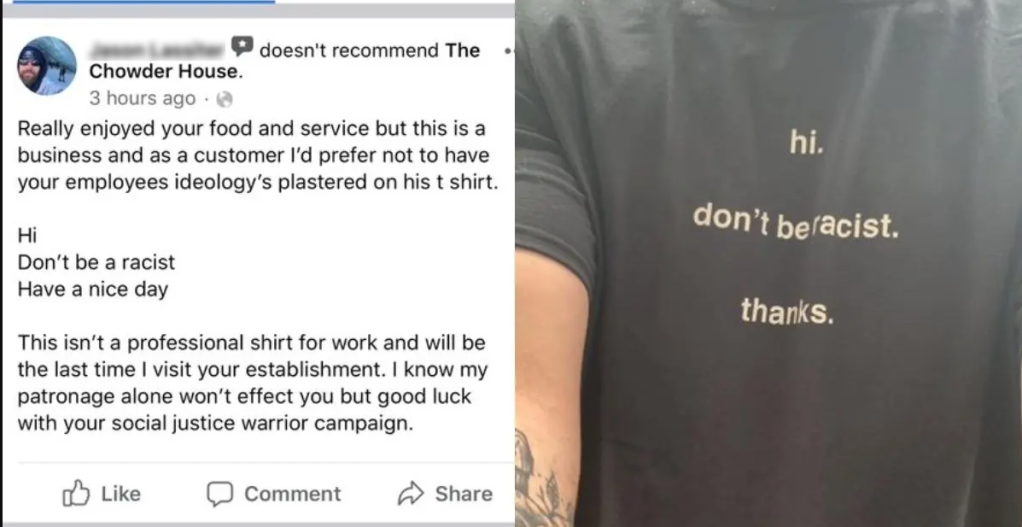
When a customer left a negative review of a restaurant because of a server’s shirt that said “Hi. Don’t be racist. Thanks,” he probably didn’t expect the internet to clap back quite this hard.
The incident took place at The Chowder House in Fairbanks, Alaska, where a server—who goes by @bryantinak on X—wore a shirt carrying that short and powerful message. After the review was posted, @bryantinak shared it on social media along with a selfie in the now-famous shirt. “Someone complained about me wearing my favorite shirt today on our Facebook page, now I can’t wear it at work anymore :.(,” they wrote.
The reviewer, Jason Lassiter, complained, “As a customer I’d prefer not to have your employees’ ideologies plastered on his t-shirt… This isn’t a professional shirt for work and will be the last time I visit your establishment.”
Someone complained about me wearing my favorite shirt today on our Facebook page, now I can’t wear it at work anymore :.( pic.twitter.com/3Ssnl9hPDc— ⚕ (@bryantinak) June 17, 2020
That might’ve been the end of it—except the internet had other plans.
“Someone complained about me wearing my favorite shirt today on our Facebook page, now I can’t wear it at work anymore :.(“
— @bryantinak
As soon as Lassiter’s review hit Facebook, commenters began roasting him for taking issue with a message as basic as “don’t be racist.” According to @bryantinak, “So many people direct messaged the guy that he deleted his bad review.”

Some couldn’t help but point out the irony of calling a shirt that politely discourages racism “unprofessional.” One user wrote, “That’s actually an extremely professional shirt. How much more professional can you get?”
What made things more confusing was that @bryantinak initially thought they were being reprimanded by management for wearing the shirt—understandably so, given the timing of the comment during a busy shift. But they later clarified:
“Talked to my bosses. They were upset at the customer for making an absurd complaint… They have no problem with me wearing the shirt and actually urge me to continue to if I wish to do so.”
— @bryantinak
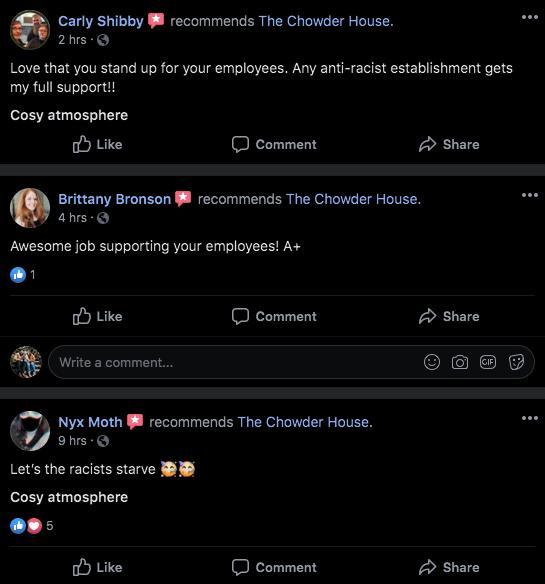
That’s when the tide really turned. Not only did Lassiter’s comment disappear, but The Chowder House’s Facebook page began receiving a flood of positive reviews. One person wrote, “Great place. Lets its employees be decent human beings.”
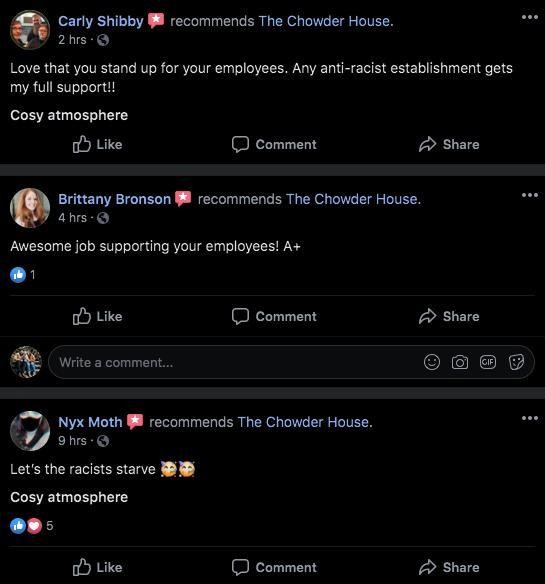
Another praised the food and the message: “Came for the anti-racism, stayed for the chowder… I had delicious racism-free salmon chowder and I’ll certainly be back next time I visit.”
“Came for the anti-racism, stayed for the chowder.”
— Facebook reviewer
@bryantinak mentioned they originally got the shirt from an Etsy shop, but that it seemed like “some fast fashion Etsy bulls–t.” They recommended instead buying similar designs from Black-owned businesses and even shared links to several apparel fundraisers and activist shops.

Black owned business sign Canva
The backlash to Lassiter’s review raises an important point—why is saying “don’t be racist” considered “ideological” or “controversial” by some people? If a simple request for basic human decency reads as offensive, it’s worth pausing to consider why.
Thankfully, it sounds like The Chowder House knows where it stands. And so does its staff.
According to some estimates, the average time dads spend caring for their kids each day has quadrupled over the past 50 years. Their attitudes about parenting are also changing. Today, men are about as likely as mothers to say parenting is a key source of meaning and a central priority in their lives. Roughly 85% of fathers identify parenthood as one of the most important aspects of their identity.
But there’s a less encouraging trend tucked into these gains. More is being asked of dads – and moms, for that matter – because the extended family and community networks that once supported childrearing have shrunk or deteriorated.
One society he studies, the Aka Pygmies of the Central Congo, have been called “the best fathers in the world” for their dedication to childcare. Aka men are frequently observed within arms reach of their infants and take a lead role in raising them. Children are seen as central to men’s lives.
However, if you compare the time Aka dads spent on childcare with recent data on American parents, as parenting writer Tomo Kumaki recently did, you might be surprised.
According to 2024 American Time Use Survey data – considered the gold standard of evidence on how Americans are spending their time – American dads of infants are devoting about 125 minutes a day to what’s called “primary child care,” in which their main activity is tending to the child. They’re spending another 394 minutes on what’s known as “secondary child care,” which involves watching a child while doing something else, such as cooking dinner or straightening up the house.
The minutes American dads relayed should be taken with a grain of salt; it’s a stretch to compare an anthropologist’s direct observations with self-reported time diary data, which can often be subject to bias. Still, it’s striking to see how – based on these calculations, at least – today’s new dads are devoting far more time to parenting than a society described as having the best dads in the world.
Among the Aka people, who are indigenous, nomadic hunter-gatherers native to Central Africa, men take a lead role in raising their children. Andia/Universal Images Group via Getty Images
When I spoke with him about how fatherhood has changed, Hewlett told me he thinks the role of fathers has taken on more importance today than ever before – not just because mothers are more likely to have jobs outside the home, but because there are simply fewer childcare helpers around.
When you’re surrounded by your kin and neighbors in a communal setting like the Aka, it’s easy to get assistance with kids. Fathers care for children, but so do lots of other people.
A 2021 study of another hunter-gatherer society, the Agta, which lives in the mountains of the Philippines, found that fathers provided only about 7% of child care. Mothers, however, provided only about 25%. The rest came from siblings, grandparents, extended family, peers and other community members, who all pitch in.
A class divide
In much of the industrialized world, daily life is organized around the nuclear family, with relatives and neighbors playing a less central role than they once did.
Today’s fathers contribute more to childcare than even the most hands-on hunter-gatherer dad, because there’s simply less of a village to support shared care.
Even as men are being asked to take on a bigger role in childcare, it’s become harder for some men to do so. That’s because – in the U.S., at least – the time men are able to spend on childcare has become increasingly stratified by class.
Journalists Derek Thompson and Aziz Sunderji analyzed multiple waves of U.S. data collected by the Multinational Time Use Study and were able to show that the significant rise in the time dads spend parenting over the past 60 years has primarily been driven by college-educated fathers.
When the Multinational Time Use Study started in the 1960s, fathers with a college degree were devoting only a few extra minutes per day to childcare compared with noncollege-educated dads. But the gap has quintupled over that time span, such that college-educated dads are now spending 46 more minutes with their kids each day compared with noncollege-educated dads.
So why the growing divide? In part, it’s because benefits such as universal paid paternity leave and stable, flexible work options are available only to dads with good jobs.
Only about half of U.S. fathers take any paid paternity leave following the birth of a new baby, because many employers don’t offer it. In theory, most dads who can’t access paid leave should be eligible for unpaid leave through the 1993 Family and Medical Leave Act. However, since that legislation doesn’t apply to small businesses or many part-time or gig work situations, about 44% of workers are ineligible for it. Low-wage dads are also often reluctant to take leave because they can’t afford to lose income.
The rise of what sociologists call intensive parenting among the most educated, affluent parents also helps account for some of the class divide in parenting time. As the wealth gap between the richest and poorest Americans has widened over the past 60 years, many parents have been eager to optimize their children’s success. Devoting extra time to children, including monitoring their schoolwork and enrolling them in enrichment activities that require time and money, has become one way for parents with privilege to give their children a leg up.
In my view, hands-on parenting should not be a luxury good. Americans should be fighting for policies that empower all dads, no matter their income, to enjoy time with their children. The village could use some rehabilitation, too, since parents fare best when they have access to community support and stronger connections with their neighbors, friends and family.
The toaster oven burns everything, a lamp constantly flickers, or maybe a favorite coat has lost all its buttons. These random irritations around the home usually lead to a simple choice: throw it out, get a new item, or live with it.
A growing number of communities have found a more productive solution called a “Repair Café.” People are bringing their broken household items and gathering around shared tables. Know-how volunteers offer a more environmentally friendly solution that has people coming back for more than simple repairs.
Repair Cafés are free community events where neighbors help neighbors fix the everyday objects that would probably end up in the trash. It’s a community-building opportunity that turns frustration into a shared, hands-on experience.
The Associated Press reports that people arrive at a local church basement carrying blunt knives, malfunctioning zippers, and other things most don’t know how to fix themselves. The volunteers with repair skills open devices, test parts, sew torn fabric, and troubleshoot issues. There’s no charge, no appointment, and no expectation that everything gets fixed.
The unique idea, according to the Repair Café Foundation, is a free meeting place where repairing things becomes something people do together instead of alone. Using shared tools and knowledge, items might get fixed and friendships might blossom.
With rising concerns about the cost of living and growing frustration with disposable consumer habits, repair culture is gaining momentum. Rather than replacing broken items, people are looking to make them last longer. It’s a planet-friendly model for reducing waste and challenging “throwaway culture.” This is an active attempt at shifting the way people think about consumption.
While the concept is often framed as a way to save money and reduce waste, research suggests they serve another purpose as well. A 2024 study in Cleaner Production Letters found they also function in building community. Visitors are often motivated not only by the opportunity to fix things, but also to learn from others and engage in shared activities.
People are finding a real sense of satisfaction that goes beyond whether the item is repaired or not. Sitting with strangers, asking questions, and learning small skills creates an engagement increasingly rare in modern lifestyles.
In an article for the The Guardian, author Nyima Jobe quotes Sophie Heathscott, an arts magazine manager in London, saying, “There is a real joy in being able to fix something for someone, and then showing them how.”
Working on a global scale, fixing thousands of items
The concept has grown into a global network with thousands of locations across multiple countries. Through volunteer-led events, countless household items have been repaired instead of discarded. However, the appeal goes beyond practicality. It may be damaged things that bring people through the door, but a repaired lamp is rarely the only thing they take home.
Repair Cafés offer something harder to find and impossible to manufacture. These gatherings give neighbors a chance to solve problems while working together on a common goal. Whatever the outcome, the main takeaway is communal connection.
Before having a conversation with a stranger, many people assume the interaction will be boring, uncomfortable, or simply not worth the effort. A recent study found that people routinely underestimate how enjoyable and meaningful these interactions can be.
People unknowingly avoid meaningful conversations with strangers
Elizabeth Trinh, a doctoral student at the University of Michigan and lead study author, placed people in conversations about topics that they identified as boring. Options varied from the stock market to cats to vegan diets.
The study asked participants to predict how a conversation with unfamiliar people might go. Most participants expected less enjoyment, less connection, and less value from the exchange. The results suggest that people are surprisingly poor at forecasting their own social experiences.
After the interaction with a stranger, the majority believed it went far better and was more engaging than they had predicted. In an American Psychological Association press release, Trinh said, “People consistently expected conversations about seemingly boring topics to be less interesting than they turned out to be.”
The study indicates people might place too much emphasis on the topic and situation itself. Because once people start actually talking, the content matters far less than the interaction. “What really drives enjoyment is engagement,” explained Trinh.
“Feeling heard, responding to each other, and discovering unexpected details about someone’s life can make even a mundane topic meaningful,” she added.
Co-workers enjoy a good conversation. Photo credit Canva
People opt out of potential connections
The study shows that people may be opting out of potential connections because they assume that opportunity isn’t worth their time and energy. It also challenges the idea that meaningful conversations require a special chemistry or a pre-existing relationship.
Instead, ordinary interactions with neighbors, coworkers, or people standing in a line may offer more emotional value than once believed. “Even a brief conversation about everyday life may be more rewarding than we expect,” said Trinh.
Researchers have repeatedly found that people feel better after engaging with strangers, even when expectations of awkwardness are high. They report feeling happier and more connected. Responding to another person, sharing experiences, and discovering unexpected connections far outweigh the importance of a strong starting point.
An epidemic of loneliness
These findings offer a reassuring contrast to the belief that modern loneliness is a growing problem that may not be easily solved. Avenues for connection may be far more abundant than many people think.
Several proposed solutions to loneliness and social isolation involve building new friendships through social groups and new hobbies. But Trinh’s research suggests a far simpler approach. People may be surrounded by opportunities that they routinely dismiss. Most of us assume boring, small talk won’t go anywhere, yet even a brief chat with a coworker or stranger may offer more social value than people realize.
The basic, everyday exchanges people have been avoiding might actually be some of the most valuable. Rather than planning the perfect social outing, a willingness to talk with a stranger that we might otherwise avoid could lead to a more meaningful experience.