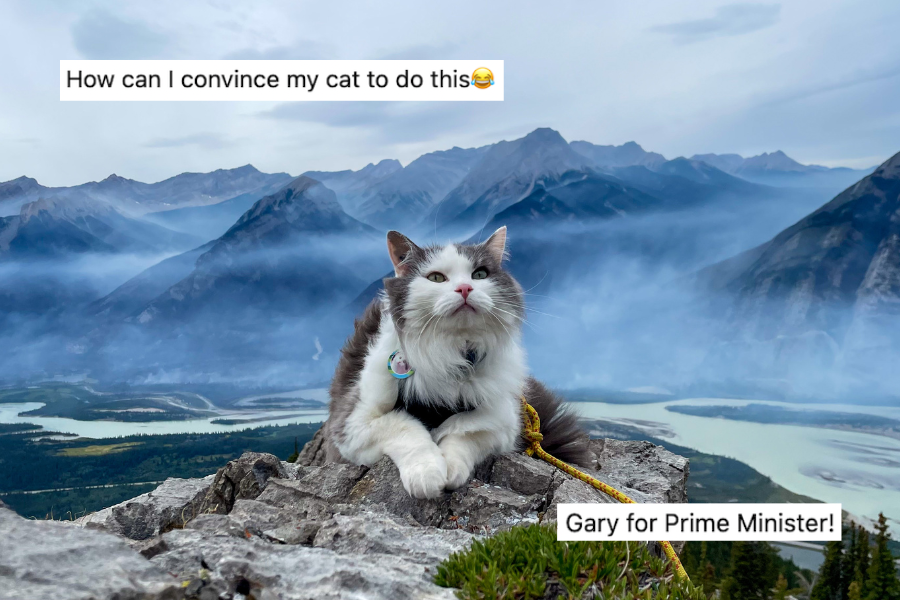
Any time my wife and I take our furry little feline, Tony, on a stroller ride through our downtown square, we’re mobbed with smiling children and laughing old ladies and confused college dudes rolling their eyes. I can’t imagine what it’s like to be James Eastham: proud guardian of Gary, the 10-year-old domestic longhair who’s become Internet-famous for his adorable outdoor adventures. Together, they’ve amassed over 600,000 loyal Instagram followers, who flock to their catalog-worthy photos of hiking, skiing, and paddling excursions around the Canadian Rockies.

In a time of extreme political divisiveness and social-media toxicity, cute-cat profiles are one of our few remaining sanctuaries. And it’s impossible not to fall in love with the handsome and gung-ho Gary, whether he’s looking all zen on the water or resting on his dad’s shoulders while zooming down a snowy hill, decked out in badass goggles. But the account, greatgramsofgary, is more than just feel-good fluff—he’s also inspired people to be more active and mindful with cats, rethinking preconceived notions of how to enrich their lives and ours.
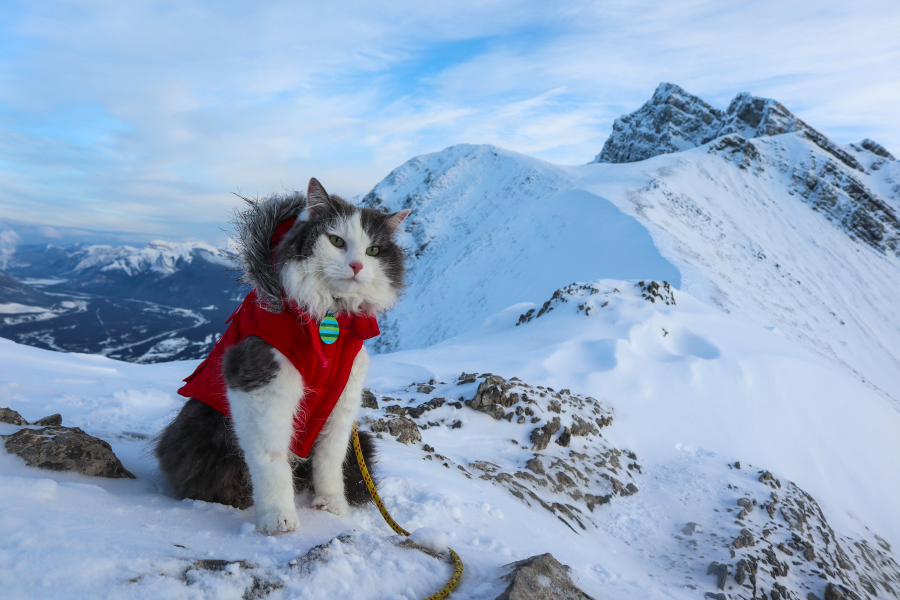
cat, gary the cat, snow, outdoors, nature
Let us all bow before Gary, the Internet's most adventurous feline. Photo credit: James Eastham

Eastham adopted Gary from the Calgary Humane Society when he was four months old. (At the time, he had an injury that required removing the head of his femur: “His leg is now attached only by muscle and tendon,” Eastham wrote on Instagram, “but he doesn’t let it slow him down.” Certainly not!) It was a slow build to hitting the slopes and charming thousands of people, and no one’s more surprised than than the guy who started the account.

“I don’t think anyone would have expected that I would have a famous Internet cat if you’d told them 10 years ago,” says Eastham, who splits time between Edmonton and Canmore, Alberta. “I didn’t grow up with cats. I moved in with my partner, and at the time she had Gary and another cat, Carl, who passed away in the spring. Gary was the first cat I’d lived with, so I went a little bit hard on the ‘crazy cat man’ thing.”

Eastham spoke to GOOD about the amusing weirdness of living with a famous cat, the common reactions he sees online, and how Gary’s free spirit first showed itself.
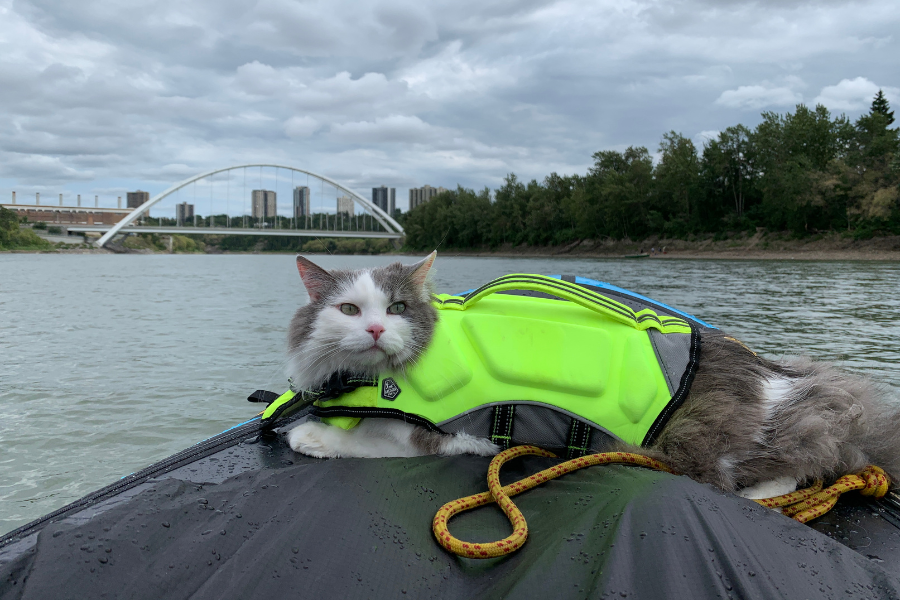
cat, gary the cat, water, outdoors, nature
Gary the Cat enjoysu00a0some paddling. Photo credit: James Eastham

When did you first notice that Gary had a proclivity for the outdoors? Was he trying to dart out the door at home?

Yeah! We were living in an apartment at the time. Our front door opened into a courtyard area, and the door didn’t latch very well, so if you didn’t lock it, it would just blow open sometimes. Occasionally we would find the door open and Gary out in the courtyard eating the plants in the planters. We decided if he wanted to go outside, he was going to have to walk on a leash. The apartment was close to major roads and a big urban park where there’s lots of coyotes, so we were like, “Not sure it’s great to have you roaming around free.” We started taking him out in the courtyard on a leash, and shortly after that is when we moved to Canmore full time. My partner had gotten a job in the mountains, and I was looking for work. As a break from doing job applications, we’d just sit on the front porch together and have coffee, and that was about when I started Gary’s Instagram account. I work in communications, so it was a bit of a jokey way to say I was “keeping up on social media trends” by posting photos of my cat on the Internet. It turned into something more than I was expected it was going to.

I don’t think there’s anything more universally beloved than cats on the Internet.

Well, exactly! [Laughs.]

I’m curious about the training piece of this. How organic was it? Would you go on a short hike and then gradually increase the distance?

I’m not sure there was ever a deliberate process. We started sitting on the front step together, and he’d look at the birds and sniff at the breeze while I’d drink my coffee. As he got confident sitting on the step, he started to explore the front yard. At the time we were across the street from this natural wooded area with some walking trails, so I was like, “We’re exploring the yard—why not walk through some of these trails?” We worked up from there. Getting Gary comfortable in the car was a big part of it as well. Gary didn’t like the car—that was almost the biggest hurdle. He was fine inside. We would drive to the end of our street, maybe 300 meters, get out and go for a walk in this wooded area, drive back, and that was how we got him introduced to the car. As he got more comfortable being outside, we thought we could introduce things slowly. We got him a little backpack carrier and got him used to that, and we tried a short hike with him. Whenever we introduce something new to Gary, we try to do it in a low-commitment way so that if he’s not having a good time, we can leave. We find a short hike kind of close to us and gave that a go, and it went OK, so we started bringing him on more hikes that summer.

Has he always been comfortable with water?

Gary’s always liked water—he’ll jump in the shower, and he’s OK if you have to give him a bath. We decided to try paddling with him. There’s a little lake about a two-minute drive from home, so we put him on the paddle board, and he was floating along in the water and enjoying the sun. Skiing was actually an accident, which sounds funny to say—how do you actually go skiing with your cat? [Laughs.] We’d been kind of snowed into the house one year around Christmas, and it was a nice day. Gary was sitting at the door, screaming because he wanted to go outside. I figured the easiest way for us to get around is if I were on skis. We were going for a little walk, enjoying the fresh snow, and as we were coming home, there was a little hill, and I thought, “When am I ever going to get the opportunity to ski with my cat again?” At that point he was very comfortable riding on my shoulders, so I ripped the skins off the skis and did two short little laps with Gary on this tiny hill and confused the heck out of some guy who was walking past at the time. [Laughs.]

I figured that would kinda be the end of it, but there’s a cat skiing place by where we lived. They invited us to go out, which was kind of amazing. I used to work as a ski patroller, and the resort I worked at was lookin for social media partners, so I sent some of the people I used to work with an email, like, “Hey, I have this cat. Why don’t you let me bring my cat to the ski hill?” [Laughs.] We had a chat, like, “What? What do you want to do?” We figured out how to make it work. That’s how that all started.

Gary seems to be having the time of his life, but you’re in this unique situation of toting around an Internet celebrity all the time. Has it been mostly fun? Is it ever annoying? Are you ever surprised at the reactions?

Yeah, I think it’s mostly fun—that’s why I keep doing it. It’s at times quite surreal. One of our longer-term partnerships is with the local [Alberta Jeep Dealers], who gave Gary a Jeep for two years. Signing a lease for my cat…for a car…was definitely a top 10 most surreal moment of my life. [Laughs.] It’s great. I love the photos. It’s a great partnership, and it fits super well with the content we have, and we’ve been able to go to a bunch of new places because of it. But it’s also like, “What?” It’s nice that people enjoy our content. So much of social media these days is polarizing and rage-bait and whatever else, so it’s nice to just have something fun to bring some smiles to people and enjoy social media rather than just getting angry when you read it.

Do you get that kind of feedback a lot?

Yeah, we get a lot of nice messages from people, telling us how they’ve enjoyed our content—it was something they [could use to] bond with their parent during health challenges or maybe their own health challenges or depression, that it was nice to have something lighthearted that they can escape with a little bit. It’s also super lovely to hear how we’ve inspired people to take their own cats out or think differently about what you can do with a cat. I don’t think all cats or all people should go skiing, but you can still take your cat out for a short walk as a way to bond with your cat or give them a bit of enrichment.

What’s your long-term vision for the account?

I feel like I’ve achieved everything I set out to. [Laughs.] We’re having fun with it, so I think we’re just gonna keep trucking along the way we have been. Part of why I’ve kept my job and not gone full-time into social media is that it allows us to be pickier about what partnerships we do choose so that it’s brands we do support or things we want to actually do. There was one opportunity that I would have loved to take but couldn’t figure out a way to do it in a way that was reasonable for Gary—we got invited to go skiing in Turkey. I’ve wanted to go to Turkey for a long time. But Gary’s never flown before, so it didn’t seem entirely reasonable that we’d just toss him on a plane for…I don’t even know how long that would be. We did decline that one, unfortunately, but I would have loved to have made it work. We’ll see what comes along. I wasn’t expecting that we’d have a partnership with Jeep, and you never know what the future holds.

One final burning question: Does Gary have a favorite treat? My little Tony loves his Temptations.

Gary loves Temptations. The treat he gets the most is Greenies, but probably his favorite thing in the world is bacon and ham. He likes beef and fish. He quite likes lobster and crab. Chicken is like, “Eh, take it or leave it.” Some days, you give him chicken and he’s like, “Do better. Not good enough.”


cats, animals, interview, animals, cat parents
James and Gary chat with Ryan Reed and Tony Photo credit: Ryan Reed
  • Air Force graduate tears up when friend steps in to ‘tap him out’ during graduation
    Photo credit: CanvaA lone soldier and friends celebrating.

    Sometimes the biggest moments in our lives might slip by unnoticed. That’s exactly what was happening to Airman Joel Usher. At his United States Air Force graduation ceremony, he stood alone, already knowing that no family members were coming to celebrate the occasion.

    Many people know what it feels like to hit a major milestone and wish someone were there. Usher was visibly emotional as fellow graduates reunited with cheering family members. Suddenly, a friend he made during training stepped forward. Phone in hand, recording the moment, he walked up to “tap him out.”

    @slimgudda305

    1 year ago today. it’s been a journey man still can’t believe i’ve made it this far but is only the beginning more blessing to come💫#fypシ #militarytapout #explorepage

    ♬ Gods creation – daniel.mp3

    A teary-eyed moment defined by friendship

    Caught completely off guard, a teary-eyed Usher smiles, turning what could have been a lonely memory into one defined by friendship. He posted the video on TikTok with a title overlay reading, “i had no one at my graduation to tap me out but that one good friend i met during training found me and come through for me…”

    At military graduations, there’s a tradition known as “tapping out.” Family members or close supporters step forward at the end of the ceremony to officially greet and escort the graduates away. According to the AF WingMoms, it can be an emotional experience, but the Air Force views its military purpose as a productive way to maintain orderly disbursement.

    An overwhelming gesture

    In an exclusive interview with People, Usher described how important that kind act was, leaving him holding back tears:

    “When my friend tapped me out, I was overwhelmed in the best way possible. It wasn’t just about finishing, it was about having someone there who truly had my back in that moment.”

    Usher went on to explain that the achievement was important, but the friendship and support shown to him are what he remembers most. After sharing the moment online, he was surprised by all the feedback. He believes the overwhelming response was a strong reminder of the beauty behind meaningful acts of kindness.

    airman graduation, military support, chosen family, military friendship, tapping out, tap him out
    Best friends take a group selfie.
    Photo credit: Canva

    TikTok post resonates

    After 4.6 million views, people flooded the comments with emotional reactions. For some, the small gesture perfectly captured the kind of bond people form while going through difficult experiences together. This wasn’t a performative moment—just someone refusing to let another person experience an important occasion alone.

    For others, it was heartbreaking. Often, soldiers don’t have family members who are able to make the trip, or they find themselves on a solitary journey. Either way, the idea that people can accomplish something amazing and still be left to stand alone afterward can be difficult to swallow.

    Here are some of the comments:

    “i’m glad you made a good friend along the way who came looking for ya. those are the meaningful connections you make while in the military”

    “now this just broke my heart”

    “Those teary eyes”

    “This just breaks my heart! Everyone should have someone tap them out. So much respect for the military”

    “The pain in bros eyes. Went to my soul. Brother we are here for u! Ty for serving”

    “sometimes thats all we need! Just one good friend”

    “I’m so sorry no one from your bloodline was there for you in that moment but you have all of TikTok cheering you on and we are so proud of your accomplishments”

    “Ex military that tap means more than you think.”

    “i really wish they had a volunteer program for something like this… let other mamas and dads come and be there for these young men and women.. we never know how bad they just need SOMEONE to be there for them”

    “Been there my man. But you’re going to be an amazing soldier. Use that to be the best you can be”

    The mix of responses shows why meaningful moments shouldn’t be faced alone. Friendship and community are defined by simple choices: stepping in, showing up, and refusing to let a proud day also become someone’s loneliest. These small acts turn milestone accomplishments into memories carried forward with a tearful, joyful smile.

  • 59% of Americans worry about sunscreen chemicals. Only 32% understand how sunscreen works.
    Two persons applying sunscreen while sitting on a beach.

    Tiffany Miller for Melanoma Research Alliance

    Many Americans think of sunscreen at the beach. Fewer consider wearing it for the drive there. And many are questioning if they should wear sunscreen at all.

    These trends, uncovered in a new national survey from the nonprofit Melanoma Research Alliance (MRA), highlight a central challenge in skin cancer prevention.

    Skin cancer is the most common form of cancer in the United States, according to the CDC. Nine in 10 skin cancers, including melanoma, are linked to exposure to ultraviolet (UV) radiation, according to the MRA. Reducing exposure to UV radiation lowers the risk of skin cancer, making sunscreen a key part of prevention.

    A survey of 2,000 adults found that most Americans have a basic understanding of the risks of sun exposure, but that awareness doesn’t always translate into action. More than 8 in 10 recognize that spending long hours in the sun contributes to melanoma risk, yet roughly one-quarter say they rarely or never use sunscreen when spending time outdoors.

    Then there are those everyday moments that most people don’t recognize as risky. The light coming through the window over the sink. The short walk from the parking lot. The hour in the bleachers with the sun hitting one side of your face. A single sunburn can be dangerous, but it’s the accumulation of exposure over time that often drives risk.

    Sunscreen is widely recognized as an effective tool for skin cancer prevention, yet confusion and misinformation persist, especially on social media. Fifty-three percent of respondents say they have seen claims that sunscreen ingredients may be harmful. Fifty-nine percent say they are concerned about what’s in sunscreen, and 38% don’t believe sunscreen is safe and effective.

    An infographic on Melanoma Research Alliance's surveys on sunscreen facts and usage.

    Many Americans also say they aren’t sure how sunscreen works. Only about a third can correctly explain the difference between types of sunscreens, while a much larger share reports being unsure.

    Sunscreen works by absorbing or blocking UV radiation from reaching the skin, preventing DNA damage that can cause skin cancer. In the United States, the active ingredients in sunscreen undergo rigorous review by the Food and Drug Administration, which evaluates them as over-the-counter drugs. This drug-level standard requires extensive testing and contributes to a more limited set of approved UV filters compared with Europe, where sunscreens are regulated as cosmetics. The FDA is currently evaluating additional methodologies for assessing sunscreen ingredients, a process that could expand the number of approved UV filters available to U.S. consumers.

    All of this is unfolding during a period of real progress in melanoma research. While melanoma remains the deadliest form of skin cancer, more than 8,500 Americans are expected to die from it in 2026, roughly one person every hour, according to the American Cancer Society. Recent advances are improving outcomes for many patients with advanced disease, though approximately 50% of patients do not respond to current treatments, according to MRA, underscoring why prevention and early detection remain critical.

    Survey methodology: The Melanoma Research Alliance commissioned Atomik Research to conduct an online survey of 2,000 U.S. adults between March 27 and April 1, 2026. The sample is nationally representative based on gender, age, and geography. Margin of error: ±2 percentage points at a 95% confidence level. Atomik Research, part of 4media group, is a creative market research agency.

    This story was produced by Melanoma Research Alliance and reviewed and distributed by Stacker.

  • The salary you need to live comfortably in 100 US cities
    A view of the San Antonio River walkway in San Antonio, Texas.
    ,

    The salary you need to live comfortably in 100 US cities

    Big-city comfort comes with a six-figure price tag.

    Jaclyn DeJohn, CFP for SmartAsset

    To truly understand the context of a household’s income, it must be compared to local costs and long-term goals, which both may fluctuate over time. For most people, the same pillars will make up the biggest nonnegotiables in their budget. These include basic necessities like housing, groceries, utilities, and transportation, and likely some discretionary spending on hobbies, activities, and other enrichment. In an attempt to secure this lifestyle for the future, many households aim to save some of their income for emergencies, investments, retirement, education, and other long-term goals. A common budgeting technique that encapsulates these three pillars is called the 50/30/20 rule: 50% of your post-tax income goes to needs, 30% to your wants, and 20% gets set aside for the future.

    With this in mind, SmartAsset assessed the salary needed to reach this 50/30/20 ideal — designated as a comfortable salary — based on the local costs in 100 of the largest U.S. cities.

    Key Findings

    • A single adult needs to earn $150,000 to live comfortably in these places. New York has the highest individual salary needed to live comfortably at $158,954. San Jose, California, follows closely at $158,080. Orange County cities Irvine, Anaheim, and Santa Ana require an estimated $151,965 in income for a single adult.
    • These cities have the lowest salary needed to live comfortably. San Antonio has the lowest salary threshold for both single adults and families of four at $83,242 and $192,608, respectively. New Orleans has the second-lowest salary needed for a single adult to live comfortably at $84,406, followed by Memphis, Tennessee, at $86,320.
    • The Bay Area is the most expensive place for a family to live comfortably. Bay Area cities make up the top four of the five places with the highest salary needed for a family of four to live comfortably. Incomes across two parents are projected at $407,597 in San Francisco, $402,771 in San Jose, and $371,488 in both Fremont and Oakland. Boston rounds out the top five at $368,742.
    • Families in these Texas cities are closest to a comfortable salary. In Frisco, the median household earns $145,444 — substantially higher than the national median of $83,730. This figure also accounts for 63.1% of the $230,464 income a family of four in Frisco needs to live comfortably. In McKinney, the $124,177 median household income accounts for 53.9% of the $230,464 needed.
    Table listing the top cities by the lowest annual salary needed for a single adult to live in sustainable comfort using the 50/30/20 budgeting rule.

    10 Cities With the Highest Salary Needed to Live Comfortably

    1. New York, New York

    • Salary needed for a single adult: $158,954
    • Salary needed for a working family of four: $337,875
    • Median household income: $81,228

    2. San Jose, California

    • Salary needed for a single adult: $158,080
    • Salary needed for a working family of four: $402,771
    • Median household income: $148,226

    3. (tie) Irvine, California

    • Salary needed for a single adult: $151,965
    • Salary needed for a working family of four: $327,226
    • Median household income: $145,731

    3. (tie) Anaheim, California

    • Salary needed for a single adult: $151,965
    • Salary needed for a working family of four: $327,226
    • Median household income: $101,145

    3. (tie) Santa Ana, California

    • Salary needed for a single adult: $151,965
    • Salary needed for a working family of four: $327,226
    • Median household income: $95,118

    6. Boston, Massachusetts

    • Salary needed for a single adult: $139,776
    • Salary needed for a working family of four: $368,742
    • Median household income: $97,791

    7. (tie) San Diego, California

    • Salary needed for a single adult: $136,781
    • Salary needed for a working family of four: $312,915
    • Median household income: $111,032

    7. (tie) Chula Vista, California

    • Salary needed for a single adult: $136,781
    • Salary needed for a working family of four: $312,915
    • Median household income: $105,101

    9. San Francisco, California

    • Salary needed for a single adult: $134,950
    • Salary needed for a working family of four: $407,597
    • Median household income: $139,801

    10. (tie) Fremont, California

    • Salary needed for a single adult: $134,410
    • Salary needed for a working family of four: $371,488
    • Median household income: $175,816

    10. (tie) Oakland, California

    • Salary needed for a single adult: $134,410
    • Salary needed for a working family of four: $371,488
    • Median household income: $102,235

    10 Cities With the Lowest Salary Needed to Live Comfortably

    1. San Antonio, Texas
    • Salary needed for a single adult: $83,242
    • Salary needed for a working family of four: $192,608
    • Median household income: $66,176
    1. New Orleans, Louisiana
    • Salary needed for a single adult: $84,406
    • Salary needed for a working family of four: $197,766
    • Median household income: $58,821
    1. Memphis, Tennessee
    • Salary needed for a single adult: $86,320
    • Salary needed for a working family of four: $193,939
    • Median household income: $52,679
    1. Oklahoma City, Oklahoma
    • Salary needed for a single adult: $86,861
    • Salary needed for a working family of four: $213,325
    • Median household income: $70,040
    1. Baltimore, Maryland
    • Salary needed for a single adult: $87,485
    • Salary needed for a working family of four: $224,224
    • Median household income: $64,778
    1. Louisville, Kentucky
    • Salary needed for a single adult: $88,234
    • Salary needed for a working family of four: $212,742
    • Median household income: $67,251
    1. Tulsa, Oklahoma
    • Salary needed for a single adult: $88,317
    • Salary needed for a working family of four: $215,238
    • Median household income: $60,930
    1. Winston-Salem, North Carolina
    • Salary needed for a single adult: $88,442
    • Salary needed for a working family of four: $205,421
    • Median household income: $57,758
    1. Tucson, Arizona
    • Salary needed for a single adult: $88,899
    • Salary needed for a working family of four: $218,400
    • Median household income: $60,483
    1. Fort Wayne, Indiana
    • Salary needed for a single adult: $88,982
    • Salary needed for a working family of four: $233,126
    • Median household income: $61,436

    Data and Methodology

    SmartAsset used MIT Living Wage Calculator data to gather the basic cost of living for an individual with no children and for two working adults with two children. Data includes the cost of necessities, including housing, food, transportation, and income taxes. It was last updated to reflect the most recent data available on Feb. 15, 2026.

    Applying these costs to the 50/30/20 budget for 100 of the largest U.S. cities, MIT’s living wage is assumed to cover needs (i.e., 50% of one’s budget). From there, the total annual wage was extrapolated for individuals and families to spend 30% of the total on wants and 20% on savings or debt payments. Median household income data for cities comes from the U.S. Census Bureau’s 1 Year American Community Survey for 2024.

    This story was produced by SmartAsset and reviewed and distributed by Stacker.

Explore More Stories

Well-being

You know exercise is good for you – so why is it so hard to put it into practice?

Society

Foreign aid’s hidden benefit: Recipients are more likely to pay the generosity forward

Health

Photographic memory is a myth – here’s what research really says about remembering

Well-being

How workplace stress hijacks the nervous system to cause headaches − and a neurologist’s guide to managing them