
Mystery lurks everywhere. Like an undersea treasure box, it lurches in every object, whispering sweet nothings in spaces long abandoned. From closed attics to vintage journals, mystery hangs in everything. At least, this is what Mr. Jimmie Smith would think, from now on, each time he looks at anything. He found this mystery and hit the jackpot, literally, in one of the shirts hanging in his closet. And this mystery turned out to be a 24-million-dollar winning lottery ticket, according to NJ.com

Representative Image Source: Pexels | Pixabay

A retired security guard by profession, and a father of two, the 68-year-old Jimmie went through his closet after he heard an announcement on television that this particular lottery ticket hadn’t found its prize winner yet. Jimmie, who had been an avid buyer and collector of lottery tickets, gave it a thought to do a quick check inside his closet. And there he found it, the ticket to his jackpot, lying among stacks of booklets and piles of crisp tickets.

Jimmie couldn’t believe his luck, especially considering it was tucked away in his closet. “I ended up with a stack – a pile of tickets, including the one they were talking about on the news,” he told lottery officials. He also said that he’s been buying tickets in New Jersey and New York since the 1960s, but has never been in a rush to see if he’s the winner of some prize. This time, he checked the numbers and stood stunned. He wasn’t sure he could believe it as he sat there gazing at the piece that had brought golden fortune to him, “I stood there for a minute thinking, ‘Do I see what I think I see?’” he told NJ.com. “I had to stick my head out the window and breathe some fresh air. I was in serious doubt. I really had to convince myself this was real.” But it was real indeed.

Representative Image Source: Pexels | Pixabay

On the other side of it, Gweneth Dean, director of the New York Gaming Commission’s Division of the Lottery, said, “A lucky New Yorker has a $24 million Lotto payday just waiting — but the winner has to act fast as time is running out. We urge New York Lottery players: Check your pockets. Check your glove box. Look under the couch cushions. If you have this winning ticket, we look forward to meeting you,” according to The Washington Post.

Representative Image Source: Pexels | markus winkler

On May 25, 2016, Jimmie, a resident of East Orange, New Jersey, won $24.1 million from the New York Lottery. The winning numbers were 5, 12, 13, 22, 25 and 35. Jimmie had earlier bought the ticket at a grocery and tobacco shop at 158 Church Street in the Tribecca neighborhood in Lower Manhattan, according to NJ.com. “I always told myself, ‘I’ll check them when I have the time,’” he said. However, post this prize-winning and claiming himself as the owner of the winning ticket, Jimmie suddenly disappeared. He reappeared five months later only to complete the required paperwork and disappear again, as reported by The Washington Post. He chose to receive his $24 million in installments over 26 years, according to the commission.

This article originally appeared last year.

  • Bank of America foreclosed on a couple’s home by mistake. So they got a court order and showed up to foreclose on the bank.
    Photo credit: CanvaThe exterior of a bank and a happy couple reading a document.
    ,

    Bank of America foreclosed on a couple’s home by mistake. So they got a court order and showed up to foreclose on the bank.

    When the bank ignored them for months, the couple got a court order and showed up with a moving truck to take the bank’s furniture instead.

    Warren and Maureen Nyerges bought their home in Naples, Florida, in 2009. They paid cash. No mortgage, no bank involved, nothing. Bank of America foreclosed on it anyway.

    The bank had confused them with the previous owner, who actually did have an outstanding loan. A quick check of their own records would have cleared this up. According to the Nyerges’ attorney Todd Allen, it would have taken about 15 minutes. Nobody checked. The foreclosure went through.

    Warren called branch managers. He wrote certified letters to the bank’s president. Nothing came back. He eventually hired Allen, who got the foreclosure reversed within two months. The court also agreed that Bank of America should pay Warren’s legal fees of about $2,500. The bank was notified. Five months went by. No payment.

    At that point, reports ABC News, Warren went back to court and obtained a writ of execution: a court order giving him the legal authority to seize Bank of America’s assets to satisfy the debt. On June 3, 2011, he showed up at the local branch with two sheriff’s deputies and a moving truck.

    The deputies delivered the message to the branch manager: pay the $2,500, or they start loading furniture. After a call to superiors, the bank produced a check. They misspelled Warren’s name on it.

    Attorney Allen noted that Bank of America apologized for the payment delay but never for the wrongful foreclosure itself. A spokesperson eventually issued a statement: “We’re truly sorry for the series of unfortunate circumstances that Mr. Nyerges experienced.”

    The moving truck left empty. The deputies left with a check. Warren and Maureen still own their home.

  • A millionaire swapped lives with a struggling family for a week on a $230 budget. The money wasn’t what broke him.
    Photo credit: CanvaDepressed man looks at his laptop.

    Matt Fiddes runs a multi-million dollar martial arts franchise in Britain. His family’s weekly budget runs around $2,058. He’d never really looked at a price tag before buying something.

    For a social experiment documented by the YouTube channel Only Human, the Fiddes family swapped lives with the Leamons (Andy, Kim, their two kids, and two dogs) who get by on $230 a week. Kim had a life-saving surgery after an accident and now lives with Chronic Regional Pain Syndrome. They lost their savings. Andy works alone to support the family.

    On day one of the swap, Matt learned his weekly budget was $230. “That basically fills up the fuel tank of my car,” he said.

    wealth inequality, poverty, social experiment, class, viral video
    A man calculating his budget on his laptop. Photo credit: Canva

    What followed was a week of grocery bills he had to think about, a neighborhood with nothing much in it, and night shifts, something he’d never worked in his life. His wife Moniqe cried when she heard about Kim’s condition from the Leamons’ friends.

    By the end of the week, Matt had something to say that was harder to shrug off than the budget: “I feel guilty; no one should live like this.”

    He also said the week brought his family closer together. The Fiddes left a gift behind for the Leamons when they returned home: a mobility scooter for Kim, so she could get around on her own.

    The Leamons, meanwhile, spent the week in the Fiddes’ house taking their kids to a theme park and doing a little shopping experiencing, briefly, what it feels like when money isn’t a constant calculation.

    One YouTube commenter put it plainly: “I feel this was a much-needed vacation for the poor family and a grounding experience for the rich family.” That’s about right.

    You can watch the full documentary here:

  • Gen Z was asked if $75,000 a year counts as poor. Their answers say a lot about America right now.
    Photo credit: CanvaA woman comforts her friend.
    ,

    Gen Z was asked if $75,000 a year counts as poor. Their answers say a lot about America right now.

    “$75k is a fantasy amount of money to me. I can’t even imagine what it’s like to make that much.”

    Someone on social media posed a simple question to Gen Z: do you consider $75,000 a year to be poor? The answers that came back weren’t simple at all and, taken together, they’re a pretty honest portrait of what it costs to exist in America right now.

    The question came from u/NoHousing11 on r/GenZ, along with a screenshot of an X post that had already made the rounds. In it, an MSNBC commentator suggested that young people fresh out of college, earning $75k or $80k, would naturally be drawn to policies like student loan forgiveness and free healthcare. Another commenter fired back at the framing: “Imagine being so rich that $75k is what you think poor people earn.” Then the kicker: “$75k is a fantasy amount of money to me. I can’t even imagine what it’s like to make that much money a year.”

    That response alone split the thread.

    Some Gen Zers pushed back pointing out that $75k in NYC with a roommate and no car is actually workable if you’re disciplined about it. “There are people making $20 or even less living in Manhattan,” one commenter noted. The city, for all its expense, at least gives you options for getting by without a car, which in a lot of American suburbs isn’t remotely possible. Another commenter made the sharper point: people who claim to live paycheck to paycheck on $100k in NYC are usually doing it because they’re trying to keep up with wealthier friends enjoying dinners out, Broadway shows, and cabs everywhere.

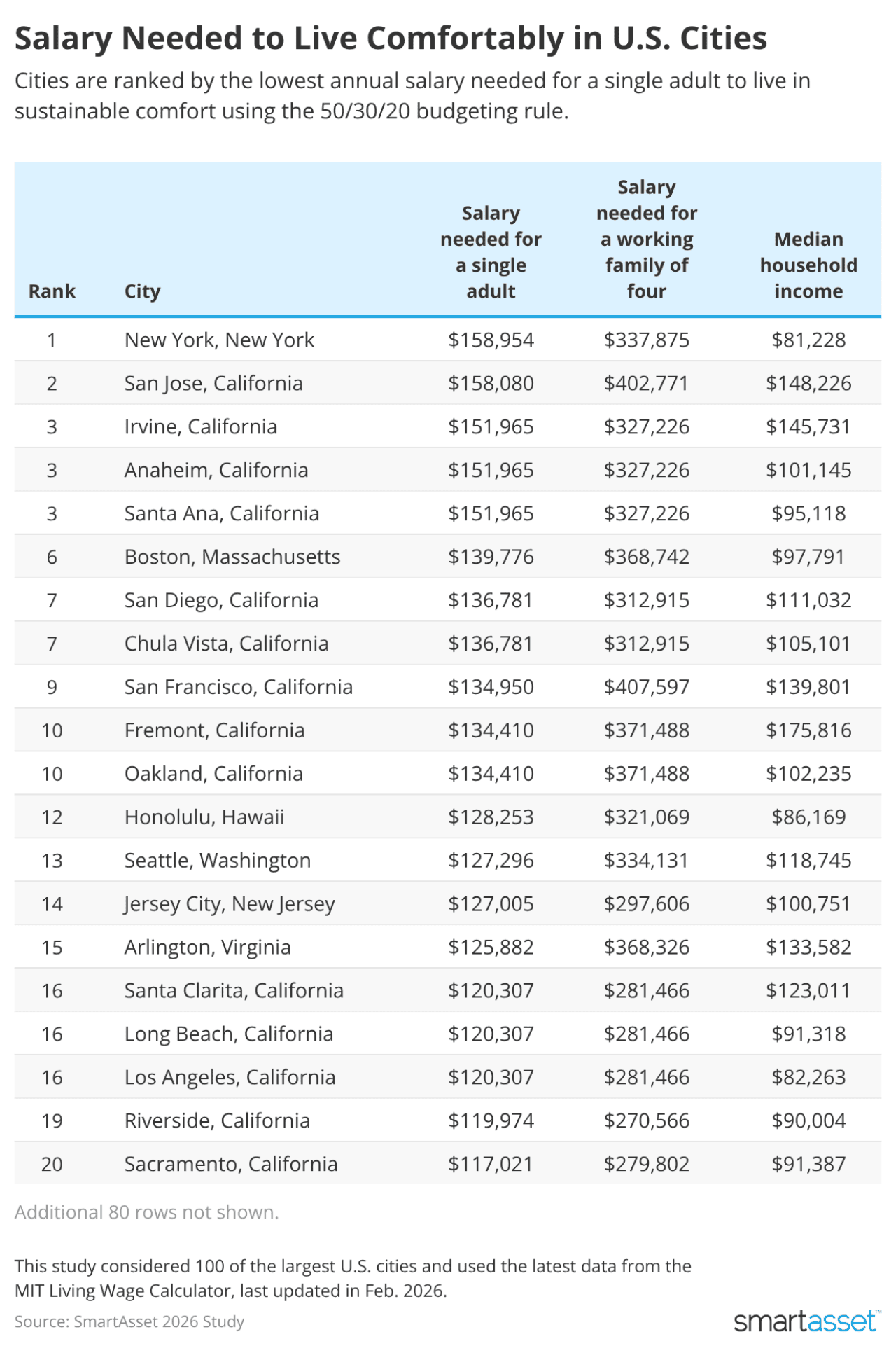
    But others had a different read entirely. In some high cost-of-living areas, a single person earning less than $80k is already classified as low income by local standards. “If you live in an HCOL area and have to pay every single one of your bills,” one commenter wrote, “then yes, you might be considered struggling.”

    The geographic reality of American wages is the whole story here. “Depends on the area. NYC? Yes. Nebraska? No.” That two-sentence comment got a lot of upvotes because it’s basically correct, and also kind of depressing that it needs to be said at all. The number that represents a comfortable life in one zip code represents genuine hardship in another, and the policies, conversations, and assumptions that get built around a single national salary figure tend to miss that entirely.

    What the thread really exposed wasn’t a generation with distorted expectations. It was a country where “how much is enough” doesn’t have a single answer anymore.

Explore More Money Stories

Money

Bank of America foreclosed on a couple’s home by mistake. So they got a court order and showed up to foreclose on the bank.

Money

A millionaire swapped lives with a struggling family for a week on a $230 budget. The money wasn’t what broke him.

Money

Gen Z was asked if $75,000 a year counts as poor. Their answers say a lot about America right now.

Everyday Economics

Illustrator says the best way to stay motivated when learning a new hobby is to spend money