Among the passengers crammed into the rattling white van traversing Lebanon’s northern edge were a pair of young Syrian refugees.

As the van slowed to a stop at the first of several Army checkpoints along the route, the Syrians tensed, waiting to see if the soldier on duty would wave them through, as he had with the line of cars before. But this time, the soldier told the driver to stop. He walked around to the passenger door and asked the question the men had been fearing: “Where’s your identification?”


[quote position=”left” is_quote=”true”]I thought before that the most difficult part would be to live in a tent, to have a different routine. I was completely wrong.[/quote]

The younger of the Syrians didn’t have legal residency papers. A month earlier, he had fled Syria, where he had been tortured and castrated. He was en route to Beirut to file a report with a human rights group when the van was stopped. Now he could be arrested for his lack of legal status.

The Syrians were accompanied by a pair of Italian volunteers, who flashed their own passports and began to explain the situation.

In the past, they had often found that the sight of a European passport was enough to persuade soldiers to let undocumented refugees go. But this time, their presence and the explanation failed to move the soldier, who escorted the younger Syrian man into the station. The Italians persisted. Finally, the Italians managed to get permission to enter the station and talk to the commander.

It’s made possible by Operazione Colomba—“Operation Dove” in English—an Italian organization formed by Catholic activists that sends volunteers to live in conflict zones around the world. The group believes that the presence of foreigners from a European country can help protect people who might otherwise be targeted for attacks. In other cases, volunteers can serve as mediators between opposing sides.

The project launched in 1992 during the Balkans conflict and now operates in Colombia, Palestine, Albania, and here in Lebanon, just across the border from Syria. Although spillover of the fighting next door has been limited, Lebanon is hosting an estimated 1.5 million Syrian refugees, inflaming an already tense political environment in a small country still healing from its own 15-year civil war.

When the Italian volunteers arrived in Lebanon three years ago and asked the residents of one of the many informal refugee camps if they could set up a tent and live with them, the refugees said no, said Alberto Capannini, one of the group’s founders who now oversees its operations in Lebanon. “We asked why. They said because it’s not possible to live like this,” he said. “They meant it’s not human—we are not human, and you are from Europe, so you are very important. We decided to stay there because the only way to tell someone you are a man is not to say it, but to stay with them.”

Later, the volunteers moved to another camp nearby, where some of the refugees had received death threats—likely from Lebanese locals, Capannini believes—and were in a state of high anxiety. A rotating group of volunteers have been living in this camp of some 20 families in the village of Tel Abbas, some five kilometers from the Syrian border, for the past three years.

As the Muslim holy month of Ramadan began in late May, the volunteers were wrestling with a particularly knotty situation. A few weeks earlier, they had been approached by the family of a 13-year-old Syrian boy with aplastic anemia, a rare and dangerous disease in which the bone marrow stops producing enough blood cells. The boy needed a bone marrow transplant, an expensive and risky operation. Capannini and other volunteers were scrambling to arrange visas and raise funds for the boy and two family members to travel to Italy for the operation and to manage his care in Lebanon in the meantime.

The day before the start of Ramadan, they had an appointment with the Italian embassy to bring the boy there to have his fingerprints taken—but he was in the hospital, which initially refused to let him go because the bill had not been paid. After negotiating his release and traveling to the embassy, the volunteers then had to scramble to get $1,700 in cash to pay for medication the boy needed immediately. Eventually, they were able to get the boy and two of his brothers to Italy, where he is now awaiting the operation.

This case is an exception, Capannini said—in general, Operazione Colomba does not provide material aid directly to the refugees, instead acting as a liaison with the United Nations and other organizations. Much of their day-to-day work relies on nothing more than the power of having a European passport. Because of the complicated and expensive requirements to maintain legal residency status in Lebanon, most of the Syrian refugees are not legally authorized to live or work in the country. With a network of Army checkpoints dotting roads throughout the country, any travel outside the confines of the camp means risking arrest and spending time in Lebanese jail.

[quote position=”full” is_quote=”true”]The Syrians have an incredible possibility to be invisible to the Lebanese. When we come, they are visible.[/quote]

The Italians accompany the refugees on trips to the doctor, to U.N. offices, and on other errands. Often, simply the presence of a European is enough to prevent a soldier from taking an undocumented Syrian into custody. Other times, the Italians’ presence can encourage medical workers and bureaucrats to pay attention to refugees whose cases they might otherwise brush off. “The Syrians have an incredible possibility to be invisible to the Lebanese,” Capannini said. “When we come, they are visible.”

Over the past year and a half, the organization has also served a second purpose: as a conduit for some refugees to travel from Lebanon to resettlement in Italy. In 2016, church-affiliated organizations in conjunction with the Italian government launched the humanitarian corridors program, under which a total of 1,000 refugees will travel from Lebanon and Morocco to Italy. The Operazione Colomba volunteers worked with the program, referring families for resettlement.

[quote position=”left” is_quote=”true”]I thought before that the most difficult part would be to live in a tent, to have a different routine. I was completely wrong.[/quote]

The family of Ahmed al-Khalid was one of those. Al-Khalid, from Homs, had been imprisoned by the Syrian regime for a year, he said. Upon his release, he and his family fled to Lebanon, where they lived in refugee camps for more than three years. Al-Khalid spent many nights sharing tea and meals with the Italian volunteers in the Tel Abbas camp. Even when the volunteers arrived speaking little or no Arabic, al-Khalid said, “they understood us a bit, and we understood them a bit.”

In February, al-Khalid, his wife, and their three young children traveled to Italy via the humanitarian corridor and settled in a village near the northern city of Rimini.

Their tent has been replaced by a house with three bedrooms. Al-Khalid and his wife are studying Italian, and the older children are enrolled in school. Former Operazione Colomba volunteers have made trips to see them. Al-Khalid stops by the organization’s office in Rimini almost every week, sometimes to attend meetings, sometimes just to visit.

“The Italians were very, very good with us,” he said in a telephone interview. “They helped us with the hospital, with the army, with the U.N. Many times they went with us to the doctor, with the children to the doctor.” Most importantly, he said, “Without them, we couldn’t have come to Italy.”

  • A bonobo’s make-believe tea party has scientists rethinking whether imagination belongs only to humans
    Photo credit: CanvaAn adorable baby bonobo.

    Childhood activities like playing house, superheroes and villains, the floor is lava, and the classic tea party all involve imagination. We create stories and worlds with rules and roles to play.

    Humans want to believe that our creativity and art make us unique. But a bonobo named Kanzi was part of research that has scientists wondering how different we really are. In three evolving experiments, Kanzi correctly identified pretend objects, demonstrating that he could understand and engage in make-believe situations.

    primate research, behavior, bonobo study
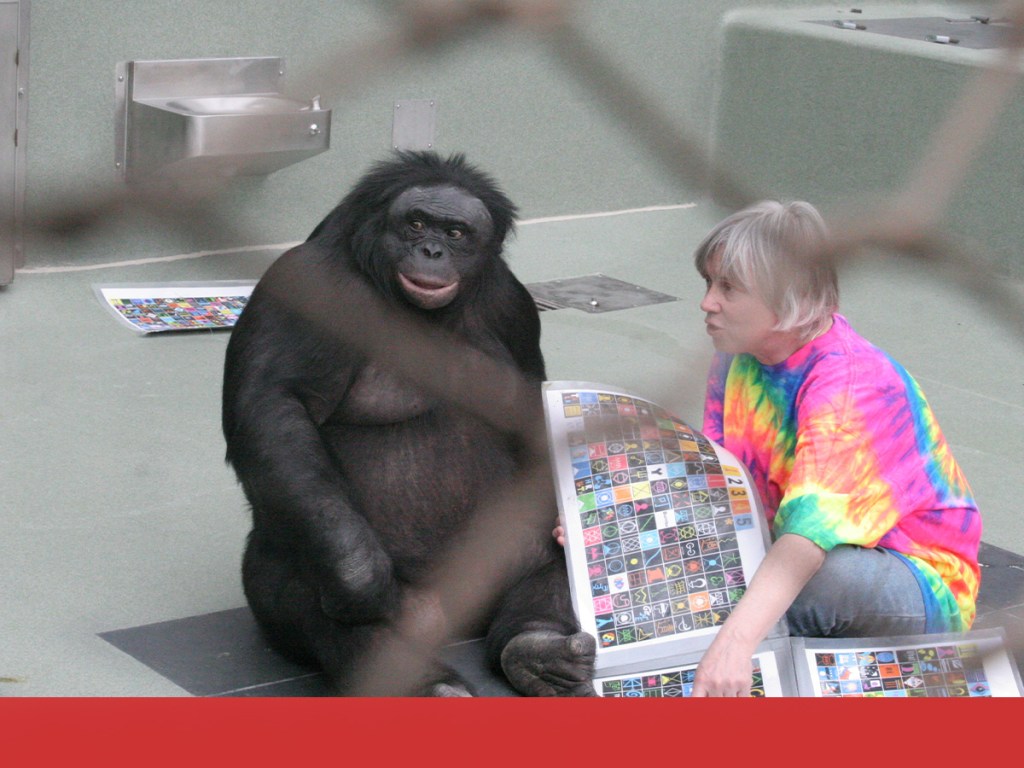
    Kanzi associates words and symbols with Sue Savage-Rumbaugh.
    Photo by William H. Calvin, Phd/ Wikimedia Commons (Cropped)

    Kanzi has a make-believe tea party

    Researchers developed a simple setup using cups, a pitcher, and actions that began as real pouring and gradually shifted into pretend play. The first experiment used real liquids. The second had a combination of real and pretend liquids. The final scenario had no real liquids and relied entirely on imagination.

    The scientists used gestures and make-believe to see if Kanzi would react differently depending on what he was being shown. He didn’t react the same way in each setup. His responses showed he was paying attention to more than just the objects, but also to the way the situation was presented.

    bonobo play, animal imagination, Kanzi bonobo, apes
    Kanzi participates in an indoor test.
    Photo by William H. Calvin, Phd/ Wikimedia Commons (Cropped)

    Animals engaging in fantasy

    The experiment revealed that non-human animals can understand and follow along with imaginary situations.

    “[It] shows that animals are capable of understanding pretence in a controlled experimental setting, which hadn’t been done before,” Dr. Amalia Bastos, first author of the research from the University of St Andrews, told The Guardian.

    Scientists involved in the research are careful about how they describe it. They don’t treat it as proof that bonobos imagine things the same way humans do. Instead, they suggest that animals are capable of responding to situations where meaning is implied rather than directly shown.

    Why scientists care about pretend play

    Albert Einstein, one of the greatest scientific minds in history, is often credited with the idea that logic gets you from A to B, but imagination can take you everywhere. This study suggests that the more we learn about animals, the more it seems the difference between us may not be as great as we once thought.

    Developmental research credits early social and cognitive growth in human children to imagining situations that aren’t physically present. A 2024 meta-analysis found that make-believe is not just entertainment but also directly linked to social understanding and real-world interpretation.

    Researchers now describe animal play as more flexible than once believed. A 2025 study of ravens revealed that play included the manipulation of sticks, stones, and other items, suggesting social awareness and responsiveness to context rather than simple instinctive behavior.

    Play and imagination may be versatile behaviors no longer seen as uniquely human traits. A broader cognitive toolkit shared across multiple species suggests the gap between humans and animals may be smaller than it once seemed. Things we’ve long believed to be uniquely human may instead exist along a spectrum of abilities expressed in different ways.

  • This  hand-written Walmart note about employee hours is a real head-scratcher
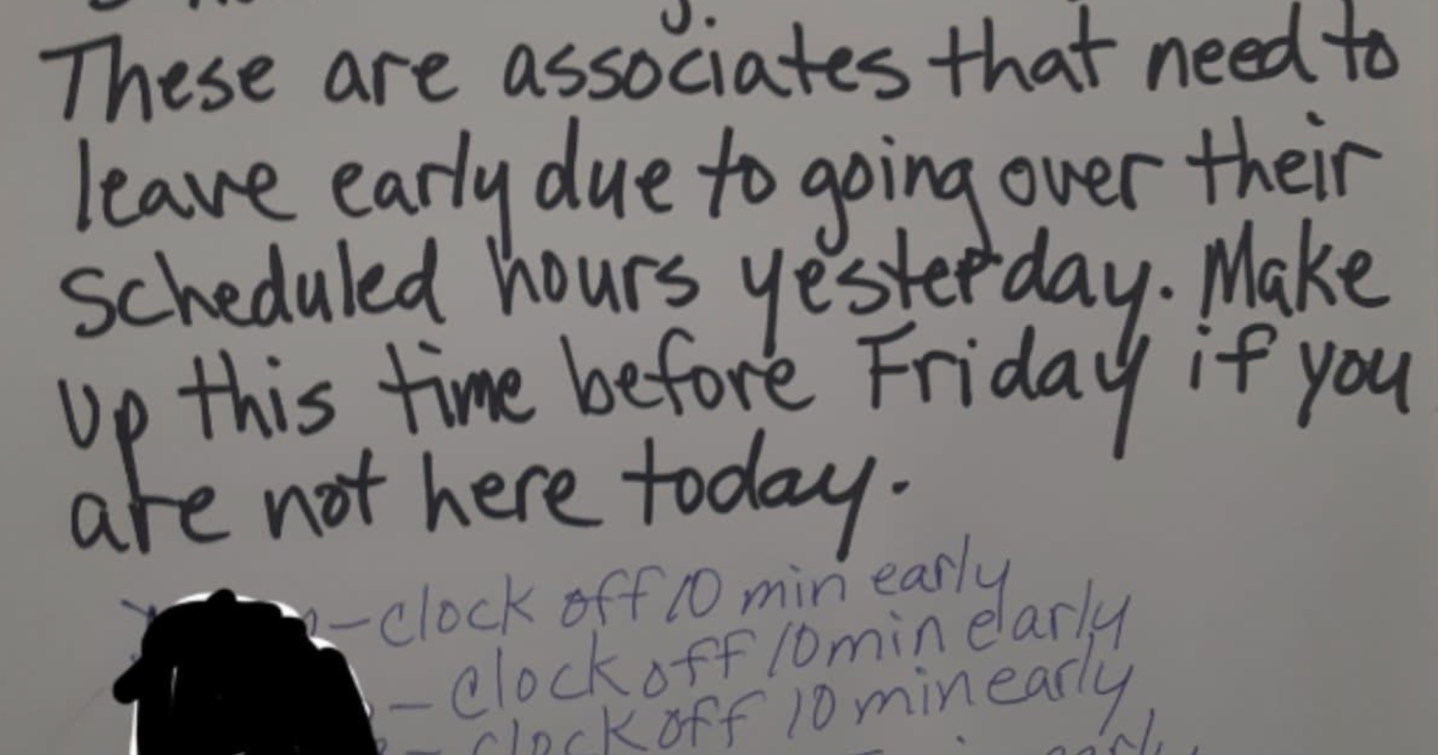
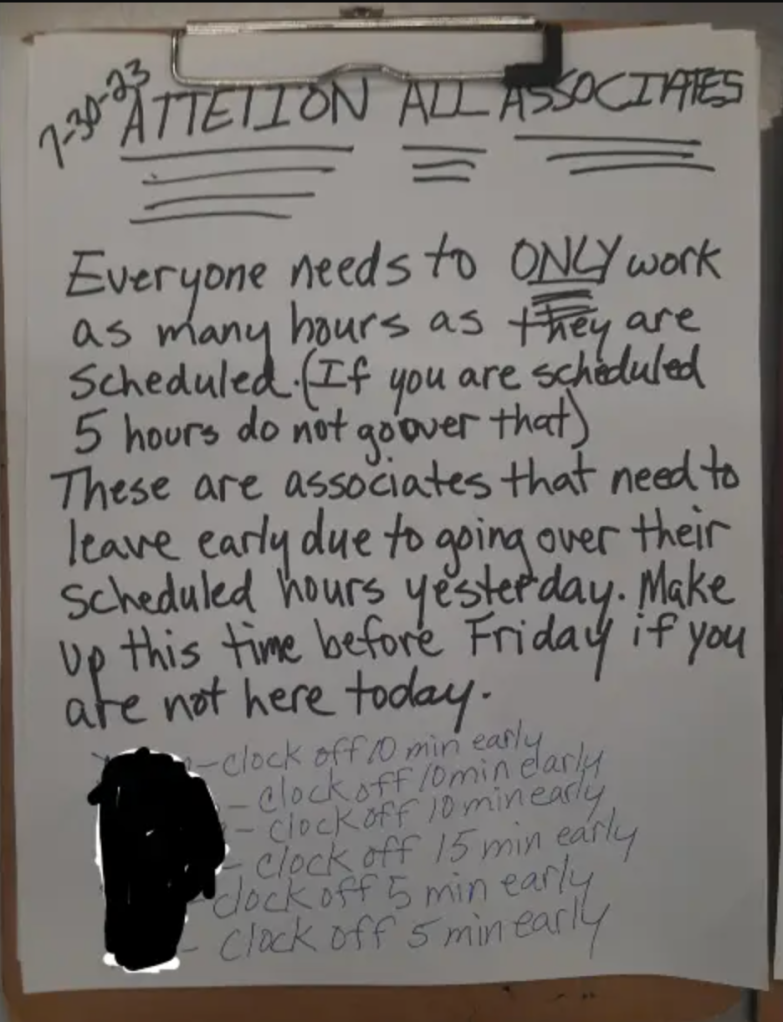
    Photo credit: u/Grizzlypupper / RedditA note from a Walmart manager to the employtees

    A handwritten notice posted at a Walmart store has gone viral, and the more people read it, the more complicated the conversation got.

    The sign, photographed and shared to r/walmart by user u/grizzlypupper in April 2024, begins plainly enough: “Attention all associates. Everyone needs to only work as many hours as they are scheduled. (If you are scheduled 5 hours do not go over that.)” So far, standard retail stuff. But the notice then lists six employees by name and tells each of them to leave early to compensate for a few minutes they’d already worked over their scheduled shifts the day before. One worker was told to clock out ten minutes early. Several others were directed to shave off five minutes.

    The response on social media was immediate. Some workers defended the practice as straightforward scheduling management, arguing that staying over even a few minutes without authorization creates payroll headaches. Others found the optics jarring, given that most of the workers named had gone over by less than fifteen minutes, seemingly out of dedication rather than negligence.

    Walmart, workers rights, overtime, labor laws, workplace
    A note from the manager to the employees. Photo Credit: @Grizzlyupper/Reddit

    But the comment that drew the most attention came from someone who identified themselves as a current Walmart employee, as reported by Distractify in their coverage of the post. According to that commenter, the notice may actually violate Walmart’s own corporate policy. “Associates can report it to the wage and hour hotline,” they wrote, “and I’m pretty sure they will have to pay out the OT. I know for such a petty amount like this it won’t make a difference on your paycheck, but it’s about the principle.”

    Walmart’s own ethics page states explicitly that the company is “committed to complying fully with all applicable laws and regulations dealing with wage and hour issues, including off-the-clock work” and overtime pay. Whether a store-level manager directing employees to offset previously worked minutes crosses that line is a question workers would need to raise through official channels.

    It’s not the first time Walmart has faced scrutiny over hour management. As Market Realist noted in covering the story, the Pechman Law Group has documented at least two separate lawsuits from former Walmart employees alleging the company skimped on overtime pay, in one case by allegedly adjusting time clock records manually to avoid paying the time-and-a-half rate that kicks in over 40 hours.

    Walmart, workers rights, overtime, labor laws, workplace
    A cashier takes payment from a customer. Photo credit: Canva

    Walmart has not commented publicly on the specific notice. The store location was not identified in the Reddit post.

    For many workers in the comments, the frustration wasn’t about the policy itself but the execution. “When they cut our hours, it’s like one or a half an hour each day,” wrote u/Wooden_Tomato919. “Just give me a whole half day off. But that would benefit me, not them.” Another user, u/JediFed, offered a manager’s perspective: “If I need another 10 minutes to clean everything up, I should take that 10 minutes and clean everything up.”

    A notice meant to manage labor costs ended up raising a question that goes a bit further than scheduling: if an employee works the time, are they owed the pay? Under the Fair Labor Standards Act, for most hourly workers, the answer is yes.

    This article originally appeared last year.

  • Love educator shares how awkward flirting can be turned into a romantic superpower
    Photo credit: CanvaA couple flirts on the dance floor.

    In a recent TED Talk, love coach Francesca Hogi shared how even your awkward flirting can be a superpower. Sometimes mistaken as off-putting, flirting actually offers a powerful gateway to real human connection.

    By reframing flirting as an act of curiosity, she explains how anyone can kickstart attraction and open the door to lasting love. In an impassioned presentation, Hogi demystifies flirting and explains why building attraction matters.

    Flirting can be a superpower

    Hogi explains that for 12 years she’s been helping people fall in love as both a matchmaker and a coach. “As a love professional, I can assure you that many dating problems can be solved with flirting,” Hogi says. “If you’re single, it helps you to connect and fall in love. If you’re partnered, it helps you to reignite or maintain the spark of chemistry that brought you together in the first place.”

    Many might have concerns about their ability to flirt. Will they be received well, or are they even doing it right? Hogi explains, “I’ve got good news for the introverts out there. You don’t have to be extroverted to be a magnet for connection. In fact, I believe that introverts have a secret advantage when it comes to flirting because your efforts at being more open feel more genuinely inspired by another person and therefore special.”

    She shares that flirting can give you confidence and courage. She also acknowledges that feeling awkward is normal. “Confidence with flirting comes from knowing yourself, your intentions, reading the room, discerning other people’s reactions, and adapting accordingly,” she says. “Sometimes it’s going to be awkward, sometimes it’s going to be embarrassing, and that’s okay.”

    flirtation, connection, mental health, good vibes, sexuality
    A couple enjoys flirting.
    Photo credit: Canva

    Healthy flirting

    “Flirting gives you more agency over human connection,” says Hogi.

    She then describes the two foundational principles of healthy flirting. The first is presence: being in the moment and avoiding distractions like a phone or the surrounding environment. The second is enthusiasm. Getting the right vibe while being enthusiastic goes a long way toward mastering the art of flirting. These principles have a strong effect on other people.

    Hogi explains that expressing positive intentions has a large impact on outcomes:

    “You have the ability to leave other people feeling good for having interacted with you…Even your unspoken appreciation for a shared moment of connection, no matter how brief, can often be felt. Lean into being the version of you who leaves other people with a smile on their face and notice how much more magnetic you become.”

    community, expression, humor, self-confidence, self-esteem
    A flirtatious interaction.
    Photo credit: Canva

    Hogi inspires the crowd

    People seem quite taken with Hogi’s energy and charisma. Some of the comments expressed admiration for her vibe and flirtatious delivery on stage. Hogi was sharing her own version of flirting as a superpower:

    “Even this presentation feels like shes flirting…especially her laughs”

    “She is such a good public speaker, ten minutes of speech with no filler words whatsoever”

    “Flirting is a way making one feel seen and acknowledged.”

    “Where were you, Francesca, when I needed these words? Like, 40 years ago? Never too late, right?”

    “Had me clapping in the end! She’z good”

    “I feel better about my flirting abilities after watching this now.”

    “She’s good , reading her body language generally teaches me more about flirting than learning it itself”

    gender, attraction, laws of attraction, social skills, personality traits
    A vintage photo of a couple flirting.
    Photo credit: Canva

    The power behind a flirtatious connection

    Flirting can have a powerful effect on both the initiator and the person on the receiving end. It isn’t necessarily about romance or sex. It helps build and strengthen relationships in everyday life.

    A 2025 study on ResearchGate analyzed where and how people flirt. The results suggested that people who flirt can improve with practice. The best flirting involved humor, confidence, and social skills. A 2026 study on ScienceDirect found that flirting can be an effective way for people to express their personality and individual differences. While personality traits and sex were linked to how often and how skillfully people flirted, these influences had only modest effects on overall outcomes.

    Hogi suggests flirting requires nuance and a little bit of courage. Practice prepares you for any occasion. “Attentiveness, compliments, playfulness—there’s nothing complicated about these actions, yet they have the potential to spark and sustain connection over time,” she says. “That’s a true superpower we can all tap into.”

    Hogi and the research suggest flirting isn’t just a trivial social game. It’s a meaningful way to express personality, build connections, and boost self-confidence. Flirting isn’t shallow. It doesn’t need to involve manipulation or outcome-obsessed action. These small everyday acts of courage embolden human connection and reveal individual superpowers in all of us.

Explore More Uncategorized Stories

Science

A bonobo’s make-believe tea party has scientists rethinking whether imagination belongs only to humans

Society

This hand-written Walmart note about employee hours is a real head-scratcher

Well-being

Love educator shares how awkward flirting can be turned into a romantic superpower

Ideas

A 6-year-old girl thought skateboarding was just for boys. One stranger at the skate park spent an hour proving her wrong.