Sometimes it can feel like you know something is present without seeing it or touching it. A scientific study just investigated our ability to “feel” things without contacting them. This isn’t a science fiction movie. It’s reality, and they’re calling it “remote touch.”
A 2025 study explored humans’ abilities to sense objects in sand. Participants were asked to detect hidden cubes by sifting their hands through sand without touching them. Subjects successfully discovered the objects with 70% accuracy. The research demonstrates that humans can detect objects buried in the sand before physical contact, indicating a form of “remote touch” previously believed to be exclusive to shorebirds.

A unique skill robots try to mimic
Dr. Elisabetta Versace, a senior lecturer in psychology at Queen Mary University of London, led the study. In an article on Earth.com, when talking about the experiment, she said, “It’s the first time that remote touch has been studied in humans and it changes our conception of the perceptual world.” Measuring the human performance against a robotic system, people outperformed the machines designed for that very same task.
Perceiving the tiniest things and detecting the subtlest signs by moving close to an object buried in sand reveals a detailed biological skill. As the grains shift, even if only a little, there’s a pressure change that spreads out like ripples. The results suggest that humans are far more sensitive to their surroundings than we realize.
Scientists have been studying birds that find hidden food under sand. The Red Knot is a bird that searches for food and feels those tiny pressure changes with the tip of its beak. The skill can be amplified when the sand is wet, but it can also be made more difficult when things like blades of grass get in the way of those tiny pressure ripples.
Why remote touch is important to understand
This study challenges traditional views of touch being effective only with direct contact. It opens questions about sensory evolution and what our actual perception thresholds are. How do our brains interpret the indirect signals it receives from the environment? A 2022 study on multisensory adaptation suggests humans are very good at noticing things close to their bodies. Calling the zone peripersonal space (PPS), they determined that our bodies actually increase this size and space depending on what’s happening in the environment around us.
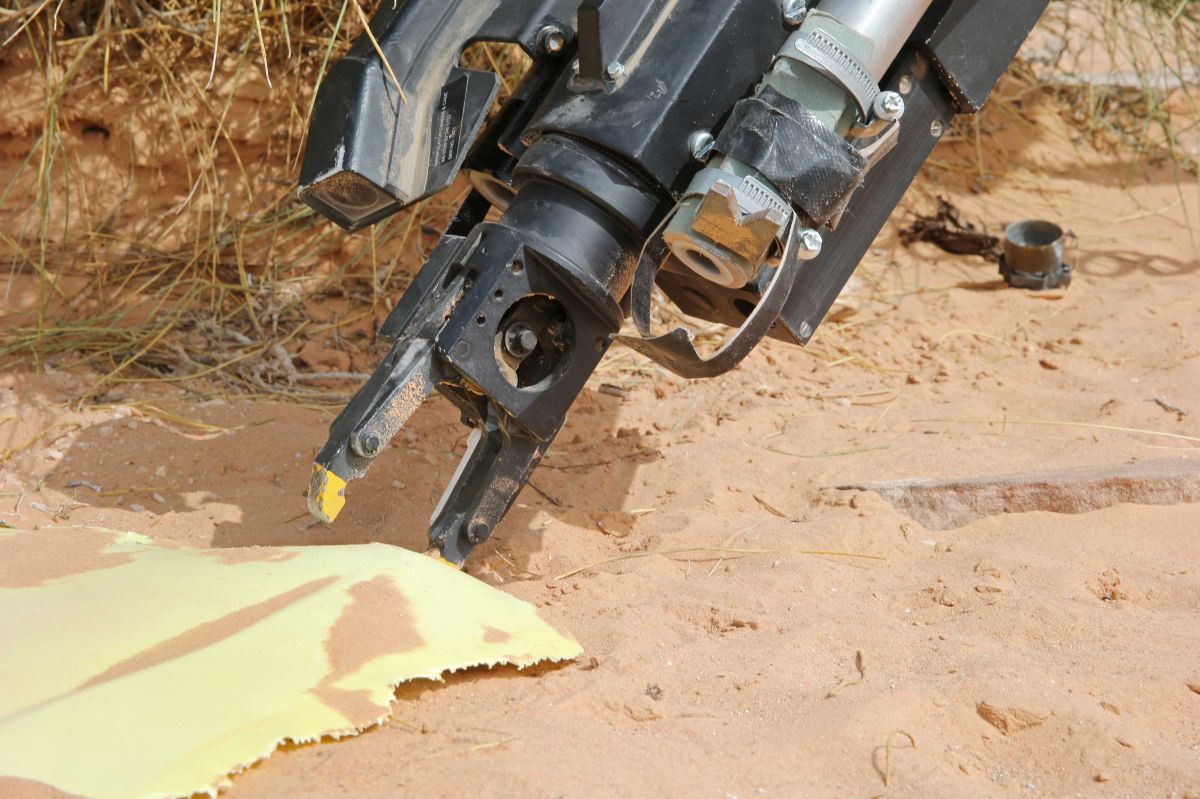
Having a better understanding of how humans use these skills can influence the design of mechanical devices. Things like minesweepers and proximity sensors can be evolved to work with physical vibrations instead of visual or chemical reactions. A 2024 study at Cornell University examined the very expensive machines designed to locate landmines. They created a simpler and cheaper tool that sifts through the sand and detects how the grains push back. Teaching the computer to recognize patterns and notice the sand reacting differently, they were able to “feel” hidden objects underground more effectively.
A 2021 study in MIT News reported on a robotic digger finger. The aim was to teach robots to distinguish between the things that are important versus the things that are not. The advancing technology models the abilities and evolutionary adaptations that humans have developed over thousands of years.

These findings reveal that touch, vision, and other human senses work together in complicated ways. Studying them will not only improve our understanding of human perception and animal behavior, but also help evolving technologies like robots and sensors to work better. We are constantly interacting with our environment, even when we don’t see or feel it directly. Studies into “remote touch” through the localization in granular media, hands and robot fingers sifting in sand, will help us better understand it.
You can learn a little bit more about nature and the evolution of the Red Knot as it hunts for food on sandy beaches: