For nearly a century, a massive mural by painter Victor Arnautoff titled “The Life of Washington” has lined the hallways of San Francisco’s George Washington High School.


It may not be there much longer.

The mural “glorifies slavery, genocide, colonization, manifest destiny, white supremacy [and] oppression.” So said Washington High School’s Reflection and Action Group, an ad-hoc committee formed late last year and made up of Native Americans from the community, students, school employees, local artists and historians.

It identified two panels as especially offensive. One shows Washington pointing westward next to the body of a dead Native American. The other depicts slaves working in the fields of Mount Vernon.

Because the work “traumatizes students and community members,” the group concluded that “the impact of this mural is greater than its intent ever was.” They are campaigning for its removal.

The idea that impact matters more than intention has informed debates about everything from microaggressions to cultural appropriation.

But when it comes to art, should impact matter more than intention?

As historians committed to preserving our cultural heritage – and as citizens invested in the power of art to engage the public – we see the growing chorus of voices favoring impact over intention as a dangerous trend, one that makes art more vulnerable to rejection, censorship or even destruction.

A radical work for its time

For most members of the Washington High School’s Reflection and Action Group, the only message “The Life of Washington” sends is one of crushing, dehumanizing oppression.

What happens, though, when we examine the mural in the context of the life and times of the artist?

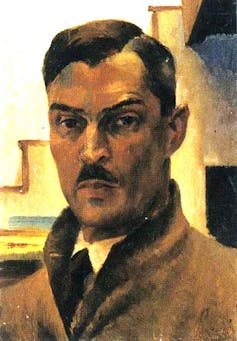
Painter Victor Arnautoff was born in 1896 in a small village in present-day Ukraine. He emigrated to San Francisco in 1925, where he joined a leftist art collective. During the Great Depression he was a supporter of workers’ strikes and formally joined the Communist Party in 1937. He was even hauled before the House Un-American Activities Committee in 1956 for drawing a “Communist Conspiracy” cartoon that caricatured then-Vice President Nixon.

In “The Life of Washington,” Arnautoff decided to place Native Americans, African Americans and working-class revolutionaries front and center in the four largest panels, relegating Washington to the margins.
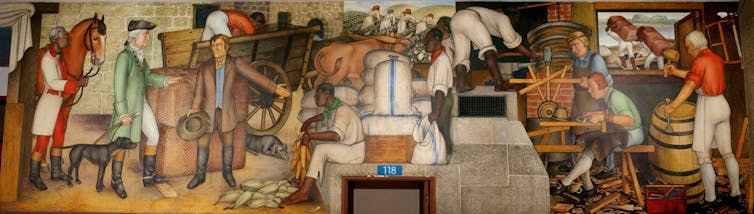
The slaves toiling in the Mount Vernon fields highlight a central paradox of America’s history: The nation was founded by men who championed liberty, freedom and equality, and yet owned slaves.

Then there’s the striking image of the fallen Native American. The mural’s detractors say that it dismisses the humanity of indigenous peoples. But why must it necessarily be read as dehumanizing to Native Americans? Could it not instead be seen as throwing into sharp relief the inhumanity of the founding fathers?

According to Arnautoff’s biographer, Robert W. Cherny, the image challenged the fallacy that “westward expansion had been into largely vacant territory waiting for white pioneers to develop its full potential.”
That the mural appears in a school is particularly important in this regard. For decades, the country’s educational institutions perpetuated national myths about American exceptionalism and American history as one long glorious march of forward progress. Up until the 1960s, the standard U.S. history curriculum ignored the country’s dark and terrifying history of racial violence, including enslavement and the slaughter of indigenous peoples. So drawing attention to the horrors inflicted on Native Americans and African Americans would have been a radical statement in 1930s America.

Many of those in favor of scrapping the murals seem to believe that merely depicting past atrocities justifies them. In fact, the Action and Reflection Group concluded that the mural contravened the San Francisco Unified School District’s commitment to “social justice.”

Quite to the contrary. In our view, the “Life of Washington” provides an invaluable opportunity for students to engage in a serious and sustained way with social justice issues. There’s a strong case to be made that Arnautoff is exposing – rather than celebrating – slavery and genocide. Moreover, those arguing for the mural’s removal are overlooking the fact that African Americans are not only portrayed as picking cotton and that Native Americans are not only depicted as victims of genocide. Rather Arnautoff is insisting that African Americans and indigeneous peoples were key historical actors in the making of the United States.

Only the latest controversy

The controversy over this mural is sadly not an isolated exception.

Over the past several years, there have been dozens of cases where plays, poems, books, prints, paintings, sculptures, installations and other creative works have been shut down, canceled, removed or otherwise censored based on snap judgments, social media swarms, ideologically motivated reasoning and obtuse interpretations of the art in question.

In all of these cases, there has been little to no regard for the aspirations, aims and ambitions of the artists themselves. Their intentions have been treated along a spectrum that runs from indifference to contempt.

To be clear, we are not saying that an artist’s intent is all that matters. How people interpret and respond to a work of art is inseparable from its raison d’etre.

But disregarding the intentions of artists would place every significant creative work with a whiff of controversy in jeopardy because of its “problematic” or “offensive” content. In a world where intentionality and context are irrelevant, satire and irony would not only be incomprehensible but forbidden.

Artist Kara Walker’s searing paper cuts depicting the horrific violence of slavery in the United States? Nothing more than a celebration of the white domination of black bodies. The pungent, explosive litany of racial slurs in Spike Lee’s “Do the Right Thing”? Just a vicious rehearsal of profoundly damaging ethnic stereotypes. Keegan-Michael Key’s brilliant sketch character Luther who serves as Obama’s “anger translator”? Simply a racist caricature of the “angry black man.”

What else becomes vulnerable to censorship?

Calls to censor “offensive” art by committees, petitions or the Twitterverse are especially dangerous. For every case of “righteous” censorship that removes works of art that are allegedly racist, sexist, homophobic and so on, there will be scores more censored on the grounds that they are anti-American or offensive to Christians.

As the American Library Association reports, the most frequently challenged and banned books are those that contain “diverse content” and include characters of color or address themes of sexuality, racism, religion, disability and mental illness.

Four out of the top 11 most challenged or banned books in 2018 were objected to on the basis of their LGBT content. “Two Boys Kissing” – a 2013 novel centered around the lives of seven gay teenagers – has made the American Library Association list for several years running, even though The Guardian described it as a “complex,” “intricate” novel “so extremely powerful [it] leaves you thinking long, long after you have finished reading it.”

Thinking long and hard, alas, is in short supply for members of the “we are not interested in the artist’s intentions” when the art offends us brigade. Ripping art from its context degrades our critical faculties and imprisons us in the present. It smacks of a literal-minded authoritarianism that assumes and indeed insists that a creative work can and must only be read in one way.

When people refuse to see the contradictions, tensions and ambiguities of art, it becomes disposable. Arnautoff’s detractors bring to mind Oscar Wilde’s warning that any time a spectator of art tries to “exercise authority over it and the artist,” he “becomes the avowed enemy of Art and of himself.”

It took Arnautoff almost a year to complete the mural, painstaking labor that could be erased with a single coat of paint. Not only would this outcome whitewash history, it would also deal a severe blow to our own capacity for creativity and critical thought.

is Associate Professor of History, Carleton College. is Associate Professor of Educational Studies, Carleton College.

This article originally appeared on The Conversation. You can read it here.
  • Australia produces so much solar power that they’re giving three hours of it away each day for free
    Photo credit: CanvaSolar energy surpluses during the day offers Aussies free energy.

    In a time when energy costs are rising, Australia is taking a different approach. The country has acquired so much solar power that they’re giving it away. In fact, those who sign up for the program will get three free hours of energy each day.

    This comes from a government-run offer dubbed Solar Sharer. It offers a free three-hour period for those who sign up. This period runs from 11:00 a.m. to 2:00 p.m. in Queensland, Victoria and New South Wales. The period runs from noon to 3:00 p.m. in South Australia. 

    Free, but not unlimited, power

    While the power is free for those who are eligible and have a smart meter, there is a daily cap of 24 kilowatt-hours (kWh). Any amount above that will be charged. However, the energy cap is based on the Australian Energy Regulator’s assessment of what a five-person household uses each day. 

    While that free period each day provides a great window to use major appliances or charge electric cars, there are some catches. Solar Sharer isn’t yet available to residents outside those areas, but energy brokers are making similar offers. There is also no guarantee that electricity rates won’t get higher outside of those free periods either.

    Who benefits?

    The program is designed for those who are a part of a solar power grid. It also benefits people who work from home the most. If the people in the household are at their job or the office, they likely won’t be able to take advantage of the deal.  

    While Energy Consumers Australia supports this offer, they are concerned about how governments and retailers relay the information to customers. In short, they don’t want people to be surprised if their electricity rates are charged higher during the non-free periods. They’re also concerned that, by their measure, only three in 10 eligible people were aware of this offer.

    “We don’t want to have people signing up to these plans assuming it will decrease their bills, when in fact it could do the opposite,” the consumer advocacy group said to The Guardian.

    There is a chance that rates won’t get higher if more people are able to take advantage of Solar Sharer. Since most electricity use is during the evening when more people are home from work, changing up the usage towards daytime hours can benefit everyone. It would still be an uphill battle as electric light is mostly used in the evening and nighttime when it’s dark.

    Similar programs elsewhere

    While there are catches, this isn’t the first program of its type. There are similar successful free energy programs in other nations. Areas such as Germany and the Nordic countries create so much green energy through wind farms that they make similar free power offers. California has also offered government programs for low-income households and farmworkers housing cheap-to-free solar energy.

    While kinks definitely need to be sorted out, creating so much generated energy to the point that it can be given freely is a good problem to have.

  • Motorcyclist trapped under a 3,300 pound car saved by Australian car salesmen
    Photo credit: @ACurrentAffair9 on YouTubeA man was saved from being crushed under a car.

    Tyler Wiebe was on his way to work on his motorcycle in Brisbane, Australia. Then a car approached in the wrong way in traffic, colliding with another car that then hit Wiebe. The accident threw Wiebe off his bike and under a car. He was trapped under the 3,300-lb. vehicle, doomed until a group of salesmen and onlookers came to his rescue.

    “I was being dragged and when it stopped, my head and chest were under the car,” Wiebe said to the Australian Broadcasting Corporation. The crash and being pinned down under the vehicle gave Wiebe several injuries. He suffered broken ribs, a broken collarbone, and a collapsed lung.

    But that would be diagnosed later. At the time, the car’s weight was crushing Wiebe to the point that he couldn’t breathe. His heart was also unable to beat, the pressure causing his eyes, mouth, and nose to bleed.

    “Initially it was ‘can I get out?’ and then it was ‘man I am dying, this is it,’” recalled Wiebe. “[My] wife and two kids are not here, and this is it.”

    Hope comes in the form of a car salesman

    After being stuck for two minutes under the car, help arrived from the nearby Auto Request Kedron, a used car dealership.

    “I was in the office at the time, so I heard the bang [and] came running to the doors,” Mick, one of the employees, said to A Current Affair.

    “I realized there was someone trapped under the car,” fellow employee Rob added.

    They rushed into action, recruiting other coworkers to help.

    “[I] saw Rob running and he was just whistling out saying, ‘Hey, boys, hurry up,’ ” Corbin recalled. “I remember seeing him, just like two legs. They weren’t moving at that time.”

    The salesmen tried to lift the vehicle up to get Wiebe to safety, but the car wouldn’t budge.

    “We tried to lift it off. We couldn’t, and then on the second attempt, we had a couple of other good Samaritans come and help us,” said Brian, another employee of Auto Request Kedron.

    Reportedly 15 people were finally able to lift the car and free Wiebe underneath. He was rushed to the hospital where he went under emergency operations. Under hospital care, Wiebe’s condition stabilized and he survived. Had he been under that car any longer, the worst would have happened.

    Wiebe was humbled and grateful to the salesmen and others who stepped up to save him.

    “I get more time with my daughters, I get more time with my family and a second lease on life, so just thank you, thank you,” Wiebe said in his hospital bed.

    Certified legends

    When he was discharged from the hospital, Wiebe set up a reunion with the employees of the used car dealership. He was able to introduce his family to his rescuers and thank them face-to-face. Wiebe presented them with matching t-shirts, each one with a logo reading “Certified Legend” on the front and an illustration of a person lifting a car over their head on the back.

    “You guys are legends, but now you’re certified legends,” Wiebe said to his heroes.

    A father and husband was saved thanks to the alertness and quick action of the nearby community.

  • Texas engineers develop a jacket that pulls fresh drinking water out of thin air
    Photo credit: @fascinatingonX/CanvaWearing this jacket could help keep people hydrated.

    For too many, access to clean drinking water is incredibly difficult. According to the World Health Organization, over two billion people live in water-stressed areas due to pollution, climate change, or population growth. However, engineering experts in Texas have developed a possible solution: just put on a jacket.

    The engineers and researchers gathered at the University of Texas at Austin developed a prototype jacket that can pull drinking water out of thin air. The jacket could help anyone frequently in areas where drinkable water is scarce. This could be used recreationally by campers, hikers, and runners—but it could also save lives. Emergency responders, soldiers, and agricultural workers could also collect water for themselves and others simply by wearing it.

    The technology behind the jacket is similar to the materials used in netting for water harvesting of air and fog. This time, however, the idea is to collect water while also being mobile.

    “Water harvesting from air is usually imagined as a stationary device such as a box, a panel or a large sorbent bed,” said Guihua Yu, chair professor of the Cockrell School of Engineering’s Walker Department of Mechanical Engineering and Texas Materials Institute. “Here, we wanted to rethink the form of the technology. If the fabric itself can collect water from air, it opens a new direction for personal and portable water access.”

    How does this jacket collect water?

    The textile used to create the jacket was derived from a device the same team created. That device was a specially engineered hydrogel fabric made from biomass-derived materials. This hydrogel fabric takes moisture from the air and then releases it as water via condensation when it’s heated by sunlight. The water can easily be collected.

    The jacket’s textile collects moisture from the air and funnels it into detachable harvesting units. The units can be placed into a foldable collector piece where they are heated to produce water. The material and system doesn’t just absorb water like other materials. Instead, it actively converts vapor into water while functioning as a piece of protective clothing.

    The jacket is able to produce between 400 to 900 milliliters of drinkable water daily. This is a vast improvement upon other similar inventions that yielded less water and were significantly bulkier to wear. The jacket’s material could collect and produce more water over time and testing, depending on the humidity of the terrain.

    Aside from creating clothing out of the material, the researchers hope to make backpacks, tents, emergency shelters, and other outdoor gear from it. The hope is that this could create more clean water access for disaster response units and everyday people living in water-stressed areas alike.

    How much hydration do you need in the heat?

    Until water-collecting jackets are commercially available, it’s important to have drinkable water nearby at all times, especially during the summer. When out in the heat, the Center for Disease Control recommends having a drink of water before working outdoors. Then drink a cup of water every 15 to 20 minutes. This can help keep your body cool and hydrated to prevent heat stroke. That said, stay alert and stay indoors if there is a heat warning in your area.

Explore More Stories

Local

Ohio local news viewers spring into action after seeing an elderly woman threatened with jail time

Culture

In America’s sandwiches, the story of a nation

Health

Every dog has its day, but it’s not the Fourth of July

Society

Who owns the beach? It depends on state law and tide lines