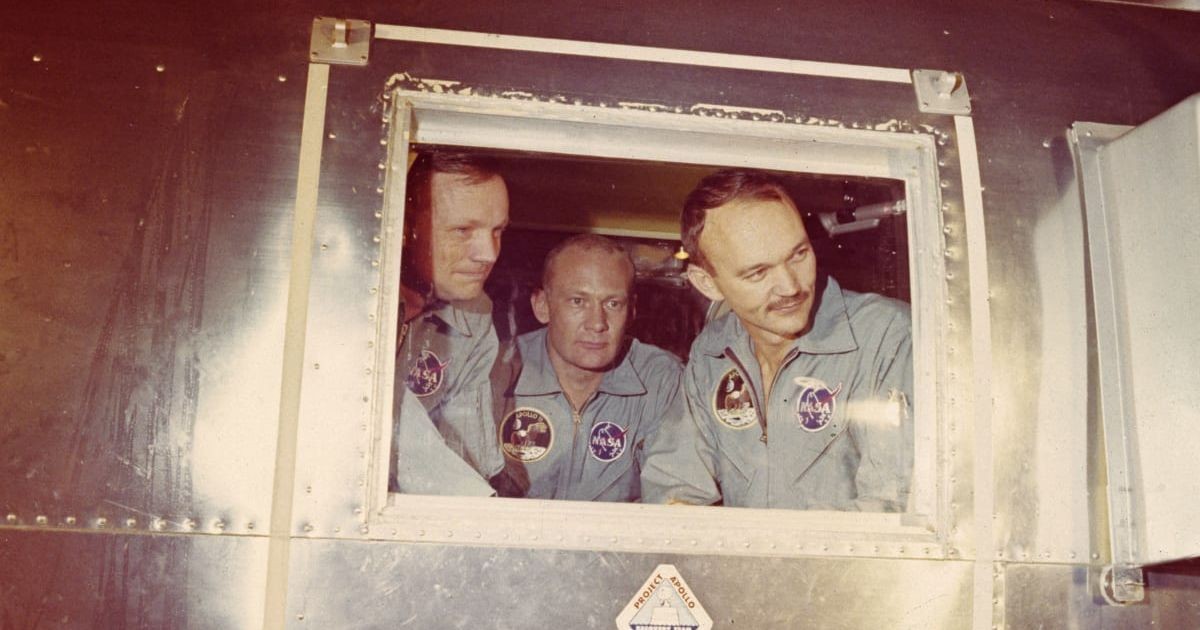
Photo credit: Cover Image Source: From left to right, Neil Armstrong, Edwin ‘Buzz’ Aldrin Jnr, and Michael Collins, the crew of the historic Apollo 11 moon landing mission quarantined upon their return to Earth. (Photo by MPI/Getty Images) – Array
It has been almost six decades since man first set foot on the Moon. The success of NASA’s Apollo 11 will be etched in history forever. This important mission has some very interesting tales attached to it. From the doomed speech in case the mission failed to the lead astronaut bringing a secret bag of objects that were supposed to be left on the Moon, some have come to light very recently. In a YouTube video uploaded by 60 Minutes Australia, one of the astronauts onboard revealed that they were made to live in a container with a colony of white mice for some days after returning to Earth.
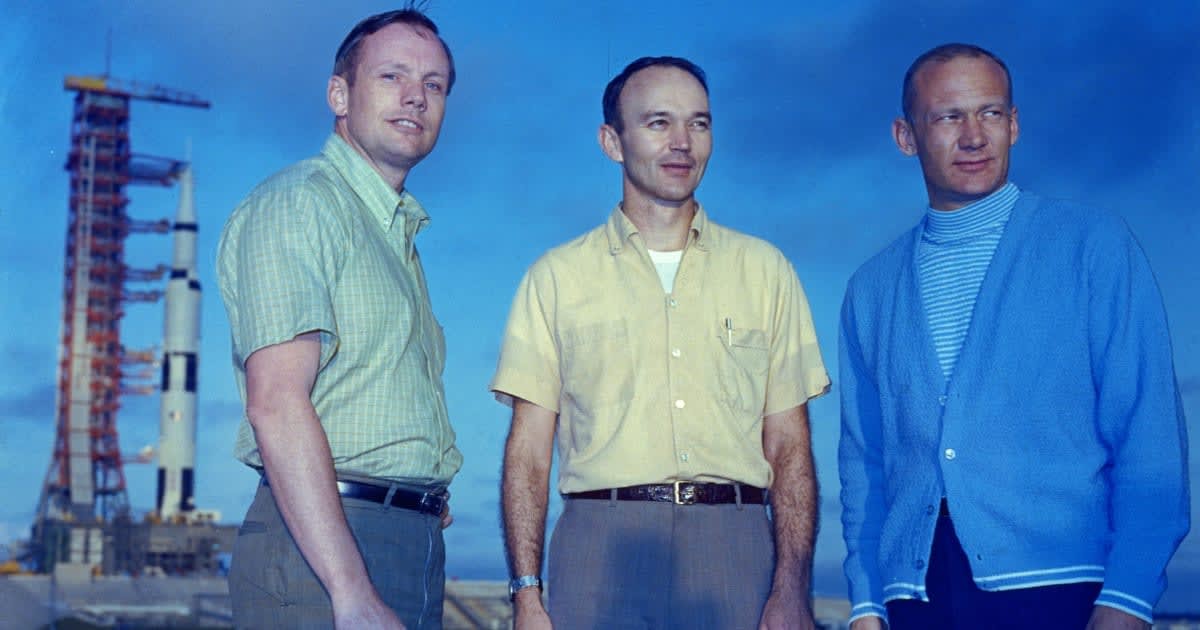
Image Source: From left to right, astronauts Neil Armstrong, Michael Collins, and Edwin 'Buzz' Aldrin Jnr, the crew of the lunar module Apollo 11 at the Kennedy Space Center, Florida. (Photo by MPI/Getty Images)
Apollo 11 was a success because of everyone involved in the mission, especially the three astronauts- Neil Armstrong, Buzz Aldrin, and Michael Collins. While most of us remember Armstrong and Aldrin, the third crew member of Apollo 11, Collins, is usually forgotten as he did not get to walk on the Moon. However, in the grand scheme of things, Collins was the backbone of the entire mission. He was assigned to work on the operations of the space vessel – which turned out to be crucial in the end for the success of the lunar mission.
July 20, 1969 is a date that represents a pinnacle of human achievement – the #Apollo11 Moon landing. And while it was certainly special, it was only part of a long and challenging effort that involved thousands of people working hard and doing their part, resulting in the… pic.twitter.com/GHyn3zfBVn— Dr. Buzz Aldrin (@TheRealBuzz) July 20, 2023
In 2019, he was asked about his experience on the Moon in an interview with 60 Minutes Australia. The 88-year-old quipped, “Did I have the best seat on Apollo 11? No. Was I happy with the seat I did have? Yes. I really was. And to be any small part of that suited me very well.” With a humourous touch to the conversation, he added, “Besides I was their (Armstrong and Aldrin) ticket home. They couldn’t get home without me.”
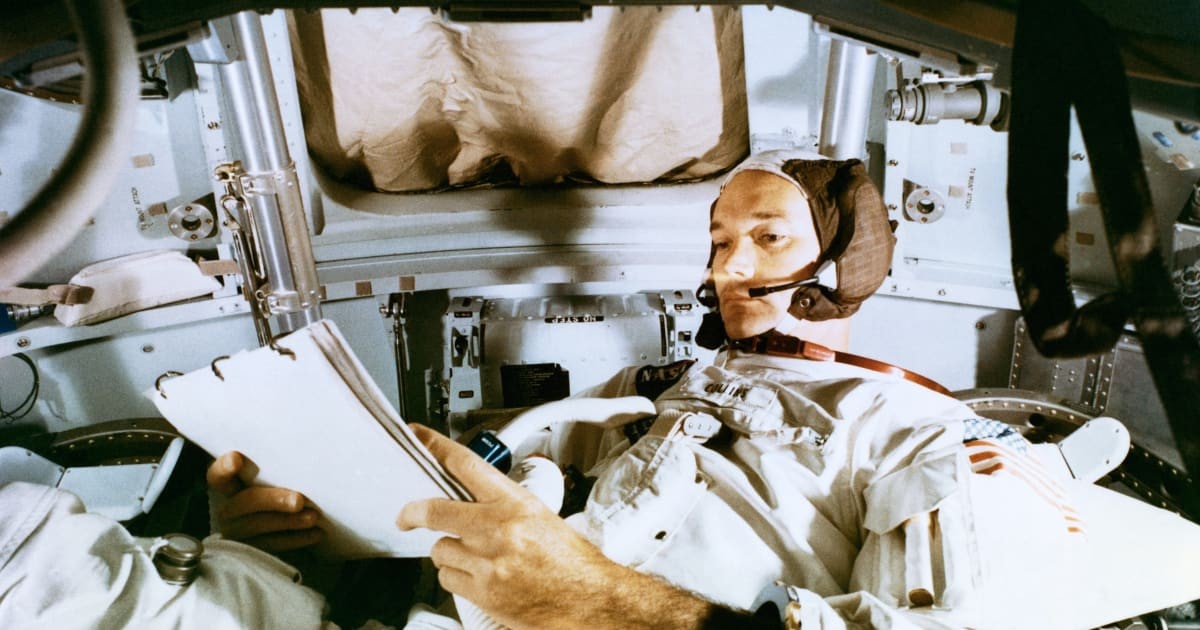
Image Source: Astronaut Michael Collins, command module pilot of the Apollo 11 lunar landing mission, studies flight plan during simulation training at the Kennedy Space Center for the scheduled July 16th mission. (Photo by Bettmann/Getty Images)
Sharing a story about their return to Earth, Collins said that the government did not allow them to come into contact with anyone for 2 weeks and they were quarantined in a separate space. The American astronaut revealed, “We were put into quarantine for two weeks. Some of our scientists were worried about the pathogens that we might have brought back from the moon. They possibly would be dangerous to humankind.”
Collins further stated their quarantine zone was a “hermetically sealed container with a gigantic colony of white mice.” He said, “If the white mice lived, we were okay. If the white mice died, we were in deep trouble.” He then added that the mice eventually became his friends and by the end of their quarantine, the rodents were living and healthy.
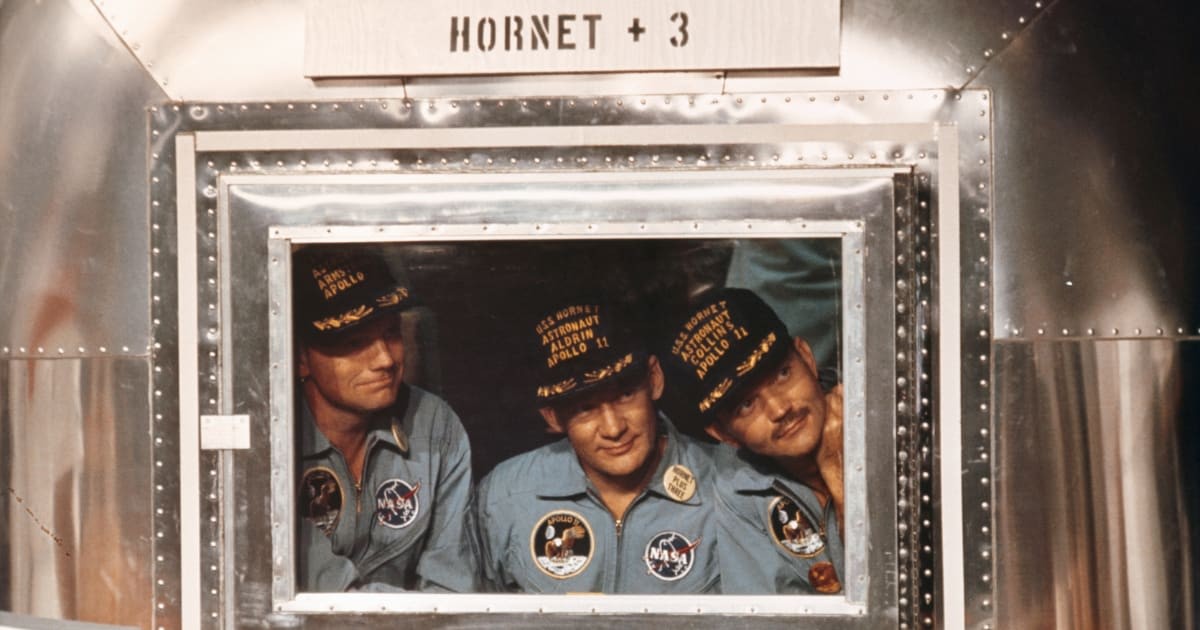
Image Source: Wearing their baseball caps, the Apollo 11 astronauts look out from the mobile quarantine facility aboard the USS Hornet here, the day after their successful splashdown in the Pacific. (Photo by Bettmann/Getty Images)
Not only that, their spacecraft, the Apollo 11 Command Module, as well as the 49 pounds of lunar samples they brought back, were also kept in quarantine. It has been reported that these items were kept away from human contact for 21 days, as per NASA.
On the evening of August 10, Armstrong, Aldrin, and Collins were finally given a green signal to step out of their quarantine zone. The astronauts were given a warm welcome by Manned Spacecraft Center’s Director Robert L. Gilruth, other NASA officials, and colleagues. It was the first time they could freely interact with the outside world after their return.
George Washington knew his forces could not win the American Revolutionary War without some measure of sea power. “It follows then as certain as that night succeeds the day,” he later wrote in a letter, “that without a decisive naval force we can do nothing definitive, and with it everything honorable and glorious.”
The problem was that the American commander did not have a navy.
As a professor of early American history, I have taught courses on the American Revolution for more than 20 years and have written two books on its maritime dimensions. Washington’s solution wouldn’t come from a French shipyard or a congressional committee. It would come from a group of angry, out-of-work New England fishermen.
Supplying the army from the sea
In 1775, American ground forces managed to lay siege to the British army in Boston, but Washington needed provisions and military stores to sustain pressure on this key commercial hub. Looking out across the Atlantic Ocean, he noticed supply ships arriving in droves from Great Britain – unescorted – to supply the British army in Boston with guns and ammunition.
Unbeknownst to them, the British had already handed the American commander the ships and mariners he needed to capture those resources.
The Sons of Liberty, a network of political activists, had angered the British government by resisting taxes and commercial regulations – from the 1765 Stamp Act, which taxed printed documents, to the 1773 Tea Act, which controlled what tea leaves made their way into North American cupboards.
To punish rebels for their treason, Parliament passed the Restraining Act of 1775, banning New Englanders from fishing on the Atlantic Ocean. Overnight, thousands of skilled mariners – men who spent their lives wrestling 100-pound cod out of the freezing, storm-tossed North Atlantic – were out of a job. They weren’t just unemployed; they were furious. These fishermen left their work tools and ships behind, picked up weapons and joined the siege of Boston alongside American farmers.
Ashley Bowen, who lived and worked in Marblehead, Massachusetts, the principal fishing port in America at the time, recorded in his journal on May 22, 1775, “the fishermen are enlisting quite quick.”
A letter from a French diplomat to the foreign minister in Paris confirmed the news a couple of weeks later: “4,800 sailors seeing they were going to be deprived of their fishing rights, deserted their ships and joined their compatriots under arms.”
Washington, commissioned by Congress as commander in chief of all American armed forces in June 1775, saw an opportunity. He didn’t wait for Congress to build new frigates. Instead, he reached out to John Glover, a fish merchant from Marblehead and a commissioned officer under his command.
Washington’s plan was simple: Take the sturdy, salt-stained schooners used for fishing and turn them into armed, seagoing predators.
The first of these was Glover’s own fishing vessel and trade ship, Hannah. She wasn’t a formidable man-of-war but a 78-ton workhorse that spent summers at the Grand Banks and winters hauling rum and sugar from the Caribbean. Washington armed the trade ship with a few cannons, manned her with fishermen and sent her out to hijack British supply ships to help his army win the siege of Boston.
Just two days after the Hannah was underway, her crew captured the Unity, a sloop loaded with naval stores and lumber, supplies sorely needed by British forces in Boston.
Between August and October 1775, Washington outfitted a fleet of schooners at Congress’ expense to intercept British supply ships off the coast of New England. These vessels and crews, whose wages were paid by the American government, constituted what many historians consider America’s first navy. Washington reminded each captain that they sailed “at the Continental Expense.” These orders from Washington and the payments made by Congress made these ships official American warships, operating under the authority of what would become the federal government.
These recruits didn’t need nautical training; they were seasoned seafarers who had battled rough waters and gale force winds. On Oct. 13, 1775, George Washington wrote to his brother, John Augustine Washington, that the fishermen were “soldiers … who have been bred to the sea.”
In 1776, Washington informed the governor of Connecticut, who had asked to draft seamen from Washington’s regiments for his own naval expedition, that he could not spare any. “I must depend chiefly upon them for a successful opposition to the Enemy,” Washington explained.
Because the British navy was spread too thin, with too few warships available to police the Atlantic coastline, the armed fishing vessels were able to disrupt supply lines and keep the Revolution alive through its infancy. By the time the British realized the threat, the damage was done.
On Feb. 26, 1776, just a few months after Washington launched his fleet, British Admiral Molyneux Shuldham wrote in a report to his superiors that his forces in Boston were low on everything from naval supplies to weapons. What little they could find had to be purchased “at the most extravagant prices.”
The British government had not assigned military convoys to trans-Atlantic shipments at the start of the conflict in 1775. Now, Shuldham recommended arming the supply ships themselves, since valuable stores were being intercepted by rebels in small vessels, “however attentive our Officers to their Duty.”
He concluded the report with an ominous note, explaining that he simply did not have the resources to do everything that was being asked of him – support the army, blockade rebel ports and protect British ships bound for Boston: “I must beg leave to observe to you the very few Ships I am provided with to enable Me to Co-operate with the Army, Cruize off the Ports of the Rebels to prevent their receiving Supplies, or protect those destined to this place from falling into their hands.”
Medical debt is one of the biggest drawbacks of the current United States economy. Per a report from the National Library of Medicine, 36% of U.S. households had medical debt in 2024. The report also stated that 21% of U.S. homes had a past-due medical bill, and another 23% were paying a medical bill over time to a provider. The pain is real, but relief has come for 97,000 people in Connecticut who just had their medical debt erased.
In June 2026, letters were sent to residents of Connecticut telling them that some or all of their medical debt had been paid off. This miracle fends off the growing trend of people declaring bankruptcy due to unpaid medical debt.
Now, people who otherwise have to choose between paying off their debt or buying necessities are given some much-needed breathing room. Eliminated medical debt means low-income families do not have to fear seeking medical care when it is most needed.
“You have so much money in your pot, so to speak, and you have to divide it amongst different obligations and expenses, and for some, whose out-of-pocket costs for healthcare are so huge, they have to make very difficult decisions,” said Dr. Traci Marquis-Eydman told NBC Connecticut. “We see this in rural America, rural Connecticut, that patients are making those decisions all the time.”
Connecticut’s government was able to provide this financial relief through Undue Medical Debt, a national nonprofit funded through donors and state funds. Using that money and $6.5 million in state funding they obtained for COVID-19 relief, Undue Medical Debt can purchase past-due medical debt.
How does Undue Medical Debt work?
Because they purchase debt in large batches, Undue Medical Debt can purchase the debt at a deep discount. Their website claims that every dollar donated purchases $100 worth of debt. If this sounds like how collection agencies make their money purchasing debt from hospitals, that’s because it is. The difference is that Undue Medical Debt isn’t trying to profit collecting from folks who cannot pay.
Connecticut isn’t the first state to use Undue Medical Debt to help their citizens. In 2025, over $17 million in medical debt was purchased and wiped clean in Arizona through Undue Medical Debt and the AZ Blue Foundation.
There are some caveats. In order to qualify, medical debt must match 5% or more of your annual income. If not that, then your income must be four times lower than the federal poverty level. Usually, people don’t apply for Undue Medical Debt relief. They will receive a letter in the mail indicating that their debt, whole or in part, has been taken care of.
Does paying off others’ medical debt actually help them?
There are arguments and studies that contradict the idea that this type of medical debt relief is effective. Critics believe that, even though medical debt is paid off, it doesn’t relieve overall financial stress of those in need. There is also the issue of paying off current medical debt and not additional debt that could be accrued. If a person has another medical emergency or is going through ongoing care, the problem can return.
More time, experimentation, legislation, and study needs to be made to see what path is the most ideal for this problem. However, for 97,000 folks in Connecticut, there is one less item to worry about.
On February 11, 2026, Kathleen Thomas was pulled over in Lake Worth, Florida by a Palm Beach County Sheriff’s deputy. She was then issued a citation for using her cell phone with her right hand, breaking Florida’s distracted driving law. There was a big problem though. Thomas doesn’t have a right hand.
Thomas, who goes by Katie, is a fitness influencer that doesn’t have a right arm below her elbow. She recorded the interaction between herself and the deputy on her phone after she was issued a citation. Thomas wisely had the officer repeat that he said that her nonexistentright hand had a phone in it. Then she shared that video on her social media, garnering a lot of attention. Unsurprisingly, Thomas decided to fight the ticket in court.
On May 26, 2026, the day before Thomas’ court date, she shared the body cam footage of her the citation. In the footage, we hear the deputy explain to Thomas that she was being pulled over for manipulating her phone with her right hand. Thomas responded by holding up her partially missing arm.
“So, obviously not,” Thomas laughed in the footage. “So, do you wanna just call this a day or…?”
In spite of either misspeaking or being mistaken, the deputy still issued the ticket, even asking Thomas “hand to God” whether or not she did it. Many commenters were flummoxed as to why the deputy just didn’t let Thomas go given that his assessment of the situation couldn’t have been true.
‘Lack of evidence’
On May 27, 2026, Thomas posted a video saying that the citation had been dismissed before she even went to court. She went to the courthouse anyway to get the dismissal on paper.
“I can’t make up the reason why it was dismissed,” Thomas said in the video with a sigh and a smile. “It says ‘lack of evidence.’”
Needless to Thomas took this entirely frustrating situation with humor and her story has gotten a lot of attention in the media.
It was later reported that the deputy himself that had requested dismissal of the ticket days before the court hearing.
Is it legal to use your cell phone while driving?
While this was a unique circumstance, distracted driving is not. According to the National Highway Traffic Safety Administration, distracted driving caused the deaths of 3,208 people in 2024. Sadly, the majority of these deaths are easily avoidable, with people keeping their attention on the road rather than conversations with other passengers, eating, and using cell phones.
However, that doesn’t mean you cannot use your cell phone while driving. The laws regarding cell phone use while driving vary from state to state.
In Florida, where Thomas’ run-in with the law took place, distracted driving is illegal but enforced after a traffic violation or accident. Regarding cell phones specifically, officers can only pull you over for texting while driving. You’re allowed to use GPS, talk on speakerphone, and use it hands-free provided that it doesn’t cause an accident or violation.
“The statute’s actually really explicit,” traffic attorney Michael Donahue said to KATV News. “It says you have to be engaged in manually typing letters or numbers into the device.”
Regardless of what the law says in your state, it’s good advice to not touch your phone at all while driving.