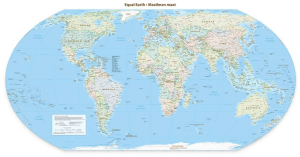
Alex Steffen says solving our current planetary crisis could lead to an unimaginably good future. Here’s how we get there.

as told to GOODWe are at a moment unique in human history, when we are using the planet’s bio-capacity so quickly that we risk a catastrophic collision with ecological reality. Every creature and every biological system on Earth is now dependent, intentionally or unintentionally, on our management. We’ve never been in the position of managing the planet before and we have no idea how to do it.It’s really serious. What’s at stake here is not just the ability of civilization to function in a way that we have come to take for granted, but possibly even the survival of human beings. And, unfortunately, the causes of the crisis are complex and everyone on Earth is involved. There’s a tendency for people to think that there’s an environmental crisis and a poverty crisis and a war and terrorism crisis, and so forth. But in reality they’re all the same big crisis. Right now we are coming to realize the magnitude of that big crisis.

We need people who change their thinking and not just their light bulbs.

The future toward which we are moving quickly is unthinkably bad. However, the kinds of things we need to do to solve these problems could lead to a future that is unimaginably good.In 2009, we’re going to have what may well be the most important international summit of our lifetimes: the Cop15, the United Nations Climate Change Conference, in Copenhagen, where we will decide what the successor to the Kyoto treaty will be. It is the last opportunity we’re going to have as a species to decide the degree to which we’re going to tackle climate change before it’s too late. And the United States will play a critical role, because we’ve been the ones holding up progress.In the last ?ve years the politically expedient form of environmental activism became privatizing responsibility, encouraging us to think that the future of the planet depends on us making small choices in our daily lives: recycling, buying organic shampoo, whatever. But most of the damage that we cause in our lives is caused by big systems we have very little control over as isolated individuals. We have this idea that changing the world ought to be reducible to simple steps, but it just doesn’t work that way; this isn’t that kind of a world. Even if we all followed every last eco-tip and simple step, we’d still be hurtling towards catastrophe.If we want to avoid that catastrophe, we need to not just do fewer bad things: we need to do different things altogether. We need to reinvent the way our whole society works. We need bright green upgrades to our cities, our energy systems, industrial design and technology, farming and forestry-everything. It all needs to change, essentially immediately. That will take millions of people transforming their lives to pursue new solutions, to become more effective and innovative citizens, business people, investors, community leaders, and so on. We need people to actually step up and do big things. We need people who change their thinking and not just their light bulbs.I don’t think that we have ever experienced, at least in American history, a transformation of political opinion like the one we’ve seen in the past several years on the environment and climate. Young people understand that the world we’re talking about is the world they’re going to raise their kids in, that this isn’t a distant reality, that the ice caps are melting now. While that gives me hope, the gap of understanding between those people and the 70-year-olds who are in the U.S. Senate is staggering. It’s a generation gap that makes everything the boomers talked about in the 1960s look like a disagreement at a tea party.I really think that the biggest political difference on the planet right now is what time frame you define moral responsibility in. Most politics is really all about hoping the good times last until the rich old people die. There’s even a denial that we can do anything about the problems. It’s all about delay, fake debates, and encouraging cynicism, inducing apathy.But there’s another political force growing fast, and that’s the politics of optimism. It’s a politics that says transformation is not just a duty, it’s an amazing opportunity. We might, instead of doing nothing and leaving our kids a ruined planet, decide to build them an awesome future and spend the rest of our lives enjoying it. That’s the choice we wake up to every day now: cynicism or change.


  • Bank of America foreclosed on a couple’s home by mistake. So they got a court order and showed up to foreclose on the bank.
    Photo credit: CanvaThe exterior of a bank and a happy couple reading a document.
    ,

    Bank of America foreclosed on a couple’s home by mistake. So they got a court order and showed up to foreclose on the bank.

    When the bank ignored them for months, the couple got a court order and showed up with a moving truck to take the bank’s furniture instead.

    Warren and Maureen Nyerges bought their home in Naples, Florida, in 2009. They paid cash. No mortgage, no bank involved, nothing. Bank of America foreclosed on it anyway.

    The bank had confused them with the previous owner, who actually did have an outstanding loan. A quick check of their own records would have cleared this up. According to the Nyerges’ attorney Todd Allen, it would have taken about 15 minutes. Nobody checked. The foreclosure went through.

    Warren called branch managers. He wrote certified letters to the bank’s president. Nothing came back. He eventually hired Allen, who got the foreclosure reversed within two months. The court also agreed that Bank of America should pay Warren’s legal fees of about $2,500. The bank was notified. Five months went by. No payment.

    At that point, reports ABC News, Warren went back to court and obtained a writ of execution: a court order giving him the legal authority to seize Bank of America’s assets to satisfy the debt. On June 3, 2011, he showed up at the local branch with two sheriff’s deputies and a moving truck.

    The deputies delivered the message to the branch manager: pay the $2,500, or they start loading furniture. After a call to superiors, the bank produced a check. They misspelled Warren’s name on it.

    Attorney Allen noted that Bank of America apologized for the payment delay but never for the wrongful foreclosure itself. A spokesperson eventually issued a statement: “We’re truly sorry for the series of unfortunate circumstances that Mr. Nyerges experienced.”

    The moving truck left empty. The deputies left with a check. Warren and Maureen still own their home.

  • Humans nearly vanished 800,000 years ago, revealing a quiet truth: most family lines disappear
    Photo credit: CanvaA group of people hiking in the mountains.

    There was a moment in human history when our entire existence may have desperately clung to a thousand or so people. A DNA-based study found that between 800,000 and 900,000 years ago, our ancestors experienced a severe population crash.

    This wasn’t humans dealing with a giant meteor like the one that wiped out the dinosaurs. It was a much slower stretch during which humanity teetered on the brink of disappearing completely. This bottleneck in the human gene pool, comprising roughly 1,280 breeding individuals, lasted about 117,000 years.

    population, genomes, Ice Age, Early-Middle Pleistocene
    Removing representation of a human population group.
    Photo credit: Canva

    Human population levels plummet

    According to Scientific American, the study analyzed modern human genomes to piece together what the early human population looked like. By constructing a complex family tree of genes from present-day humans, researchers were able to identify important evolutionary events.

    During the Early-Middle Pleistocene, a period within the Ice Age, humans faced severe weather and intense glacial cycles. Most human ancestors may have died out, clearing the path for a new human species to take their place.

    Focusing on Africa, the study showed that 813,000 years ago, human populations began to recover and grow again. With an estimated two-thirds of genetic diversity potentially lost, traits like brain size appear to have been among the important features that survived. “It represents a key period of time during the evolution of humans,” population geneticist and study co-author Ziqian Hao said. “So there are many important questions to be answered.”

    DNA, genomes sequence, human existence, heredity
    DNA genome sequences.
    Photo credit: Canva

    Understanding evolution and ancestry

    What we know about evolution reveals a different story than a simple, continuous line of human improvement. Over time, genetic lines disappear—not dramatically all at once. It’s a slow and steady change, generation after generation.

    Human existence isn’t inevitable. Species strength or technical advancement doesn’t guarantee the future or explain our past. It’s contingent on narrow, accidental circumstances. A 2021 study showed that human evolution is better seen as a continuous flow of incremental fragments over time. Categorizing people into races and groups oversimplifies human history.

    species strength, evolutionary improvement, genetic lines, technical advancement
    A diverse group of wooden figures.
    Photo credit: Canva

    What does the bottleneck study say about us?

    The study reveals humanity didn’t simply decline; it nearly collapsed. With over 98% of our genetic diversity erased, entire branches of the human family tree permanently ceased to exist.

    It’s quite possible that if even a few more of those genetic lines had ended, human history could have vanished with them. Most branches of life don’t continue. What we witness today reflects biological persistence and countless moments that could have gone another way.

    A 2024 study conducted five billion simulations, revealing that as a species’ population shrinks, its risk of extinction rises. Even stable groups can quickly collapse if their numbers suddenly drop low enough.

    A 2025 study found that small populations erode genetic diversity. Isolation increases inbreeding and elevates the risk of extinction. Once a lineage shrinks, recovery becomes vastly more challenging over time. Long-term survival is an exception, not the guiding rule.

    Humanity likes to think of itself as the result of an incredibly unique progression. Perhaps studies like these suggest that we are actually what remains when everything else disappears. The reason any of us live today comes down to a small group of ancient outlasters: persevering individuals whose genetic lines are the building blocks of every human living today.

  • A millionaire swapped lives with a struggling family for a week on a $230 budget. The money wasn’t what broke him.
    Photo credit: CanvaDepressed man looks at his laptop.

    Matt Fiddes runs a multi-million dollar martial arts franchise in Britain. His family’s weekly budget runs around $2,058. He’d never really looked at a price tag before buying something.

    For a social experiment documented by the YouTube channel Only Human, the Fiddes family swapped lives with the Leamons (Andy, Kim, their two kids, and two dogs) who get by on $230 a week. Kim had a life-saving surgery after an accident and now lives with Chronic Regional Pain Syndrome. They lost their savings. Andy works alone to support the family.

    On day one of the swap, Matt learned his weekly budget was $230. “That basically fills up the fuel tank of my car,” he said.

    wealth inequality, poverty, social experiment, class, viral video
    A man calculating his budget on his laptop. Photo credit: Canva

    What followed was a week of grocery bills he had to think about, a neighborhood with nothing much in it, and night shifts, something he’d never worked in his life. His wife Moniqe cried when she heard about Kim’s condition from the Leamons’ friends.

    By the end of the week, Matt had something to say that was harder to shrug off than the budget: “I feel guilty; no one should live like this.”

    He also said the week brought his family closer together. The Fiddes left a gift behind for the Leamons when they returned home: a mobility scooter for Kim, so she could get around on her own.

    The Leamons, meanwhile, spent the week in the Fiddes’ house taking their kids to a theme park and doing a little shopping experiencing, briefly, what it feels like when money isn’t a constant calculation.

    One YouTube commenter put it plainly: “I feel this was a much-needed vacation for the poor family and a grounding experience for the rich family.” That’s about right.

    You can watch the full documentary here:

Explore More Stories

Voices

Elementary teacher shares the 3 biggest mistakes modern parents need to fix immediately

Culture

Despite all the likes, literallys and dropped g’s, English isn’t decaying before our eyes

Health

Placebo effect can work as well as real medicine – but your body may need permission to use it

Money

Gen Z was asked if $75,000 a year counts as poor. Their answers say a lot about America right now.