Animals often exhibit strange behaviors, but a flock of sheep in China took things to a new level. In November 2022, the Chinese state-run media outlet People’s Daily (@PDChina) shared footage on X (formerly Twitter) showing sheep in Baotou, Inner Mongolia, moving in a bizarre and continuous circle. This unusual activity quickly went viral on social media.

Representative Image Source: Pexels | Photo by Marian Havenga

Closed-circuit camera footage showed a large circle filled with black and white sheep moving in a continuous loop. According to the post, the sheep had been trotting this way for over 10 days. “The great sheep mystery! Hundreds of sheep walk in a circle for over 10 days in China’s Inner Mongolia. The sheep are healthy and the reason for the weird behavior is still a mystery,” the caption read.


Viewers were stunned by the footage. What was happening to the sheep? The scene, reminiscent of George Orwell’s “Animal Farm,” captivated everyone. “As soon as I looked at it, I thought, ‘I’ve never seen sheep act like that,’” said Emma Doyle, a livestock expert and lecturer at the University of New England’s School of Environmental and Rural Science, to ABC News.


In the comments section, Reba Wilson (@rebawilsongirl) speculated on the mystery saying that this could be due to inflammation. “Encephalitis (inflammation of the brain) is the main cause of clinical signs of listeriosis. Inflammation usually affects one side of the brain, hence why we typically see unilateral signs such as circling, excessive salivation and paralysis of the affected,” she wrote.


Wilson’s hypothesis is backed by science. This kind of circling in sheep is known as a symptom of Listeriosis, also called “circling disease” in sheep. According to Michigan State University, Listeriosis is an infectious disease mostly observed in sheep and goats, most commonly causing encephalitis, but also capable of causing a blood infection and abortion.


via GIPHY


Listeriosis is caused by the bacterium Listeria monocytogenes and it commonly infects the animals in cooler climates. This affirms the possibility that the sheep moving in circles were suffering from this disease, as the climate of Inner Mongolia during November is typically freezing cold. This bacteria can be found in the soil, food sources, the gut, and feces of healthy animals. 


There could be another possibility. According to Dan’s Pet Care, one possible explanation for animals walking in circles is “mass hysteria.” Mass hysteria, also known as mass psychogenic illness, is a phenomenon that occurs when a group of animals exhibit similar physical or emotional symptoms due to a shared belief or fear. It can be caused by a variety of factors, including social isolation, stress, or a perceived threat.

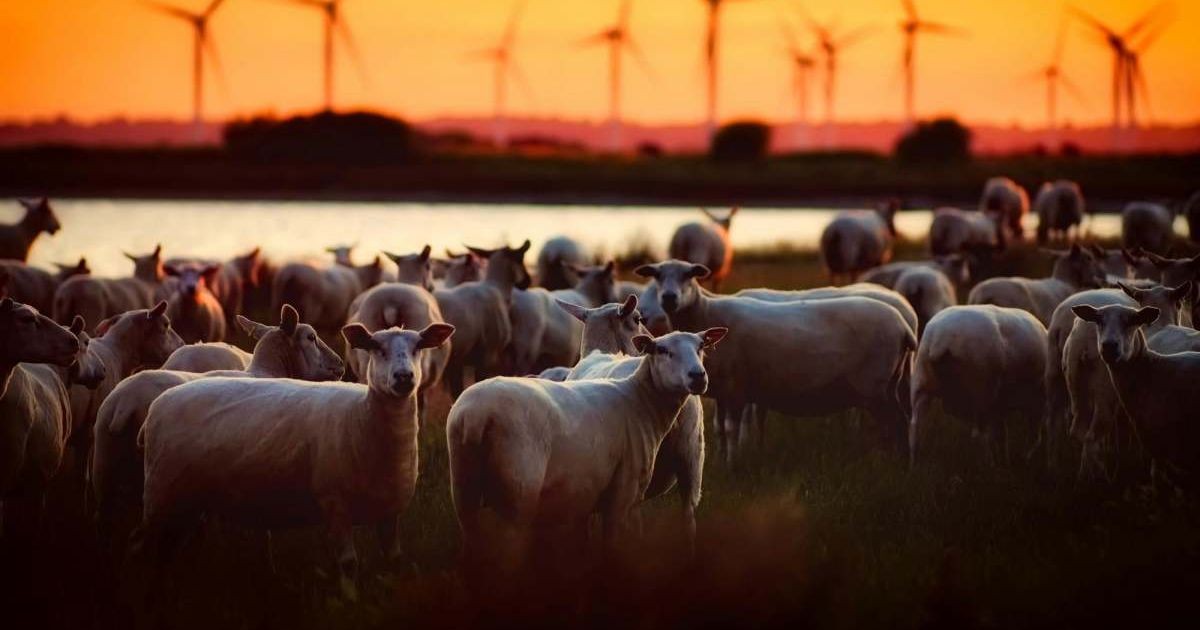
Representative Image Source: Pexels | Quang Nguyen Vinh
Representative Image Source: Pexels | Photo by Quang Nguyen Vinh

Additionally, a potential reason for this strange behavior is “isolation for prolonged periods.” Matt Bell, a professor and director at the Department of Agriculture at Hartpury University, in Gloucester, England told Newsweek, “It looks like the sheep are in the pen for long periods, and this might lead to stereotypic behavior, with the repeated circling due to frustration about being in the pen and limited as to where they can go. This is not good. Then the other sheep join as they are flock animals and bond or join their friends.”


via GIPHY


While experts thought that the cause behind sheep’s bizarre behavior could be a disease or psychological condition, people had their other ideas. @C_Flarity commented on the video, “What’s freakiest about this is it looks close to a perfect circle!” Dr. Doyle thought the same thing and told ABC News that it would be highly unlikely for sheep to form such a perfect, concentric shape, without some sort of interference.


https://twitter.com/robinhoodwallet/statuses/1595537104326500361

@joncutt reflected that it could be some kind of stuck loop behavioral pattern like the “death spiral” ants can sometimes get caught in, whereas, many people likened this performance with sheep sensing some strange activity in tectonic plates or geology.


Still, several viewers were unable to believe that the sheep were walking in a circle for over 12 days. But @Drpeterokongo shared a similar scenario, “The white rhino at the Nairobi National Park has also been walking in circles but anticlockwise. A police station in Maragua has witnessed thousands of bats flying above the station for 2 days in a row day and night.”


via GIPHY


Speaking to Metro, the sheep owner, Ms Miao, revealed that all of it started with a few sheep before the whole flock joined. There were reportedly 34 sheep pens at the spot, but only the sheep in the number 13 pen moved in this way. He added that the sheep started moving in circles on November 4 and continued for over two weeks.


  • Dog missing for 11 years ‘acts like he’s a puppy again’ after emotional reunion with owner
    A woman pets a pit bull. Photo credit: Canva
    ,

    Dog missing for 11 years ‘acts like he’s a puppy again’ after emotional reunion with owner

    She kept his microchip information up to date for over a decade after he went missing from her backyard.

    When Jourdyn Koziak got a phone call saying her lost dog had been found, she thought it was a sick joke. After all, her pit bull, Forty-Cal, had gone missing 11 years earlier, back when she lived in Philadelphia. Since then, she had gotten married, had another child, and moved to Luzerne County, Pennsylvania. Yet when she took a chance and drove to the Philly shelter, there he was.

    “I am overwhelmed. I am shocked. I am in disbelief,” Koziak told Fox 29 News. “I had tunnel vision of him walking down that hallway.”

    How the lost pit bull was found

    Back in 2015, Forty-Cal and another of Koziak’s dogs went missing from their backyard, presumably stolen. While the other dog was found, Forty-Cal never returned home. Despite this, Koziak never stopped putting up missing signs and kept Forty-Cal’s microchip information up to date.

    “I never gave up hope because, obviously, I’m relentless,” Koziak told CBC Radio.

    Apparently, Forty-Cal walked up to a little girl in Philadelphia and befriended her. The girl and her parents took him home, fed him hot dogs, and called Animal Control. The shelter then used the information from Forty-Cal’s microchip to contact Koziak and reunite them after more than a decade.

    The shelter warned Koziak and her family that Forty-Cal might be overwhelmed and that it could take time for him to recognize them. However, it took only moments for Forty-Cal to realize he was back home.

    “We put our hands out, he sniffed us, and then proceeded to pull us towards the door, like, ‘Let’s go,’” said Koziak.

    While what happened to Forty-Cal over the past eleven years remains a mystery, Koziak is just grateful that he appears to have been cared for. When Forty-Cal was found, he was clean and well-fed. He was also friendly enough to approach the young girl who found him.

    “He acts like he’s a puppy again,” she said. “He wants to go for a walk. He’s wagging his tail…I had other animals in the house, as well, that were family pets, but Forty was my dog. I paid for him with my own money at 16 years old.”

    Now that he’s back home, both Forty-Cal and Koziak are making up for lost time.

    “I’m over the moon,” she said. “It’s like Christmas morning every day.”

    Tips to prevent lost dogs

    This reunion wouldn’t have been possible if Koziak hadn’t had Forty-Cal microchipped and kept the information up to date. It’s important to have your dog microchipped and registered for this reason, among others.

    There are other ways to help prevent a dog from becoming lost, as well as simple ways to find them should the worst happen. When outdoors, keep your dog leashed and within your line of sight at all times. Make sure your pup is also well trained and responsive to your commands.

    @thehannahestelle

    ❤️‍🩹 with how common this apparently is, I wanted to share all the resources we used to find our girl. Relieved doesn’t even begin to cut it. Safe to say miss Fifi is never leaving our side again. #lostdog #dallaspets #lostpets #24petconnect #petcolovelost #dogsofdallas #dogsofinstagram #lostdogfound #dallaspetsalive

    ♬ original sound – hannahestelle

    Along with microchipping your dog and keeping their tags up to date, there are additional collar options to consider. A bright, vibrant collar can help your dog stand out in the dark and among trees and bushes. A Martingale collar is also recommended, as it stays secure on a dog’s neck without choking them. Lastly, there are collars with built-in GPS systems, as well as devices like the Apple AirTag, which you can attach to a collar to track and pinpoint your dog’s location.

    This story is a reminder that sometimes a reunion between a lost pet and its owner takes determination, community, and patience.

  • 10 boys and 10 girls were left alone in separate houses. The results were shockingly different.
    A girl plays with block while two young boys play a gamePhoto credit: Canva
    , , ,

    10 boys and 10 girls were left alone in separate houses. The results were shockingly different.

    Videos showed the children living normally for the first two days, but then the experiment took a chaotic turn.

    It sounds like the plot of William Golding’s Lord of the Flies, but in the mid-2000s, it was a very real, and very controversial, reality television experiment. Footage from the UK Channel 4 documentary “Boys and Girls Alone” is captivating audiences all over again, offering a fascinating—and chaotic—look at what happens when you remove parents from the equation.

    The premise was simple but high-stakes: 20 children, aged 11 and 12, were split into two groups by gender. Ten boys and ten girls were placed in separate houses and told to live without adult supervision for five days.

    While there were safety nets in place—a camera crew was present (though instructed not to intervene unless safety was at risk), and children could ring a bell to speak to a nurse or psychiatrist—the day-to-day living was entirely up to them. The houses were fully stocked with food, cleaning supplies, toys, and paints.

    As the resurfaced footage shows, the results between the two houses could not have been more different.

    In the boys’ house, the unraveling was almost immediate. The newfound freedom triggered a rapid descent into high-energy chaos. They engaged in water pistol fights, threw cushions, and in one memorable instance, a boy named Michael covered the carpet in sticky popcorn kernels.

    The destruction escalated to the walls, which the boys covered in writing, drawing, and paint. But the euphoria of freedom eventually crashed into the reality of consequences.

    “We never expected to be like this, but I’m really upset that we trashed it so badly. We were trying to explore everything at once and got too carried away in ourselves,” one boy admitted in the footage.

    Their attempts to clean up were frantic and largely ineffective, involving scraping paint and messily mopping floors. Nutrition also took a hit; despite having completed a cooking course, the boys survived mostly on cereal, sugar, and the occasional frozen pizza. By the end of the week, the house was trashed, the garden was littered with garbage, and the group had fractured into opposing factions.

    The girls’ house, however, looked like a different planet.

    In stark contrast to the mayhem next door, the girls immediately established a functioning society. They organized a cooking roster, with a girl named Sherry preparing their first meal. They baked cakes, put on a fashion show, and drew up a scrupulous chores list to ensure the house stayed livable.

    While their stay wasn’t devoid of interpersonal drama, the experiment highlighted a fascinating divergence in socialization. Left to their own devices, the girls prioritized community and maintenance, while the boys tested the absolute limits of their environment until it broke.

    This article originally appeared last year.

  • A ‘Severance’ fan with Stage 4 cancer made a ‘bucket list’ request. Ben Stiller’s reply is perfect.
    Ban Stiller with a quote card overlayedPhoto credit: Frank Sun via Wikimedia Commons
    , , ,

    A ‘Severance’ fan with Stage 4 cancer made a ‘bucket list’ request. Ben Stiller’s reply is perfect.

    After a fan reached out with a “bucket list” wish to meet the cast, Stiller’s immediate response proved the internet can still be a force for good.

    Due to their serialized format, terrific TV shows can create a real sense of community, sparking our imaginations in ways other mediums simply cannot. The very best, like Apple TV+’s mind-bending dystopian mystery series Severance, can also offer a comforting form of escapism.

    Ben Stiller, the show’s primary director and executive producer, was reminded of that fact over X, when a hardcore fan reached out with a seemingly long-shot request:

    “Hi @BenStiller! Severance is the best show my husband and I have ever seen,” wrote Emily Powell-Heaton. “I have stage 4 cancer. A great bucket list item to check off would be to meet you and any of the cast and crew from the show. We can fly anywhere. We live near Toronto, Canada. Would this be possible? Thanks for your help!”

    Stiller, who has 5.3 million followers on the platform as of this writing, responded on the same day, asking for a DM. While we don’t know the specifics of their conversation, it appears they made plans to meet up in some fashion—potentially even with other people involved in the acclaimed show.

    “Thank you so much @BenStiller and team for making my wish come true!” they wrote. “My husband and I are over the moon about meeting you and the many other incredible people who work together to create #Severance! I am so happy.” The filmmaker replied, “Look forward to meeting you xx.”

    While social media can be a dark, depressing, divisive place, this connection highlights how it can be harnessed for good. Even the replies to their exchange were disarmingly positive, with strangers praising Stiller’s kind gesture and sending well wishes to Powell-Heaton.


    – “What a good guy. Prayers up for you, Emily!”

    – “YES!!! Fantastic… when the internet works well it really does. Xx”

    – “He is a legend! He’s made such an important dream come true!”

    – “You’re the man @BenStiller”

    – “Good on you, Ben. Emily, I hope you enjoy all things good and wish you wellness. XO”

    After the interaction with Stiller went viral, Powell-Heaton reposted an article about the news, writing, “He is a legend! He’s made such an important dream come true!”

    Powell-Heaton, who, according to their X profile, is 34 and has metastatic breast cancer, shared a health update shortly after the interaction with Stiller: “The spinal surgery is a go. No date set up yet but it’s likely to be in April. The spinal surgeon has to consult with some ENT specialists and I have to get a [CT] scan done on my face and neck area. This will determine if the surgery will be done from the back of the spinal cord or the front. A metal cage will be placed around the crumbling part of my spine to strengthen it.”

    Metastatic breast cancer, according to the Cleveland Clinic, is a cancer “that’s spread from your breast to other areas of your body.” The article states that there is no cure, “but thanks to newer treatments, more people with metastatic breast cancer are living longer than ever before.”


    In a study published in February 2025 in Cancer Causes & Control, researchers from Columbia University’s Mailman School of Public Health analyzed data from all 50 U.S. states, concluding that breast cancer cases are increasing for women under 40. “From 2001 to 2020, breast cancer incidence in women under 40 increased by more than 0.50 percent per year in 21 states, while remaining stable or decreasing in the other states,” according to a news release about the study. “Incidence was 32 percent higher in the five states with the highest rates compared to the five states with the lowest rates.”

    Rebecca Kehm, PhD, the study’s co-author and an assistant professor of Epidemiology at Columbia Mailman School, wrote that these increases are “alarming” and cannot be solely explained by genetic factors or changes in screening practices.

    This article originally appeared earlier this year.

Explore More News Stories

Nation

10 boys and 10 girls were left alone in separate houses. The results were shockingly different.

Nation

A ‘Severance’ fan with Stage 4 cancer made a ‘bucket list’ request. Ben Stiller’s reply is perfect.

World

Aaron Paul recalls heartbreaking exchange with his daughter that made him rethink smartphone use

Local

Police pulled over an ’80s pop icon for speeding and it turned into a hilarious photo shoot