Say a couple wants to have a baby, but they’re infertile. Or they have a weird genetic disease. Or they’re gay. Or they aren’t a couple at all — a single parent just wants to go it alone. Right now, these would-be parents have three options: IVF, adoption, or surrogacy. All three are terrific methods, but they’re also imperfect: inconvenient, expensive, and risky.

Soon these practices may become more obsolete. According to Henry Greely, director of Stanford Law School’s Center for Law and the Biosciences, we’re only 20 years away from couples birthing the babies of their dreams. To do so, women will simply need to give scientists samples of their skin cells. From there, the cells will turn into eggs, then hundreds of embryos — allowing parents to choose which baby they’d prefer to grow in the womb. No sex required.


Greely knows the title of his new book, “The End of Sex and the Future of Human Reproduction” (Harvard University Press, 2016), sounds like science fiction. But he’s confident enough in this new technique — which he calls “Easy PGD” (shorthand for the comically scientific term “easy preimplantation genetic diagnosis”) — that he predicts sexless reproduction will soon become not just a reality, but the cultural norm.

If he’s right, how society conceives of sex, reproductive rights, and the very idea of “family” could be about to change forever. Here, Greely prepares us for the future:

Why is now the time to talk about sexless reproduction?

People have been talking about selecting babies for a long time, but it was always theoretical. Once you can cheaply review all the genetic information and once you can easily and cheaply create eggs, everything changes. Both technologies — cheap genome sequencing and induced pluripotent stem cell — are progressing enormously and attracting lots of money for reasons that have nothing to do with reproduction. When they come together for reproduction, I think they will change our world. They will change our species.

Won’t there be political and cultural resistance?

It will be used first by people who are infertile. There are people absolutely desperate to have genetic children but can’t because of a childhood disease, a birth defect, an accident, cancer, or age. That’s a huge and very politically attractive market. Nobody will want to tell people, “I’m sorry, but we are going to ban the procedure that would let you, who had testicular cancer in your youth, become a genetic father.”

But I think it will spread as more people become confident that it is safe. One to two percent of babies have a serious genetic disease. How much is it worth as a parent to avoid that one- to two-percent risk? If, as I expect in the long run, the process becomes free, then I think we’ll see lots and lots of parents choose this as the way they want to conceive their babies.

You say this will cost nothing to parents. How?

Providing it will save the health care system money. Sick babies are really expensive. Time spent in the neonatal intensive care unit can cost over a million. It will be to the advantage of government-run health care systems as well as private insurers to make Easy PGD free in order to avoid the births of really expensive babies. It will also, of course, be a public health advantage to diminish the amount of human suffering, but I’m not even counting on insurers to care about the amount of human suffering. I do expect them to care about the amount of money.

Is there a right to reproduce in the United States? Where have reproductive technologies transformed into rights?

In much of the world, IVF has changed from a new technology into a right. Denmark has a very high IVF rate. Israel has a high rate. [In those countries], it was covered by national health insurance and became a right, but at the same time, they limit it. In France, IVF is covered by the national health care system, but you can only use it if you are a heterosexual couple in an established relationship. In Italy, you can’t use it if you’re a woman over a certain age. In the United Kingdom, you can’t use a PGD for anything other than specific diseases permitted by a government agency.

On the other hand, IVF is almost completely uncovered by insurance in the United States. There’s a basic, important distinction in our constitutional law: the difference between a positive right and a negative right. A negative right is a right to have the government not interfere with you. We don’t view fertility as a positive right — as something the government will pay you to do or guarantee for you — but we’ve been almost entirely hands-off in preventing it.

[quote position=”full” is_quote=”true”]That’s a dangerous path for the government, to say some lives are worth living and some aren’t.[/quote]

What impact will this have on people with disabilities?

First, most disabilities are not the result of genetics. They’re the result of infectious diseases or accidents. There will always be people in wheelchairs, even if we were to eliminate the genetic causes of being in a wheelchair. Having said that, to me intellectually and emotionally, the disability contexts for this are the hardest. I remember at a conference I put on about PGD, one of the panelists had spinal muscular atrophy, so she was confined to a wheelchair. She was in her late 20s, a very bright woman, a Stanford graduate, and she basically said, “What you are saying is that I shouldn’t have been born.”

I surely didn’t want to say that. I said, “No, I’m saying your parents in the future would have a choice about whether you were born with a disease.” She said, quite accurately, “Me without a disease is not me.” And that’s right. There’s a very real psychologically stigmatic and symbolic effect that a technology like this will have on people with disabilities. Then there are very concrete potential effects. Let’s say Down syndrome becomes much less common. What does that do for research into Down syndrome? What does that do for social support?

These questions, for me, are the very hardest. Ultimately it is true that from disability and from suffering, wonderful things can come, but we can’t guarantee that wonderful things will come from suffering. What we can guarantee will come from suffering is suffering.

Maybe if we eliminated genes that lead to people with manic-depressive disorder, we would have lost Vincent Van Gogh, but then maybe he wouldn’t have committed suicide as a young man. And for every manic-depressive who is a Van Gogh, there are hundreds of thousands whose suffering is not redeemed by genius or experience.

This technology sounds like a eugenicist’s dream. Will it be used as a coercive tool?

I don’t have nightmares. I don’t think we’re going to require everybody to use this and to only transfer embryos [whose genes] predict above-average intelligence. Outside the U.S., I could see that happening — not in a lot of countries, but in some. But in the U.S., I can see us doing coercive things that might be borderline. I could see a state passing a law saying you can use this to detect really serious early-onset diseases but not other diseases. I think that’s a dangerous path for the government, to say some lives are worth living and some aren’t.

I don’t think coercion is always a bad idea. I’m in favor of the IRS, or at least taxation, which is coercive. But when it comes to picking the traits of my kids, my strong preference is to let the parents decide. They’re the ones who are going to have to live with the best decision and who are most likely to have the kid’s best interests at heart.

If you were in a position 20 years from now to start a family with Easy PGD as an option, how would you decide whether to use it?

First, I would talk very seriously to the person with whom I was trying to make a baby. When my wife was pregnant with our first child, she got a prenatal diagnosis to find out whether the fetus would turn into a baby with Down syndrome. I was unsure whether I wanted to know that, but she was the one who was pregnant. It’s a negotiation. I suspect our ability to influence a future child’s behavior will be pretty weak, so I would ignore that. “Oh, this embryo has a 53 percent chance of being in the top half of math ability.” That’s noise.

  • Indie coffee shops are meant to counter corporate behemoths like Starbucks – so why do they all look the same?
    Photo credit: stomy/iStock via Getty ImagesMany coffee shops today seem to be aesthetically divorced from time and place.

    Like many young, urban professionals, we run on coffee. We especially enjoy frequenting independently owned cafes that pride themselves on ethically sourced beverages, strong local ties and a hip aesthetic.

    They’re the kinds of places that sneer at the homogenization and predictability of Tim Hortons, Second Cup, Dunkin and Starbucks.

    But as public space and consumer culture researchers, we began noticing a pattern: While the invention of new, nondairy milks to mix into lattes continues to amaze us, many U.S. coffee shops seemed to share a similar aesthetic.

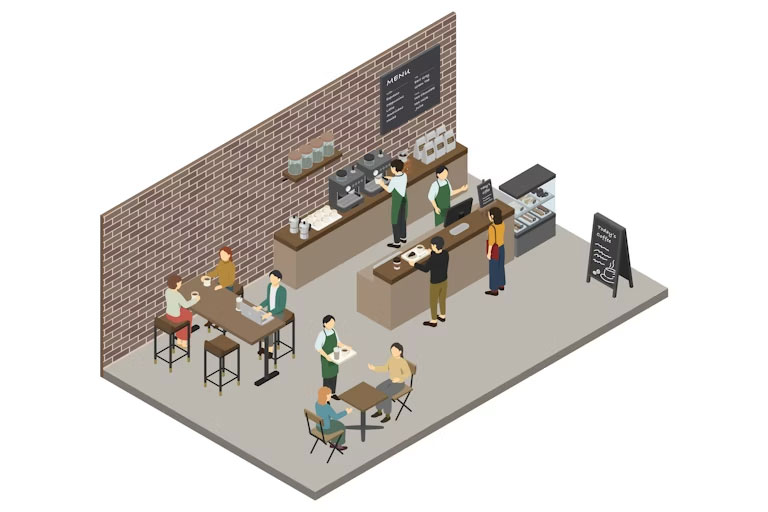
    What was up with all the exposed brick? Why did so many of the baristas look cooler than us, but also so similar to one another? And why did most menus appear on a chalkboard, as if we were still in kindergarten?

    Weren’t we supposed to be in one-of-a-kind, authentic settings that make us feel unique and, let’s admit it, slightly elevated?

    As it turns out, the visual patterns we noticed had never been backed up by research. So after a quick cortado, we set out to test our hunch that local coffee shops had adopted a uniform aesthetic.

    Measuring homogeneity

    We asked over 100 American and Canadian young professionals living in cities to share an interior image of their favorite independent coffee shop, describe why they liked the shop’s appearance, and document aspects of its interior design.

    They could select these interior design features from a list of 23 common elements that we had identified in a pilot study – brick walls, marble counters, indoor plants, local art, vintage furniture and even the look of the baristas. Respondents could also write down other details they noticed.

    The elements that they selected and wrote down showed a fascinating overlap.

    Baristas led the pack: Two-thirds of the participants’ favorite local coffee shops had staff with tattoos or piercings. Over half had baristas with beards. Well over half of the respondents noted that their favorite shop had chalkboards, reclaimed wood features, local art, milk foam designs on beverages, local event posters and exposed brick. A large share of the shops had vintage furniture, community message boards and free books available to patrons to read. One-third of the images had indoor plants, trees or greenery.

    Barista with a beard and tattooed hands pours boiling water over coffee grounds.
    Chances are your favorite local coffee shop has a barista with a beard and tattoos. Wera Rodsawang/Moment via Getty Images

    Next up, we challenged the participants to identify the city where these coffee shops were located.

    Using the images provided by the respondents from the initial survey, we asked 158 new and prior participants if they could match the location of the shops depicted in six photographs to Cincinnati, St. Louis or Toronto – cities chosen for their different architectural and aesthetic qualities.

    Not a single participant was able to correctly identify the correct city for all the photos.

    We gave respondents another chance by showing two pictures of coffee shops, one at a time. This time, the two shops were located in Chicago and San Francisco – again, places that pride themselves on their unique and recognizable design culture. They were now given the choice of these key cities to select from, as well as three wrong cities. Only 6% successfully located both coffee shops, and nearly 20% immediately gave up.

    As one participant conceded: “Honestly, these aesthetics are very transferable now … they were random guesses and they could have been in any of the cities mentioned.”

    In other words, independent coffee shops in North America have become so similar aesthetically that their location cannot be picked from a lineup. The purportedly unique and local feel of coffee shops has instead been homogenized into a singular, palatable, North American aesthetic.

    Ironically, these shops have narrowed their aesthetics like a de facto brand franchise – exactly like the chain stores that their patrons ostensibly reject.

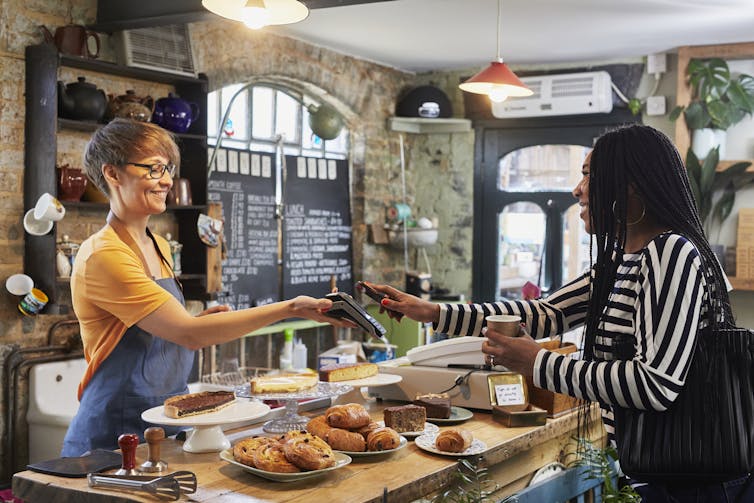
    A young woman with dreadlocks pays for her coffee as a smiling young female barista with short hair holds out a card reader.
    Exposed brick, check. Plants, check. Chalkboard, check. Tara Moore/Digital Vision via Getty Images

    Computers and capital

    So why is this happening?

    New Yorker cultural critic Kyle Chayka has attributed aesthetic homogenization to popular social media platforms like Instagram. He calls it the “tyranny of the algorithm”: Social media algorithms promote the visuals that users are most likely to engage with. This, in turn, causes the same types of visuals to be liked and shared, since users encounter them more often. Because the algorithm sees they’re popular, it continues to promote them, in a self-reinforcing cycle. In turn, coffee shop owners also see these online images and try to replicate them in their own establishments.

    Artificial intelligence will likely accelerate the digital homogenization of visual culture, since AI models are trained on massive datasets that feature widely circulated images. Whether it’s popular fashion, architecture or interior design, idiosyncrasies are collapsing into a generic, hegemonic aesthetic – what scholars Roland Meyer and Jacob Birken call “platform realism.”

    Finance plays a role as well. With the average cost of starting a new coffee shop between US$80,000 and $300,000, and with only a small share of coffee shops expected to stay open beyond five years, banks are keen to reduce their risk. Many of them will therefore ask aspiring coffee shop owners to opt for cheaper interior design choices that appeal to the broadest customer base.

    The consumer also plays a role

    But patrons of hip coffee shops may also be to blame.

    Decades before the rise of social media, AI and financial risk management, scholars such as Sharon Zukin revealed how young urban professionals paradoxically embrace the homogenization of their environment in their quest for authenticity.

    Those exposed brick walls? Zukin already described how Manhattan real estate brokers had marketed them to gentrifying SoHo yuppies in the early 1980s.

    Like their predecessors, today’s hipsters, creative professionals and knowledge workers are essentially cultural and aesthetic consumers. Many of them crave visuals – from fashion to architecture – that are different enough to feel cool and authentic, yet safe enough to match their lifestyle and their social status. They want a tasty latte as much as a palatable interior to drink it in.

    Businesses and developers are eager to appeal to these upwardly mobile consumers. At the same time, they want to reach the biggest number of customers. So they tend to create repeatable, homogenized environments in what Zukin describes as a “symbolic economy.”

    In coffee shops, patrons want more than a good espresso. They want to immerse themselves in a “scene” that matches their lifestyle and aspirations. And the exposed brick and the vintage furniture do just that – even if they’ve been copy-and-pasted in cities, small and large, across the nation.

    As we chase authenticity, we may just be finding comfort in carefully curated conformity.

    This article originally appeared on The Conversation. You can read it here.

  • Overpackers love this simple ‘5-4-3-2-1’ packing rule that makes travel way easier
    Photo credit: CanvaAn obvious overpack for travel.
    ,

    Overpackers love this simple ‘5-4-3-2-1’ packing rule that makes travel way easier

    When it comes to travel, packing efficiently is a skill acquired through experience. Lifestyle and content creator Alison Lumbatis shares a helpful 5-4-3-2-1 method designed to take the stress out of packing for both seasoned travelers and first-timers. Trying to pack light while still remembering everything you need can feel a little daunting. A simple…

    When it comes to travel, packing efficiently is a skill acquired through experience. Lifestyle and content creator Alison Lumbatis shares a helpful 5-4-3-2-1 method designed to take the stress out of packing for both seasoned travelers and first-timers.

    Trying to pack light while still remembering everything you need can feel a little daunting. A simple trick is knowing exactly what’s necessary, making your bag lighter and more practical.

    @alisonlumbatis

    Calling all overpackers—this one’s for you! ✈️🧳 The 5-4-3-2-1 packing method is one of my favorites because it’s totally customizable. Prefer dresses? Swap a top and bottom for a dress. Love skirts? Sub them in for pants! These pieces should last you 1-2 weeks, depending on your access to laundry. 🔗’s to everything in bio! #outfitformulas #packinglight #styleconfidence #wardrobemadeeasy #travelcapsule #dailyoutfits #closetconfidence #vacationstyle #fashionover40 #smartstyle

    ♬ original sound – Alison Lumbatis

    Putting The ‘5-4-3-2-1 Packing Method’ Into Action

    In her trending TikTok post, Lumbatis shares a packing system she claims to be “as easy as it sounds.” Here are the basics of the 5-4-3-2-1 packing method:

    • 5 TOPS
    • 4 BOTTOMS
    • 3 SHOES
    • 2 LAYERS
    • 1 MISCELLANEOUS

    Lumbatis explains, “So all you got to do is pick out 5 tops, 4 coordinating bottoms, 3 pairs of shoes, 2 layering pieces, and 1 of anything else. Like a dress, pajamas, a hat, a belt, or any other accessories that you might need. And then of course pack as many undergarments and toiletries as you need.”

    The strategy isn’t just about simplifying and maximizing the number of items you bring on a trip. It’s also about function. “The key is to pick versatile pieces that can mix and match so you can pair them up for whatever activities you have planned for your trip.”

    minimalism, versatile pieces, functionality, packing
    Packing the necessary items
    Photo credit Canva

    Taking Pictures Can Help Plan Ahead

    Another helpful step is taking photos of your outfits to remember how everything fits together. Lumbatis offers, “You can even take pictures of the outfits with you wearing them or flat lays of the pieces and keep them on your phone or in your Notes App — So you can refer back to it on your trip.”

    Is the 5-4-3-2-1 packing method effective? These were some of the thoughts in the comments from readers hopeful to put the plan into action:

    “Great tip for me. Hate packing and never wear all the clothes I bring.”

    “Heading to Japan and I was just going to my closet to put it together. I overpack so this is sooo helpful.”

    “I’m dreading how to not over pack for such a variety of occasions, heat, and limited washing facilities. Ugh.”

    “I struggle with under packing so this is super helpful!”

    travel, adventure, alleviate stress, preparation
    Soaking up the adventure.
    Photo credit Canva

    The Science Behind Good Preparation

    Traveling is a great way to alleviate the stress and burdens of our daily lives. A 2025 study in Springer Nature Link showed travel helped people improve their long-term resilience by creating positive emotions while ecouraging self reflection. National Geographic found the benefits of travel begin even before the trip begins.

    However, preparation can have a powerful effect on the simple stresses a person might acquire during traveling. A 2025 study revealed that planning reduced anxiety and helped people prepare for delays or unexpected changes. Research in 2025 reported by AP News found that even making a simple checklist reduced anxiety and helped make for smoother trips.

    Lumbatis claims, “If you struggle with overpacking and want to create a great capsule wardrobe packing list, you’ve got to try this method.”

    People hope that traveling will relieve stress more than generate it. The 5-4-3-2-1 packing method offers a clear and simple way to pack just what you need. Careful preparation helps prevent last-minute chaos and produces a more enjoyable trip. Hopefully, this method can help you spend less time worrying and more time soaking in the adventure.

    Watch this YouTube video on incredible vacation destinations to inspire your next trip:

  • People are cheering woman’s refusal to accept the latest trend in hotel bathrooms
    Photo credit: @bring_back_doorsSadie has declared war on non-private hotel bathrooms.

    People are cheering woman’s refusal to accept the latest trend in hotel bathrooms

    “I HATE how hotels started thinking going to the bathroom is a shared experience.”

    It can be frustrating seeing change for change’s sake in the world. To be more specific, changes that are said to be done in the name of innovation and design, but are in truth ways for companies to save a buck.

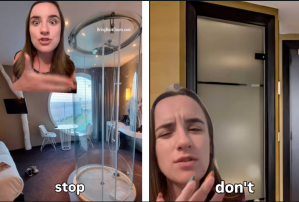
    One example that is getting attention is the bathroom doors in hotels… or the lack thereof, actually. One TikToker has had enough and has taken it upon herself to save regular bathroom doors in hotels and to point out why open-space bathrooms and glass doors just don’t cut it.

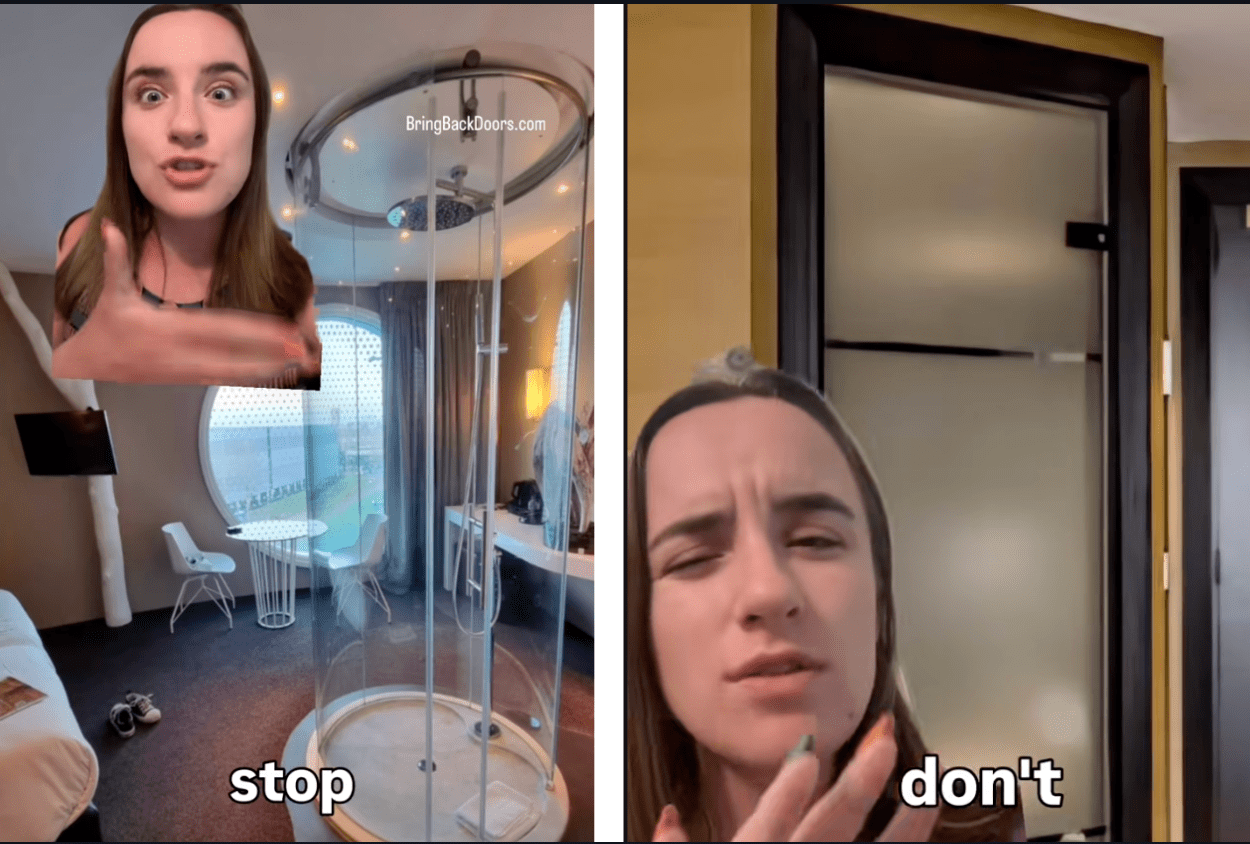
    On her @bring_back_doors TikTok account, Sadie has a collection of videos highlighting the flaws in hotel bathroom designs, with the most prominent being the lack of a regular door to the bathroom. In one viral TikTok, Sadie discussed a hotel that reached out to her, explaining that they have “foggy” glass doors to their bathroom to provide privacy. She was quick to point out that it still doesn’t provide adequate privacy. “Yes you can see through these,” Sadie said, adding that “glass doors do not close properly.”


    @bring_back_doors

    Hotel name: Alexander Hotel, Noordwijk aan Zee, Netherlands I need to be clear. Glass doors are not private. And making them foggy does not make them private. I am once again sitting here saying screw you to all bathroom doors that are not solid and close fully. And I am providing alternative hotels with guaranteed doors at bringbackdoors.com Check your hotels door situation before you book or risk your privacy. Door submitted by @mmargaridahb, DM me to submit your own bad doors. #bathroomdoors #hotel #travel #fyp Bathroom doors | bathroom design | hotel design | bad hotel design | travel fail | travel memories | travel inspo | door design | hotels with privacy

    ♬ original sound – Bring Back Bathroom Doors

    The comments rallied behind Sadie’s bathroom-door crusade

    The commenters joined in with Sadie, demanding the return of solid, closing, and lockable doors to bathrooms in hotels:

    “I HATE how hotels started thinking going to the bathroom is a shared experience.”

    “I hate how you can’t turn the bathroom light on without disturbing the other person in the room.”

    “The foggy ones are almost worse, you just get a hazy fleshy silhouette hunched over on the crapper like some kind of sack of ham.”

    “I just don’t get it, NOBODY wants this, even couples. I won’t be more likely to book two separate rooms for me and my friend/sibling/parent, I’ll just book another hotel.”

    “Love this campaign, I do not want a romantic weekend listening to the other person poo.”


    @bring_back_doors

    Hotel Names⬇️⬇️ Citizen M South Hotel (first pics) and Fletcher Hotel (third pic) both in Amsterdam. As part of this project, I’ve been emailing hotels around the world to put together an easy to reference list for people to find hotels with guaranteed doors at BringBackDoors.com And I did notice that in Amsterdam a lot of hotels were saying they don’t have doors. It wasn’t the worst city (that honor goes to Barcelona, so far I’ve only found TWO that have said yes to all doors), but it was still bad. Then I went into the comments. And kept getting people mentioning these hotels in Amsterdam. And I realized that clearly the city has a designer or architect on the loose who has a thing for test tubes. It’s horrible. Luckily, I was able to find 6 hotels in Amsterdam that all have bathroom doors in every room and have them all listed on BringBackDoors.com These hotels were submitted by so many people I couldn’t name them all. But to submit your own bad hotel bathroom send me a DM with hotel photo, name, and location! #hotel #bathroom #hoteldesignfail Bathroom doors | hotel bathrooms | hotel privacy | no privacy | travel problems | hotel issues | travel | hotel design | hotel design fail | hotel designers | design fail | hotel concept | bathrooms | Citizen M | Hotel Fletcher | Hotels in Amsterdam | Visit Amsterdam | Amsterdam

    ♬ original sound – Bring Back Bathroom Doors

    A great way to save a buck—er, I mean, ‘create a modern look’

    As many commenters asked, why do hotels have glass doors — or, worse, no doors at all—in their bathrooms? Well, this has been a growing trend in modern hotels over the past decade as a means to create a sleek aesthetic and to allow glass partitions to bring more daylight into otherwise darker sections of the room.

    At least that’s what’s being promoted to the customer. In reality, skimping on solid doors for glass ones or none at all gives the illusion that the room is bigger than it is while requiring fewer building materials. It does bring in more daylight, but mostly with the hope that you’ll cut down on electricity use for lights in an otherwise enclosed space. These reasons are also why some hotels don’t have solid walls around their bathroom areas at all.

    TikTok · Bring Back Doors

    TikTok u00b7 Bring Back Doors www.tiktok.com


    Tired of the lack of privacy? Check out the database

    To combat this trend, Sadie has developed a database at bringbackdoors.com for her and her followers to report which hotels have true, solid, private bathrooms in their accommodations and which ones do not, so people can properly plan where to stay and have true privacy during their most vulnerable moments.

    “I get it, you can save on material costs and make the room feel bigger, but what about my dignity?,” Sadie wrote on her website. “I can’t save that, when you don’t include a bathroom door.”

    Over time, the hope is that sanity and dignity can be restored as hotels realize that their glass “features” don’t have any real benefit when they don’t allow basic privacy.

Explore More Design Stories

Design

Indie coffee shops are meant to counter corporate behemoths like Starbucks – so why do they all look the same?

Culture

Overpackers love this simple ‘5-4-3-2-1’ packing rule that makes travel way easier

Design

People are cheering woman’s refusal to accept the latest trend in hotel bathrooms

Design

MIT’s super-fast camera can capture light as it travels