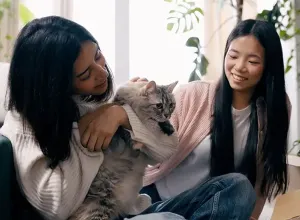

A new study of the elderly is showing that regular social activity could offset or delay dementia by five years. The study published by the Alzheimer’s Association is showing that just playing games with folks regularly, volunteering, or just having a regular lunch with a friend can significantly slow down cognitive decline.
The researchers at Rush University studied 1,923 dementia-free seniors with an average age of 80 that underwent annual neurological evaluations. Cognitive function was measured through 21 different tests that assessed various types of memory along with perception of speed and visuospatial ability. Out of the total, 545 developed dementia and 695 developed some form of mild cognitive impairment within the five-year analysis. Accounting for other factors and adjustments for analysis, such as age, physical fitness, and other health issues, the results found that the participants that participated in social activities regularly had a slower mental decline or little to no decline at all.
Social activity was measured based on a survey that asked participants if they had participated in six common social activities for their age group within the previous year. Some of the options listed included playing bingo, going out on a day or overnight trip, volunteering, visits with friends or relatives, and going out to restaurants. To put it in percentages, the findings showed that a more regular social life pointed at a 38% reduction in dementia risk and a 21% reduction in mild cognitive impairment compared to those who were the least socially active.

So being active as an older person is not only good for the soul, but good for the brain, too. But that’s when we hit a bit of a problem. As you get older, it becomes more and more difficult to develop new friendships and maintain them. In fact, according to the current U.S. surgeon general, we have a loneliness epidemic in this country that impacts the mental and physical health throughout all age ranges, but particularly people in their 30s and 40s. In other words, younger adults should learn how to be more social now in order for themselves to have the skills to develop friendships as they get older, too. For their brains’ sake, and for overall quality of life.
So how do you make friends as an adult? Well, the answer is that there are many ways you can make new friends and maintain treasured relationships, which is a wonderful problem. The problem is that there are so many options, but finding the right ones for you could take a lot of trial and error.

A simple internet search of “how to make friends as an adult” can lead you to many different options that you might be frozen by choice. To winnow it all down, think of the activities you like or causes you care about. Check online to see if there are any local clubs or a Facebook group/social media group to follow regarding events in your area to meet people. Volunteer your time to a cause or public service you support, like a pet shelter or a food pantry. If you just want to go to an Applebee’s, there might just be a group of folks who also just meet up at Applebee’s once a month. If not, maybe you can start one!
If you do have a set of friends or activities, make it a point to show up regularly for them. Have a set appointment to grab lunch with your buddies twice a month. Go to the weekly club meeting, even if you don’t feel like going. Cementing social activities in your routine can help you keep and maintain those connections while providing brain health. If you’re not in the mood, you can even tell yourself “it’s for my brain health” to help motivate you to attend. If not, again, there are other people, clubs, and activities to choose from that might be a better fit for you.

A common saying among pet owners is that the hardest thing about loving a dog is saying goodbye. Having a senior dog, especially one raised from a puppy, can be difficult not just because of the inevitable, but also because the pet may be going through age-related ailments or disease before crossing over. It’s a hard thing to experience anyway, but especially when you remember how they were in their prime. Well, veterinary scientists are testing a daily pill that extends a dog’s lifespan while also maintaining their quality of life.
Loyal, a biotech company based in San Francisco, has been trying to develop anti-aging drugs for dogs ever since it was founded. After years of research and testing, they have developed LOY-002, a beef-flavored daily prescription pill for senior dogs aged 10 and older that weigh over 14 pounds. Early testing shows that the pill can add years to a dog’s life, especially larger breeds.
What does this dog lifespan pill do?
The pill interacts and manipulates IGF-1 (Insulin-Like Growth Factor 1), a hormone that’s key to a dog’s cellular growth and metabolism. IGF-1 helps a dog grow in both size and calorie consumption. This hormone helps make young puppies become strong adult dogs. However, it also continues and accelerates aging at a cellular level when a dog is fully grown.
This explains why many larger breeds of dogs tend to live shorter lives than smaller ones. Their IGF-1 levels are higher. It moves them faster towards age-related diseases and discomfort than smaller dogs.
By reducing the excessive IGF-1, LOY-002 reduces the speed of a larger dog’s biological clock. It doesn’t just make them “feel” younger. Slowing everything down adds years to their life and curbs the risk of age-related organ dysfunction, disease, and early death. After thorough testing, LOY-002 cleared two out of the three sections of acceptance before being fully vetted by the Food and Drug Administration.
“Since founding Loyal six years ago, my goal has always been to get the first drug FDA approved for lifespan extension. This safety acceptance brings us very close to achieving that vision,” said Loyal Founder and CEO Celine Halioua. “We are well on our way to bringing the first dog longevity drugs to market.”
How can a senior dog live longer?
Should Loyal receive that final approval, the LOY-002 drug should go to market before the end of 2026. However, veterinarians and dog care experts have some tips on how to help your older dog live longer and healthier.
Visit your dog’s veterinarian often for checkups and keep them notified of any changes in their behavior. They may recommend a specific diet for your dog at their advanced age. Similar to humans, older dogs are encouraged to follow a healthy diet. They should exercise regularly (through walks or playtime) to keep a healthy weight and keep joints strong.
If your dog has joint trouble, your vet may recommend some supplements to help the dog’s mobility and comfort. No matter the issue, it is best to consult with a veterinarian before making lifestyle changes for your dog.
Such advice can help both you and your dog live full lives together. It may also add a few more years of furry companionship along the way, too.
Photo credit: Brookfield Zoo Chicago’s Sarasota Dolphin Research Program, taken under NMFS MMPA Scientific Research Permit – Bottlenose dolphins are social creatures that use whistles and clicks to communicate with each other.
But it wasn’t until the 1960s that methodical research into dolphin communication began. Scientists like John Lilly and the husband-and-wife team of Melba and David Caldwell tried various experiments to decipher the sounds dolphins can make.
The Caldwells figured out a way to record isolated animals in human care. They discovered that each individual dolphin communicated mostly with one unique whistle, which they called the “signature whistle.” Researchers now know that these whistles convey identities much like human names do. Dolphins use them to stay in touch with each other in their murky habitat, where vision is limited. It’s like announcing “I’m over here!” when someone can’t see you.
This collaborative study, led by Randall Wells of Brookfield Zoo Chicago’s Sarasota Dolphin Research Program, involves numerous researchers from a variety of institutions, who study different aspects of dolphin biology, health, ecology and behavior. Begun in 1970, this is the longest-running research project on a population of wild cetaceans – whales, dolphins and porpoises – in the world.
Photo credit: Photo by Brookfield Zoo Chicago’s Sarasota Dolphin Research Program, taken under NMFS MMPA Scientific Research Permit – Each dolphin has distinctive markings on its dorsal fin. Experienced researchers can sometimes identify them by sight in the field, and they photograph them to confirm their identity in the lab.
Recording and observing
Researchers know the age, sex and maternal relatedness of almost all of the approximately 170 dolphins in the Sarasota community. This depth of knowledge provides an unprecedented opportunity to study communication in a wild cetacean species.
The dolphins in the Sarasota project are periodically subject to brief catch-and-release health assessments, during which researchers, including me, briefly handle individual dolphins.
Our team attaches suction-cup hydrophones directly onto each dolphin’s melon – that is, its forehead. We then record the dolphins continuously throughout the health assessments, taking notes on who is being recorded when, and what is happening at the time.
This is how my colleagues and I were able to confirm that wild dolphins, like captive animals, produced large numbers of individually distinctive signature whistles when briefly isolated from other dolphins. Through observations and recordings of known free-swimming dolphins, we were further able to confirm that they produced these same signature whistles in undisturbed contexts.
We have organized these recordings into the Sarasota Dolphin Whistle Database, which now contains nearly 1,000 recording sessions of 324 individual dolphins. More than half of the dolphins in the database have been recorded more than once.
We identify each dolphin’s signature whistle based on its prevalence: In the catch-and-release context, about 85% of the whistles that dolphins produced are signature whistles. We can identify these visually, by viewing plots of frequency vs. time called spectrograms.
Spectrograms of signature whistles of 269 individual bottlenose dolphins recorded in Sarasota. Figure created by Frants Jensen, with sound files from Laela Sayigh
Signature whistles and ‘motherese’
The Sarasota Dolphin Whistle Database has proved to be a rich resource for understanding dolphin communication. For instance, we have discovered that some calves develop signature whistles similar to those of their mothers, but many do not, raising questions about what factors influence signature whistle development.
Dolphin mothers modify their signature whistles when communicating with their calves by increasing the maximum frequency, or pitch. This is similar to human caregivers using a higher-pitched voice when communicating with young children – a phenomenon known as “motherese.”
Also similar to humans is how dolphins will initiate contact with another dolphin by imitating their signature whistle – what we call a signature whistle copy. This is similar to how you would use someone’s name to call out to them.
Our team is interested in finding out if dolphins also copy whistles of others who aren’t present, potentially talking about them. We have seen evidence of this in our recordings of dolphins during health assessments, which provide a rare context to document this phenomenon convincingly. But we still have more work to do to confirm that these are more than chance similarities in whistles.
Shared whistle types
Another exciting development has been our recent discovery of shared whistle types — ones that are used by multiple animals and that are not signature whistles. We call these non-signature whistles.
I could hardly believe my ears when I first discovered a repeated, shared non-signature whistle type being produced by multiple dolphins in response to sounds we play back to them through an underwater speaker. We had previously believed that these non-signature whistles were somewhat random, but now I was hearing many different dolphins making a similar whistle type.
Our team originally had been using the playbacks to try to determine whether dolphins use “voice cues” to recognize each other – similar to how you can recognize the voice of someone you know. Although we found that dolphins did not use voice cues, our discovery of shared non-signature whistle types has led to an entirely new research direction.
The author listens to dolphin whistles on a boat in Sarasota. Jonathan Bird from the film ‘Call of the Dolphins’/Oceanic Research Group, Inc.
So far, I’ve identified at least 20 different shared non-signature whistle types, and I am continuing to build our catalog. We are hoping that artificial intelligence methods may help us categorize these whistle types in the future.
To understand how these shared non-signature whistle types function, we are carrying out more playback experiments, filming the dolphins’ responses with drones. We’ve found that one such whistle often leads the dolphins to swim away, suggesting a possible alarm-type function. We have also found that another type might be an expression of surprise, as we have seen animals produce it when they hear unexpected stimuli.
More difficult, more interesting
So far, the main takeaway from our experiments has been that dolphin communication is complex and that there are not going to be one-size-fits-all responses to any non-signature whistle type. This isn’t surprising, given that, like us, these animals have complicated social relationships that could affect how they respond to different sound types.
For instance, when you hear someone call your name, you may respond differently if you are with a group of people or alone, or if you recently had an argument with someone, or if you’re hungry and on your way to eat.
Our team has a lot more work ahead to sample as many dolphins in as many contexts as possible, such as different ages, sexes, group compositions and activities.
This makes my job more difficult – and far more interesting. I feel lucky every day I am able to spend working on the seemingly infinite number of fascinating research questions about dolphin communication that await answers.
Gavin, with help from aquarium staff, had secretly planned to propose right in front of the beluga whale tank. As he got down on one knee, a whale named Qinu swam into view.
The 16-year-old marine mammal paused right at the glass and appeared to drop her jaw in shock.
I’ve been interning with the beluga training team for the last 3 months so this was the most thoughtful way he could’ve done it 🥺 #georgiaaquarium#belugawhale#proposal
The moment was caught on video, and when Olivia shared it on TikTok, the comment section exploded. It looked exactly like the whale was gasping at the size of the ring.
“The most perfect proposal I could’ve asked for,” Olivia wrote.
Viewers immediately anthropomorphized the whale’s hilarious expression.
“The beluga NEEDS to officiate the wedding now,” one user joked.
Another simply commented: “The beluga: :O”
Even the official Play-Doh account chimed in to insist that the whale deserved a wedding invite.
According to People, Qinu’s involvement wasn’t a planned stunt. Katie Lorenz, the associate curator of mammals and birds at the Georgia Aquarium, confirmed that the reaction was entirely natural.
“Qinu’s behavior at the window was her own,” Lorenz said. “She was not intentionally trained to have any type of reaction.”
Unlike many other whales, belugas have unique physical characteristics that allow for this kind of “human” expression. They have a flexible neck and unfused cervical vertebrae, which allows them to nod and turn their heads.
Furthermore, their “melon” (the rounded forehead) is flexible and capable of changing shape, which often makes them appear to be smiling or making faces.
The moment was even more poignant because Olivia wasn’t just a random visitor. She had actually been a beluga whale training intern at the aquarium for the past three months.
“My fiancé is the most thoughtful person,” she wrote in a reply. “He knows how much I’ve loved working with the whales and truly made it the most special moment.”
The Conversation
Of course, viral videos involving captive animals often spark debate. Some commenters questioned the ethics of keeping an animal like Qinu in a tank.
“Nothing cute or adorable about these sentient creatures being kept confined in glass houses for human amusement,” one user wrote.
A beluga whale pops up from the water. Photo credit: Canva
However, for the vast majority of viewers, the video was a moment of pure joy. The clip has racked up over 7 million views on TikTok alone, and Qinu has officially become the internet’s favorite wedding crasher.
For those who want to see more of the star, the Georgia Aquarium maintains a live beluga cam where fans can check in on Qinu. As for the happy couple, they now have a proposal story that is going to be very hard to top.
This article originally appeared last year. It has been updated.