
According to the Pew Research Center, 73.9 million people in the United States collect some form of Social Security benefit. By design, it has become a primary source of income for retirees in our country to help boost their accounts and pay for needs during their golden years. As the economy ebbs and flows, it can still be difficult for retired people to make ends meet even with Social Security benefits. However, a new map could help those folks find a place to live where their Social Security funds stretch further.

A new map created through data collected by Realtor.com has found ten states in the U.S. in which retirees could live comfortably off their Social Security benefits alone—provided their mortgage has been paid off. That is considered the most important factor. While other costs such as food, transportation, and health care are factors, the difference in those costs from state to state is minimal compared to the cost of shelter. If the cost of housing is lower, the more surplus Social Security money a person can have to use elsewhere.

@retireanyage

Ever wonder how retirees survive on $2,000/month Social Security? Social Security reality check ? Here’s what most people don’t know: 21.8 million seniors rely on Social Security alone. That’s about 4 in 10 older Americans, ? and it’s similar in Australia where 62% of seniors aged 65+ rely on the Age Pension alone, also $2000 a month. $2,000/month sounds okay until you do the math. Rent $1,200, utilities $150, Medicare $200 = $1,550 gone. What’s left? $450 per mth for food, medicine, transportation, EVERYTHING else ? Most “survivors” are barely existing, not living. One car repair or medical bill = disaster ? The people who make it work either own their homes outright, live in very cheap rural areas, or qualify for assistance programs. Even then, they’re choosing between groceries and medicine ? 67 percent of seniors rely on Social Security for more than half their income, and this isn’t rare, it’s the reality for millions ? That’s why I’m building backup income at 66, because Social Security, the Pension here in Australia is survival, not retirement. If you’re worried about your future too, you’re not alone. There are other options for people our age willing to take action ? Ready to explore what’s possible? Let’s chat about creating your backup plan. Follow first, and Comment BACKUP and I’ll send you a video link explaining how the plan works. #PensionReality #RetirementPlanning #FinancialPlanningOver50 #RetirementIncome #BackupIncomeNeeded ♬ original sound – Debs Daily Pay

Where can I live off of Social Security alone?

Of the ten states, Delaware tops the list as mortgage-free retirees would have $1,764 of an annual surplus as their median monthly benefits there are around $2,139, and the average monthly costs are $1,992. This is followed by Indiana with a $1,392 annual surplus, Arizona with a $1,224 annual surplus, Utah with $888, and South Carolina with $828. The rest of the top ten ends with West Virginia, Alabama, Nevada, Tennessee, and Michigan, in which Michigan ekes out with only $132 in annual surplus funds.

@geenaildefonso

We’re not explicity told or educated on the fact that our hard earned money each month taken out for social security is being used right now to pay people who are in retirement. #money #finances #retirement #socialsecurity #life #taxes #inflation #americans #relatable #millennial #genz #genx ♬ original sound – Dr. Geena Ildefonso

It’s important to keep in mind that “make ends meet” and “living well” are different from person to person, situation to situation. There are some states in which $100 stretches further than others, and the cost of living can also vary within the states themselves. Even a retiree living in Delaware would have a harder time living off of their Social Security benefits if they lived in Greenville compared to Wilmington. It also cannot be stressed enough that these ten states allow those with Social Security benefits to live off them alone if their mortgage has been fully paid off, and that some folks might still have to live a leaner lifestyle with a strict budget.

Living on Social Security alone isn’t “living” for many people

This is partially why you may have read some stories about retirees choosing to live off-land on cruise ships for their retirement rather than on owned property. Regardless of which state you live in, a great majority of Americans are trying to find ways to have their money go further whether it’s using free services online, finding cheaper alternatives to shopping at stores, and even moving to a different country.

@vanderbilt_money

?? 8 Countries That Offer Retirement Visas to Americans ♬ original sound – Vanderbilt Money – Vanderbilt Money

If you’re approaching retirement age and have concerns, the National Council on Aging has some suggestions. Social Security is just one of the programs you’ll qualify for when you reach retirement age, and there are others that can provide financial assistance for health care (such as Medicare), housing, energy, wireless/phone service, and food alongside your benefits. If you’re active and full-time retirement isn’t for you, you can work part-time or as a freelancer in many different fields. You could take on a hobby such as woodworking, photography, or something of that nature to turn into a part-time side hustle for extra income, too. Living your golden years well can only be defined by you and, fortunately, there are a number of options out there to help you achieve that goal, whether you can live off of Social Security alone or not.


  • She tipped a dollar on a $5 coffee and the barista called her out in front of the whole café. The internet couldn’t agree on who was wrong.
    Photo credit: CanvaBarista hands customer their coffee
    ,

    She tipped a dollar on a $5 coffee and the barista called her out in front of the whole café. The internet couldn’t agree on who was wrong.

    The incident touched a nerve because almost everyone has stood at a tip screen lately wondering what they actually owe.

    A regular customer at her local coffee shop dropped a dollar in the tip jar on her way out last week and ended up sparking a debate that a lot of people clearly needed to have.

    She’d paid $5 for her coffee, skipped the card tip prompt at checkout, and left a bill in the jar on her way out the door. The barista noticed, glanced at the cash in her customer’s wallet, and said loudly enough for the room to hear: “Oh wow! A whole dollar… that’s SO generous! Thank you SO much.”

    The customer, who goes by u/moonchildcountrygirl on Reddit, said she was rattled enough to wonder whether something was going to end up in her drink. When she posted about it online, Newsweek picked up the story and more than 800 comments followed.

    Reddit’s reaction was not especially sympathetic to the barista. “Should have picked that dollar back,” was among the most upvoted responses. Others said they would have asked for a full refund on the drink. The OP herself landed on a version of that position: if a tip is going to be met with sarcasm, why tip at all?

    But the incident is a little more complicated than a straightforward etiquette violation, because the math here actually favors the customer. A dollar on a $5 drink is a 20% tip, the same percentage most people consider the standard for a sit-down restaurant with table service. Industry veterans generally say a dollar a drink is a reasonable coffee shop tip, and that baristas at most cafés (unlike servers) are paid standard minimum wage rather than the lower tipped-employee rate that makes gratuities more essential.

    A barista serves a customer in a coffee shop
    A barista serves a customer. Photo credit: Canva

    None of which makes a public sarcastic remark the right response. But it does situate the incident inside a broader frustration that’s been building for a few years. A Pew Research Center survey found that 7 in 10 American adults say tipping is now expected in more places than it was a few years ago. A Bankrate survey found that 41% of Americans think tipping culture has gotten out of hand, and around 63% have at least one negative view about tipping overall. More than 60% agreed that employers should simply pay workers better so tips don’t have to fill the gap.

    The tip jar and the checkout screen have become the place where all of that tension gets concentrated into a single uncomfortable moment. The barista’s comment was out of line. The customer’s dollar was not stingy. And the fact that it’s hard to say either of those things without someone disagreeing is probably the actual story.

    This article originally appeared earlier this year.

  • Denmark’s generous parental leave policies erase eighty percent of the ‘motherhood penalty’
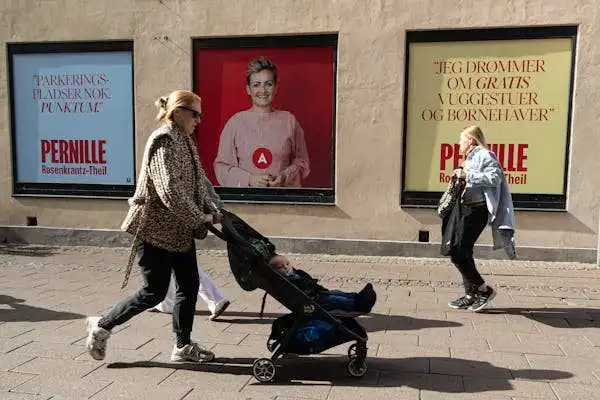
    Photo credit: Sergei Gapon/AFP via Getty ImagesA Danish mom drops her young son at his school in Copenhagen.
    , , ,

    Denmark’s generous parental leave policies erase eighty percent of the ‘motherhood penalty’

    Paid leave and universal child care help moms stay attached to work, even as reduced hours trim pay.

    For many women in the U.S. and around the world, motherhood comes with career costs.

    Raising children tends to lead to lower wages and fewer work hours for mothers – but not fathers – in the United States and around the world.

    As a sociologist, I study how family relationships can shape your economic circumstances. In the past, I’ve studied how motherhood tends to depress women’s wages, something social scientists call the “motherhood penalty.”

    I wondered: Can government programs that provide financial support to parents offset the motherhood penalty in earnings?

    A ‘motherhood penalty’

    I set out with Therese Christensen, a Danish sociologist, to answer this question for moms in Denmark – a Scandinavian country with one of the world’s strongest safety nets.

    Several Danish policies are intended to help mothers stay employed.

    For example, subsidized child care is available for all children from 6 months of age until they can attend elementary school. Parents pay no more than 25% of its cost.

    But even Danish moms see their earnings fall precipitously, partly because they work fewer hours.

    Losing $9,000 in the first year

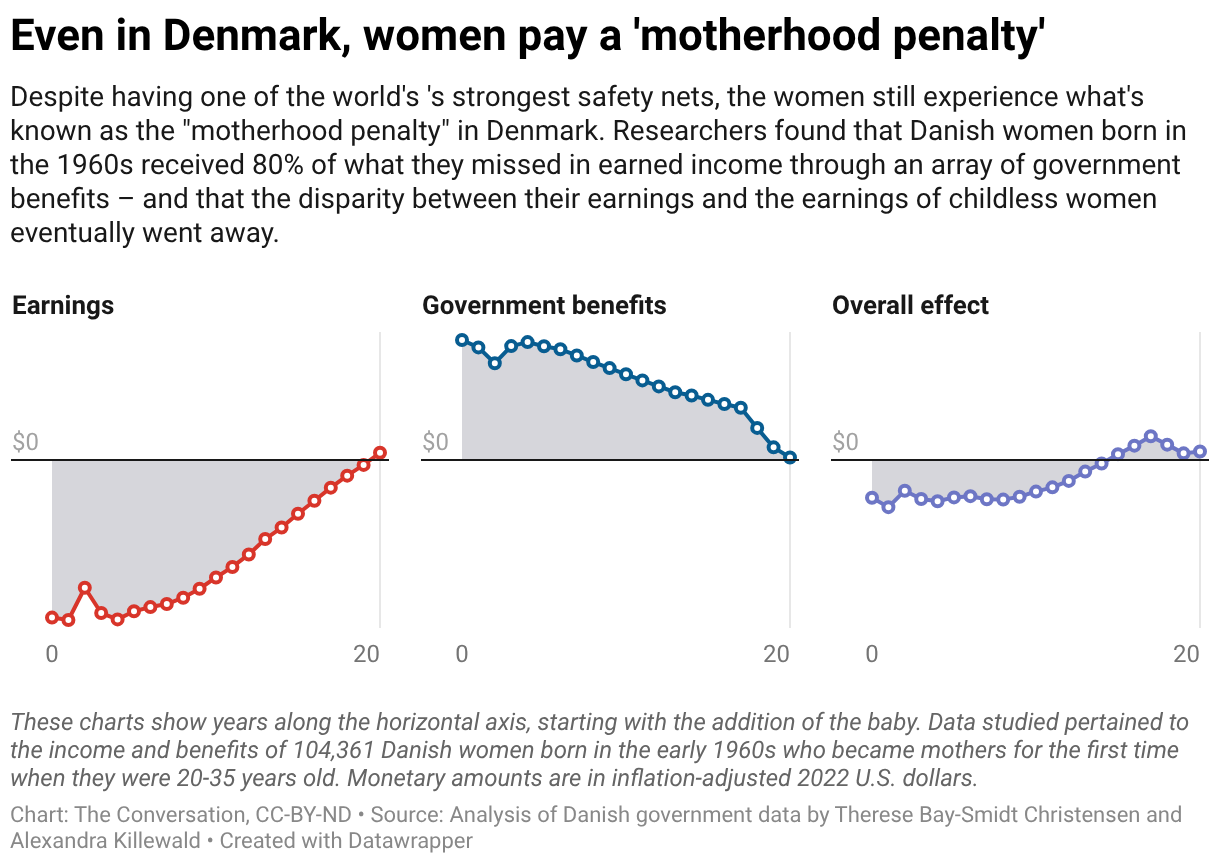
    In an article to be published in an upcoming issue of European Sociological Review, Christensen and I showed that mothers’ increased income from the state – such as from child benefits and paid parental leave – offset about 80% of Danish moms’ average earnings losses.

    Using administrative data from Statistics Denmark, a government agency that collects and compiles national statistics, we studied the long-term effects of motherhood on income for 104,361 Danish women. They were born in the early 1960s and became mothers for the first time when they were 20-35 years old.

    They all became mothers by 2000, making it possible to observe how their earnings unfolded for decades after their first child was born. While the Danish government’s policies changed over those years, paid parental leave and child allowances and other benefits were in place throughout. The women were, on average, age 26 when they became mothers for the first time, and 85% had more than one child.

    We estimated that motherhood led to a loss of about the equivalent of US$9,000 in women’s earnings – which we measured in inflation-adjusted 2022 U.S. dollars – in the year they gave birth to or adopted their first child, compared with what we would expect if they had remained childless. While the motherhood penalty got smaller as their children got older, it was long-lasting.

    The penalty only fully disappeared 19 years after the women became moms. Motherhood also led to a long-term decrease in the number of the hours they worked.

    Motherhood, Safety net, Income inequality, Denmark, Gender inequality, Scandinavia, Government benefits, Mothers Day, Mother's Day, motherhood penalty
    The u2018motherhood penaltyu2019 is largest in the first year after a momu2019s first birth or adoption. Kristian Tuxen Ladegaard Berg/NurPhoto via Getty Images

    Studying whether government can fix it

    These annual penalties add up.

    We estimated that motherhood cost the average Danish woman a total of about $120,000 in earnings over the first 20 years after they first had children – about 12% of the money they would have earned over those two decades had they remained childless.

    Most of the mothers in our study who were employed before giving birth were eligible for four weeks of paid leave before giving birth and 24 weeks afterward. They could share up to 10 weeks of their paid leave with the baby’s father. The length and size of this benefit has changed over the years.

    The Danish government also offers child benefits – payments made to parents of children under 18. These benefits are sometimes called a “child allowance.”

    Denmark has other policies, like housing allowances, that are available to all Danes, but are more generous for parents with children living at home.

    Using the same data, Christensen and I next estimated how motherhood affects how much money Danish moms receive from the government. We wanted to know whether they get enough income from the government to compensate for their loss of income from their paid work.

    Motherhood, Safety net, Income inequality, Denmark, Gender inequality, Scandinavia, Government benefits, Mothers Day, Mother's Day, motherhood penalty

    We found that motherhood leads to immediate increases in Danish moms’ government benefits. In the year they first gave birth to or adopted a child, women received over $7,000 more from the government than if they had remained childless. That money didn’t fully offset their lost earnings, but it made a substantial dent.

    The gap between the money that mothers received from the government, compared with what they would have received if they remained childless, faded in the years following their first birth or adoption. But we detected a long-term bump in income from government benefits for mothers – even 20 years after they first become mothers.

    Cumulatively, we determined that the Danish government offset about 80% of the motherhood earnings penalty for the women we studied. While mothers lost about $120,000 in earnings compared with childless women over the two decades after becoming a mother, they gained about $100,000 in government benefits, so their total income loss was only about $20,000.

    Benefits for parents of older kids

    Our findings show that government benefits do not fully offset earnings losses for Danish moms. But they help a lot.

    Because most countries provide less generous parental benefits, Denmark is not a representative case. It is instead a test case that shows what’s possible when governments make financially supporting parents a high priority.

    That is, strong financial support for mothers from the government can make motherhood more affordable and promote gender equality in economic resources.

    Because the motherhood penalty is largest at the beginning, government benefits targeted to moms with infants, such as paid parental leave, may be especially valuable.

    Child care subsidies can also help mothers return to work faster.

    The motherhood penalty’s long-term nature, however, indicates that these short-term benefits are not enough to get rid of it altogether. Benefits that are available to all mothers of children under 18, such as child allowances, can help offset the long-term motherhood penalty for mothers of older children.

    This article originally appeared on The Conversation. You can read it here.

  • Martin Luther King Jr. was ahead of his time in pushing for universal basic income
    Photo credit: Ted S. Warren/APMartin Luther King Jr. became involved not just in fights over racial equality but also economic hardship.
    , , , ,

    Martin Luther King Jr. was ahead of his time in pushing for universal basic income

    He believed UBI could go a long way toward helping those oppressed by unjust systems.

    Each year on the holiday that bears his name, Martin Luther King Jr. is remembered for his immense contributions to the struggle for racial equality. What is less often remembered but equally important is that King saw the fight for racial equality as deeply intertwined with economic justice.

    To address inequality – and out of growing concern for how automation might displace workers – King became an early advocate for universal basic income. Under universal basic income, the government provides direct cash payments to all citizens to help them afford life’s expenses.

    In recent years, more than a dozen U.S. cities have run universal basic income programs, often smaller or pilot programs that have offered guaranteed basic incomes to select groups of needy residents. As political scientists, we have followed these experiments closely.

    One of us recently co-authored a study which found that universal basic income is generally popular. In two out of three surveys analyzed, majorities of white Americans supported a universal basic income proposal. Support is particularly high among those with low incomes.

    King’s intuition was that white people with lower incomes would support this type of policy because they could also benefit from it. In 1967, King argued, “It seems to me that the Civil Rights Movement must now begin to organize for the guaranteed annual income … which I believe will go a long, long way toward dealing with the Negro’s economic problem and the economic problem with many other poor people confronting our nation.”

    But there is one notable group that does not support universal basic income: those with higher levels of racial resentment. Racial resentment is a scale that social scientists have used to describe and measure anti-Black prejudice since the 1980s.

    Economic self-interest can trump resentment

    At the same time, the results of the study also suggest that coalition building is possible, even among the racially resentful.

    Economic status matters. Racially resentful whites with lower incomes tend to be supportive of universal basic income. In short, self-interest seems to trump racial resentment. This is consistent with King’s idea of how an economic coalition could be built and pave the way toward racial progress.

    Race, Income, Safety net, Martin Luther King Day, Universal basic income (UBI), Martin Luther King, Jr. (MLK), Affordability
    As mayor of Stockton, Calif., Michael Tubbs ran a pioneering program that provided a basic income to a limited number of residents. Rich Pedroncelli/AP

    Income is not the only thing that shapes attitudes, however. Some of the strongest supporters of universal basic income are those who have higher incomes but low levels of racial resentment. This suggests an opportunity to build coalitions across economic lines, something King believed was necessary. “The rich must not ignore the poor,” he argued in his Nobel Peace Prize lecture, “because both rich and poor are tied in a single garment of destiny.” Our data shows that this is possible.

    This approach to coalition building is also suggested by our earlier research. Using American National Election Studies surveys from 2004-2016, we found that for white Americans, racial resentment predicted lower support for social welfare policies. But we also found that economic position mattered, too.

    Economic need can unite white Americans in support of more generous welfare policies, including among some who are racially prejudiced. At a minimum, this suggests that racial resentment does not necessarily prevent white Americans from supporting policies that would also benefit Black Americans.

    Building lasting coalitions

    During his career as an activist in the 1950s and 1960s, King struggled with building long-term, multiracial coalitions. He understood that many forms of racial prejudice could undermine his work. He therefore sought strategies that could forge alliances across lines of difference. He helped build coalitions of poor and working-class Americans, including those who are white. He was not so naive as to think that shared economic progress would eliminate racial prejudice, but he saw it as a place to start.

    Guaranteed income, Social programs, Universal basic income
    Martin Luther King Jr. believed Americans of different racial backgrounds could coalesce around shared economic interests. AP

    Currently, the nation faces an affordability crisis, and artificial intelligence poses new threats to jobs. These factors have increased calls for universal basic income.

    Racial prejudice continues to fuel opposition to universal basic income, as well as other forms of social welfare. But our research suggests that this is not insurmountable.

    As King knew, progress toward economic equality is not inevitable. But, as his legacy reminds us, progress does remain possible through organizing around shared interests.

    This article originally appeared on The Conversation. You can read it here.

Explore More Money Stories

Money

She tipped a dollar on a $5 coffee and the barista called her out in front of the whole café. The internet couldn’t agree on who was wrong.

Culture

Denmark’s generous parental leave policies erase eighty percent of the ‘motherhood penalty’

Justice

Martin Luther King Jr. was ahead of his time in pushing for universal basic income

Editorial

People now say that secondhand gifts are classier than those that are brand new