Earth is impressively enigmatic, with many undiscovered territories and terrains still awaiting discovery. Although geologists have scanned nearly every corner of the Earth, the possibility of hidden continents remains. In 2017, a team of geologists made a marvelous discovery in the Southern Continent, dubbing it “the eighth continent of the world.” Interestingly, this new continent, called Zealandia, was not secluded but quite conspicuous. A detailed study was published in the journal Tectonics.

Representative Image Source: Pexels | Photo by Monstera Production
Although the researchers discovered this new continent in 2017, the hunt began almost 400 years ago. In 1642, Dutch captain Abel Tasman, serving the East India Company, was ordered to explore a Southern Continent. On August 14, 1642, Tasman departed from Batavia with two ships sailing west to Mauritius in the Indian Ocean, according to Princeton University Library.
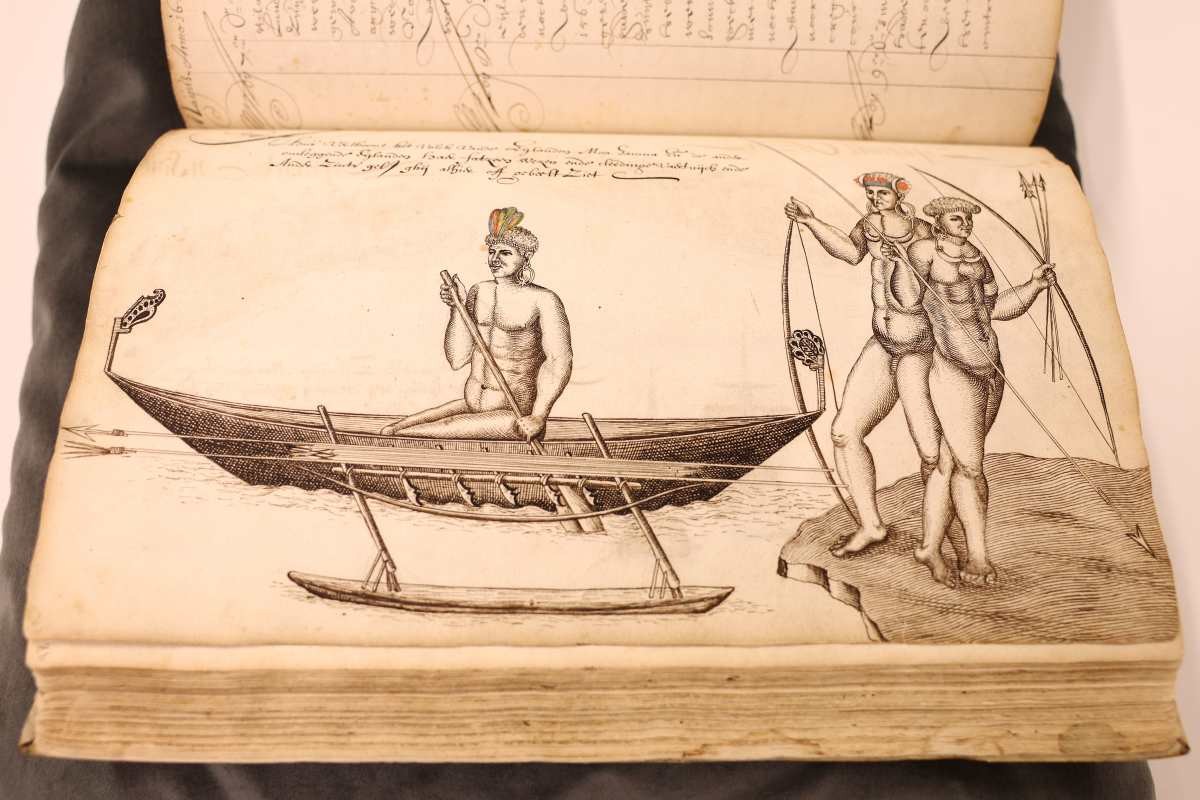
Image Source: A detailed view of the logbook of navigator Abel Tasman (Dutch East India Company) from 1642 and his journey to explore the unknown continent of Australia. (Photo by Dean Mouhtaropoulos/Getty Images)
On his voyage to the continent, he encountered the local Māori Indians. However, his meeting turned out to be tense, as per BBC. One day, many of these people paddled out on a canoe and rammed a small boat that was passing messages between the Dutch ships. Four Europeans died. This was the end of Tasman’s mission.
Tasman named the location “Moordenaers (Murderers) Bay,” and sailed home, never to return to this land, although he did believe that he had discovered a great new continent.
#onthisday in 1642 that Abel Janszoon Tasman discovered NZ. He is officially recognised as the first European to ‘discover’ New Zealand. . His men were the first Europeans to have a confirmed encounter with Māori. Map of New Zealand. (Copy from colour transparency.) R24460177 pic.twitter.com/kBBh48JLCw— Archives New Zealand (@ArchivesNZ) December 12, 2023
It was nearly 375 years after Tasman’s voyage that geologists stumbled upon this mainland. They announced the discovery by naming it “Zealandia,” based on the suggestion of American geophysicist Bruce Luyendyk who described this region in 1995. Zealandia is translated to “Te Riu-a-Māui” in the Māori language.
In a paper, researchers from GNS Science of New Zealand documented that they had to dredge rock samples from the Fairway Ridge to the Coral Sea to analyze the rock geochemically and understand the underwater makeup of Zealandia. Led by Nick Mortimer, they scanned the northern two-thirds of the submerged area, where they unearthed pebbly and cobbley sandstone, fine-grain sandstone, mudstone, bioclastic limestone, and basaltic lava from a variety of periods as concluded by their radiocarbon dating.
?? We are thrilled to announce that Te Riu-a-Māui / Zealandia has just become the FIRST continent to be completely mapped to its underwater edges ?️?
The rocks and stones were found to be roughly 95 million years old, from the Late Cretaceous period. The granite and volcanic pebbles were estimated to be 130 million years old, the Early Cretaceous period. The basalts however were newer, probably about 40 million years old, and from the Eocene period. “It is kind of cool,” said Mortimer, per BBC. Andy Tulloch, a geologist at the New Zealand Crown Research Institute GNS Science, who was part of the research team, added, “This is an example of how something very obvious can take a while to uncover.”
Te Riu-a-Māui / Zealandia – we have released two maps and a website. The maps cover the bathymetry (shape of the ocean floor) and the tectonic origins of Earth’s eighth continent.https://t.co/6Aac474VD9pic.twitter.com/fL62BwepCh— GNS Science Te Pū Ao (@gnsscience) June 23, 2020
Although Zealandia is a vast continent that spans an expanse stretched for 4.9 million square kilometers, around six times the size of Madagascar, most of it is submerged under the South Pacific Ocean. Only the area at the Ball’s Pyramid on Lord Howe Island rises above the water’s veil. It is the smallest, thinnest, and youngest of all known continents.
Usually, the continental crust is about 40 kilometers deep, thicker than the oceanic crust which is about 10 kilometers. The researchers proposed that since Zealandia ended up stretched too much, its crust became thinner, around 20 kilometers, and finally disappeared under the sea. With 95 percent of its territory submerged beneath the ocean’s depths, Zealandia prowls on planet Earth as a lair possessing an enigmatic charm of mysterious historical elements and ancient stories.
Editor’s note: This article was originally published on June 22, 2024. It has since been updated.

Photo credit: Brookfield Zoo Chicago’s Sarasota Dolphin Research Program, taken under NMFS MMPA Scientific Research Permit – Bottlenose dolphins are social creatures that use whistles and clicks to communicate with each other.
But it wasn’t until the 1960s that methodical research into dolphin communication began. Scientists like John Lilly and the husband-and-wife team of Melba and David Caldwell tried various experiments to decipher the sounds dolphins can make.
The Caldwells figured out a way to record isolated animals in human care. They discovered that each individual dolphin communicated mostly with one unique whistle, which they called the “signature whistle.” Researchers now know that these whistles convey identities much like human names do. Dolphins use them to stay in touch with each other in their murky habitat, where vision is limited. It’s like announcing “I’m over here!” when someone can’t see you.
This collaborative study, led by Randall Wells of Brookfield Zoo Chicago’s Sarasota Dolphin Research Program, involves numerous researchers from a variety of institutions, who study different aspects of dolphin biology, health, ecology and behavior. Begun in 1970, this is the longest-running research project on a population of wild cetaceans – whales, dolphins and porpoises – in the world.
Photo credit: Photo by Brookfield Zoo Chicago’s Sarasota Dolphin Research Program, taken under NMFS MMPA Scientific Research Permit – Each dolphin has distinctive markings on its dorsal fin. Experienced researchers can sometimes identify them by sight in the field, and they photograph them to confirm their identity in the lab.
Recording and observing
Researchers know the age, sex and maternal relatedness of almost all of the approximately 170 dolphins in the Sarasota community. This depth of knowledge provides an unprecedented opportunity to study communication in a wild cetacean species.
The dolphins in the Sarasota project are periodically subject to brief catch-and-release health assessments, during which researchers, including me, briefly handle individual dolphins.
Our team attaches suction-cup hydrophones directly onto each dolphin’s melon – that is, its forehead. We then record the dolphins continuously throughout the health assessments, taking notes on who is being recorded when, and what is happening at the time.
This is how my colleagues and I were able to confirm that wild dolphins, like captive animals, produced large numbers of individually distinctive signature whistles when briefly isolated from other dolphins. Through observations and recordings of known free-swimming dolphins, we were further able to confirm that they produced these same signature whistles in undisturbed contexts.
We have organized these recordings into the Sarasota Dolphin Whistle Database, which now contains nearly 1,000 recording sessions of 324 individual dolphins. More than half of the dolphins in the database have been recorded more than once.
We identify each dolphin’s signature whistle based on its prevalence: In the catch-and-release context, about 85% of the whistles that dolphins produced are signature whistles. We can identify these visually, by viewing plots of frequency vs. time called spectrograms.
Spectrograms of signature whistles of 269 individual bottlenose dolphins recorded in Sarasota. Figure created by Frants Jensen, with sound files from Laela Sayigh
Signature whistles and ‘motherese’
The Sarasota Dolphin Whistle Database has proved to be a rich resource for understanding dolphin communication. For instance, we have discovered that some calves develop signature whistles similar to those of their mothers, but many do not, raising questions about what factors influence signature whistle development.
Dolphin mothers modify their signature whistles when communicating with their calves by increasing the maximum frequency, or pitch. This is similar to human caregivers using a higher-pitched voice when communicating with young children – a phenomenon known as “motherese.”
Also similar to humans is how dolphins will initiate contact with another dolphin by imitating their signature whistle – what we call a signature whistle copy. This is similar to how you would use someone’s name to call out to them.
Our team is interested in finding out if dolphins also copy whistles of others who aren’t present, potentially talking about them. We have seen evidence of this in our recordings of dolphins during health assessments, which provide a rare context to document this phenomenon convincingly. But we still have more work to do to confirm that these are more than chance similarities in whistles.
Shared whistle types
Another exciting development has been our recent discovery of shared whistle types — ones that are used by multiple animals and that are not signature whistles. We call these non-signature whistles.
I could hardly believe my ears when I first discovered a repeated, shared non-signature whistle type being produced by multiple dolphins in response to sounds we play back to them through an underwater speaker. We had previously believed that these non-signature whistles were somewhat random, but now I was hearing many different dolphins making a similar whistle type.
Our team originally had been using the playbacks to try to determine whether dolphins use “voice cues” to recognize each other – similar to how you can recognize the voice of someone you know. Although we found that dolphins did not use voice cues, our discovery of shared non-signature whistle types has led to an entirely new research direction.
The author listens to dolphin whistles on a boat in Sarasota. Jonathan Bird from the film ‘Call of the Dolphins’/Oceanic Research Group, Inc.
So far, I’ve identified at least 20 different shared non-signature whistle types, and I am continuing to build our catalog. We are hoping that artificial intelligence methods may help us categorize these whistle types in the future.
To understand how these shared non-signature whistle types function, we are carrying out more playback experiments, filming the dolphins’ responses with drones. We’ve found that one such whistle often leads the dolphins to swim away, suggesting a possible alarm-type function. We have also found that another type might be an expression of surprise, as we have seen animals produce it when they hear unexpected stimuli.
More difficult, more interesting
So far, the main takeaway from our experiments has been that dolphin communication is complex and that there are not going to be one-size-fits-all responses to any non-signature whistle type. This isn’t surprising, given that, like us, these animals have complicated social relationships that could affect how they respond to different sound types.
For instance, when you hear someone call your name, you may respond differently if you are with a group of people or alone, or if you recently had an argument with someone, or if you’re hungry and on your way to eat.
Our team has a lot more work ahead to sample as many dolphins in as many contexts as possible, such as different ages, sexes, group compositions and activities.
This makes my job more difficult – and far more interesting. I feel lucky every day I am able to spend working on the seemingly infinite number of fascinating research questions about dolphin communication that await answers.
Gavin, with help from aquarium staff, had secretly planned to propose right in front of the beluga whale tank. As he got down on one knee, a whale named Qinu swam into view.
The 16-year-old marine mammal paused right at the glass and appeared to drop her jaw in shock.
I’ve been interning with the beluga training team for the last 3 months so this was the most thoughtful way he could’ve done it 🥺 #georgiaaquarium#belugawhale#proposal
The moment was caught on video, and when Olivia shared it on TikTok, the comment section exploded. It looked exactly like the whale was gasping at the size of the ring.
“The most perfect proposal I could’ve asked for,” Olivia wrote.
Viewers immediately anthropomorphized the whale’s hilarious expression.
“The beluga NEEDS to officiate the wedding now,” one user joked.
Another simply commented: “The beluga: :O”
Even the official Play-Doh account chimed in to insist that the whale deserved a wedding invite.
According to People, Qinu’s involvement wasn’t a planned stunt. Katie Lorenz, the associate curator of mammals and birds at the Georgia Aquarium, confirmed that the reaction was entirely natural.
“Qinu’s behavior at the window was her own,” Lorenz said. “She was not intentionally trained to have any type of reaction.”
Unlike many other whales, belugas have unique physical characteristics that allow for this kind of “human” expression. They have a flexible neck and unfused cervical vertebrae, which allows them to nod and turn their heads.
Furthermore, their “melon” (the rounded forehead) is flexible and capable of changing shape, which often makes them appear to be smiling or making faces.
The moment was even more poignant because Olivia wasn’t just a random visitor. She had actually been a beluga whale training intern at the aquarium for the past three months.
“My fiancé is the most thoughtful person,” she wrote in a reply. “He knows how much I’ve loved working with the whales and truly made it the most special moment.”
The Conversation
Of course, viral videos involving captive animals often spark debate. Some commenters questioned the ethics of keeping an animal like Qinu in a tank.
“Nothing cute or adorable about these sentient creatures being kept confined in glass houses for human amusement,” one user wrote.
A beluga whale pops up from the water. Photo credit: Canva
However, for the vast majority of viewers, the video was a moment of pure joy. The clip has racked up over 7 million views on TikTok alone, and Qinu has officially become the internet’s favorite wedding crasher.
For those who want to see more of the star, the Georgia Aquarium maintains a live beluga cam where fans can check in on Qinu. As for the happy couple, they now have a proposal story that is going to be very hard to top.
This article originally appeared last year. It has been updated.
During mating season, male gentoo penguins are tasked to find pretty and smooth rocks to present to prospective mates. This is meant as a gesture to woo them and to be used to build a nest with them, too. Well, this season, the penguins at the Edinburgh Zoo in Scotland got some help.
Kids being supported by the Edinburgh Children’s Hospital Charity gathered together to paint pebbles with vibrant colors for the penguins. The hospitalized children do this every year with the first stone traditionally placed in the penguin enclosure. The children often watch a livestream of the gentoo penguin enclosure to see the penguin pick their favorite rocks that they’ve painted.
The Edinburgh Zoo posted this year’s pebbling pickings on Instagram, delighting the commenters:
“I would cry if a penguin picked MY pebble 😭 It’s a life goal lol.”
“This is just brilliant! How wonderful to see a creative health initiative that actively connects the children with a purpose like this!”
“This is heartwarming ❤️❤️❤️”
“This is brilliant for the penguins and the children! Can’t wait to see the beautiful nests.”
“My grandson painted a pebble he’s hoping it gets picked.🤞🤞🤞”
“Penguin pebble pilfering season is upon us! So pleased it makes so many people (and penguins) happy.”
“Oh no, now I’m questioning if penguins have favourite colours.”
“Any that aren’t picked would make an awesome rock garden that kids visiting the zoo could pick from!!”
“This is the cutest thing I have seen probably ever.”
Pebbling practices for human relationships
As mentioned, this mating ritual called “pebbling” is a gesture made by male penguins to their mate to not just build a nest. It’s their version of saying, “I saw this and I thought of you.” In fact, psychologists and couples therapists recommend adopting a version of pebbling for human relationships.
Now to “pebble” in dating or married relationships doesn’t literally mean giving your partner rocks (unless they’re a geologist that would love that sort of thing). For humans, pebbling your partner means to share or give a small gift like a flower, toy, or object that has some meaning to one or both of you. It doesn’t always have to be a gift either, but it could be a photo, social media post, or a meme you can text them. It’s essentially anything that conveys “I saw this and thought of you” in order to showcase affection to them and initiate closer conversations.
Pebbling isn’t just for romantic couples either. Many autistic people find it more difficult to navigate socially due to high anxiety, sensory sensitivities, or having trouble interpreting social cues. By texting a GIF to a friend, giving a small flower to their parent during a walk, or other such pebbling, it allows some autistic people the ability to communicate their affection and connection without the pressure of using words.
Whether it’s a colorful rock or something else, pebbling can be a valid form of communication between friends, partners, or potential mates. It all depends on who you choose to build a nest with.