


On August 15, 1977, astronomer Jerry Ehman was reviewing data from Ohio State University’s Big Ear Radio Observatory when he saw something impossible to ignore. The telescope, designed to Search for Extraterrestrial Intelligence (SETI), had picked up a radio signal so strong and distinct that it lasted for 72 seconds.
Stunned, Ehman circled the data points on the printout in red pen and wrote a single word in the margin: “Wow!”
For nearly 50 years, that “Wow!” signal has remained one of astronomy’s greatest unsolved mysteries. Because it never repeated and had no obvious natural explanation, it became the strongest candidate for proof of alien life. However, a new study published on the Arxiv server suggests the source wasn’t a distant civilization, but a rare and powerful cosmic event.
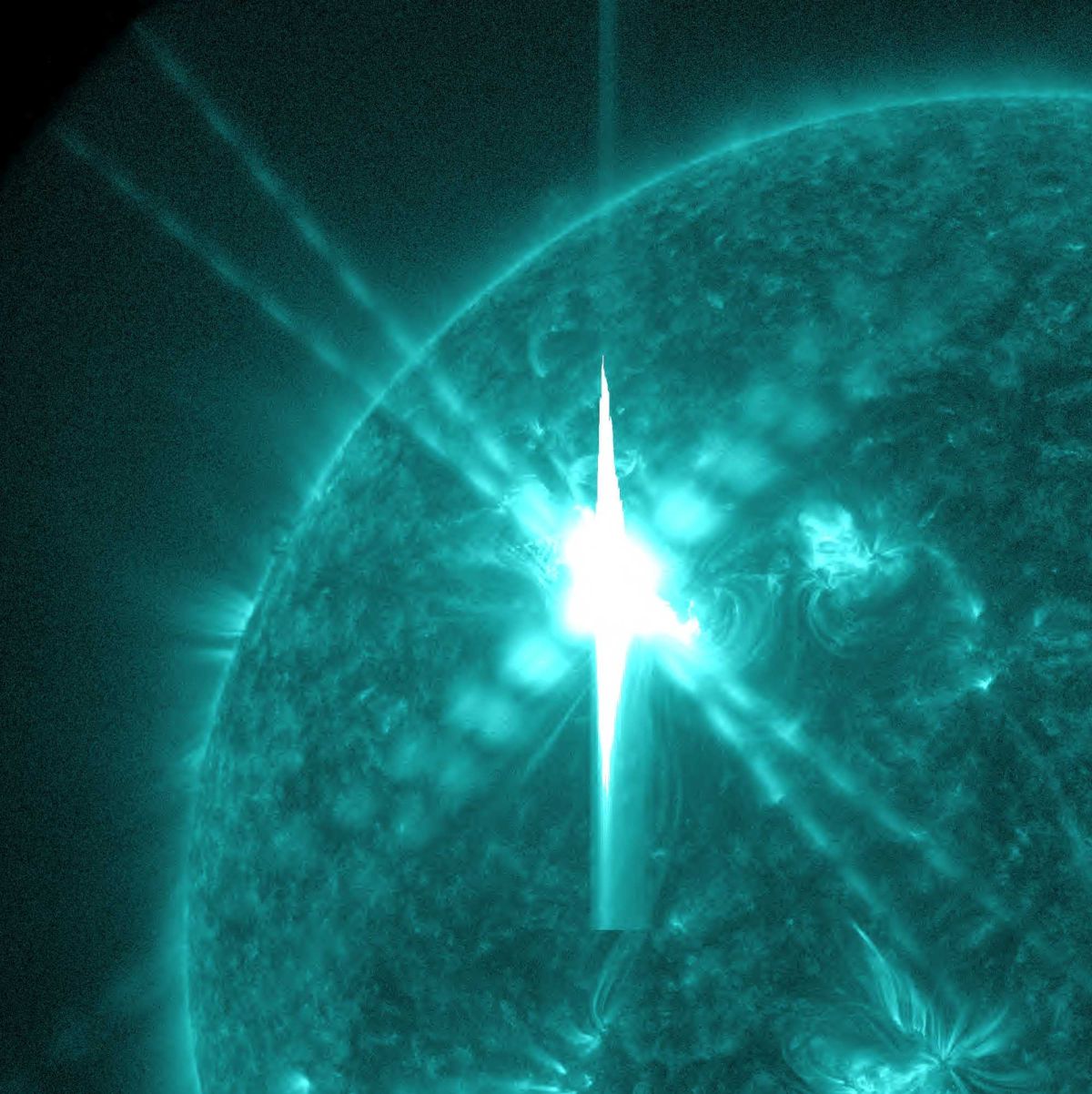
A team of researchers led by Abel Méndez of the University of Puerto Rico at Arecibo combed through archival data and proposed a fresh hypothesis: the signal was the result of a flare from a “magnetar.”
According to The U.S. Sun, a magnetar is a neutron star with a magnetic field a thousand times stronger than a normal neutron star—and up to a trillion times stronger than Earth’s.
The researchers believe the “Wow!” signal was caused when a flare from one of these hyper-magnetized stars slammed into a cloud of hydrogen gas. This interaction essentially created a natural “maser”—a microwave laser.
“We hypothesize that the ‘Wow! Signal’ was caused by sudden brightening from stimulated emission of the hydrogen line due to a strong transient radiation source, such as a magnetar flare or an SGR,” the researchers wrote in their paper.
This theory explains the signal’s specific frequency (1,420 MHz, the hydrogen line) and its intense brightness.
“I would say, wow—I never thought of that. I never thought of the Wow! signal as being real and being produced by some weird astrophysical phenomenon,” Méndez told Scientific American.
While the theory wraps up many loose ends, the team admits it isn’t definitive proof just yet.
“We’re not saying that this is definitely the case. We’re saying that it’s a very exciting hypothesis,” study co-author Kevin Ortiz Ceballos told Scientific American, noting that the story is “definitely a bit speculative.”
The investigation isn’t over. Méndez and his team are continuing their work at the Very Large Telescope in Chile. Interestingly, while observing red dwarf stars recently, Méndez caught a new set of similar signals, suggesting that while the “Wow!” signal was unique in 1977, the universe might be full of these natural, high-energy broadcasts waiting to be found.
This article was originally published last year.