Love – the universe’s sweetest four-letter word is typically the subject of lyrical sonnets, love letters, and sweet nothings. Till now, it was believed that love is a feeling, or vibration, that can be felt by the heart. But with this new study, scientists have made it possible to understand “love” with the brain. Published in the Cerebral Cortex journal through Oxford University Press, the study reveals six different types of love and how they light up different portions of the brain when felt. The study revealed that the parental form of love generates the most intense brain activity, followed by romantic love.
Representative Image Source: Unsplash | Josh Rierner

Researchers from Aalto University in Finland conducted this study to explore how love extends beyond just romance, sexual adoration, and maternity. Their goal was to investigate why the same word activated different parts of the brain varying with the type of human experience. They tested six different types of love for six different types of love objects: romantic partners, one’s children, friends, strangers (varieties of interpersonal love), nonhuman pets (interspecies love), and nature (non-social love).


via GIPHY


Involving 55 parents as participants in the study, the team used functional magnetic resonance imaging (fMRI) brain scans to examine the electrical activity of their brains as different forms of love stories and narratives were fed into them via sound induction technology. These feelings of love were induced using short, spoken, pre-recorded stories, as the researchers note in the paper.

Representative Image Source: Pexels | Anna Shvets

“Narratives are a powerful means of emotion induction. Each narrative depicted an everyday situation eliciting the feeling of love for one type of object. We also included neutral control stories about mundane situations where nothing special happens,” the researchers wrote. Once they induced these love stories into the participants’ brains and analyzed their brain activity, they simultaneously questioned them about what they felt.


via GIPHY


In total, 42 narratives were used for the experiment, which included 36 love narratives and six control narratives. Each love narrative ended with the prompt “You feel love for [x] / You love [x].” For example, one of the “romantic love” narratives was like this: “You are in the laundry room with your partner. They are loading the washer with laundry, and suddenly you remember what a lovely person your partner is. You feel love for them.” Another example is the narrative for the “parental love” category, which sounded: “Your child runs to you, joyful, on a sunny meadow. You smile together and the sunrays flicker on their face. You feel love for your child.”

Representative Image Source: Pexels | Jonathan Borba

One story was to test the brain’s response to altruistic and friendliness forms of love in individuals. Its prompt read: “You need help moving house and you call your friend. They promise to of course come to help out, and soon you are lifting cardboard boxes together in a van. In the middle of the ordinary situation, you feel love for your friend.” A story involving compassionate love for strangers was: “You see an old woman on the street carrying heavy grocery bags. You help her by carrying one of the bags to her home door one block away. The old woman is grateful, and you feel love for her.”


via GIPHY


The story for love of pets read: “You are in a park playing with your dog. You toss a stick for the dog and it retrieves it enthusiastically wagging its tail. You love your dog.” Whereas, the story for the love of nature went like this: “You are in the archipelago at the seaside. The blue waves ripple over the coastal stones, a crooked pine rises next to you, and there are white fluffy clouds here and there in the sky. You love nature.” Another prompt was how they felt when seeing their newborn for the first time. “You see your newborn child for the first time. The baby is soft, healthy, and hearty — your life’s greatest wonder. You feel love for the little one.”

Representative Image Source: Pexels | The Vibrant Machine

“We now provide a more comprehensive picture of the brain activity associated with different types of love than previous research,” said Pärttyli Rinne, the philosopher and researcher who coordinated the study. Notably, parental love was the most intense form of love, as depicted through the parents’ brain activity. “In parental love, there was activation deep in the brain’s reward system in the striatum area while imagining love, and this was not seen for any other kind of love,” said Rinne.
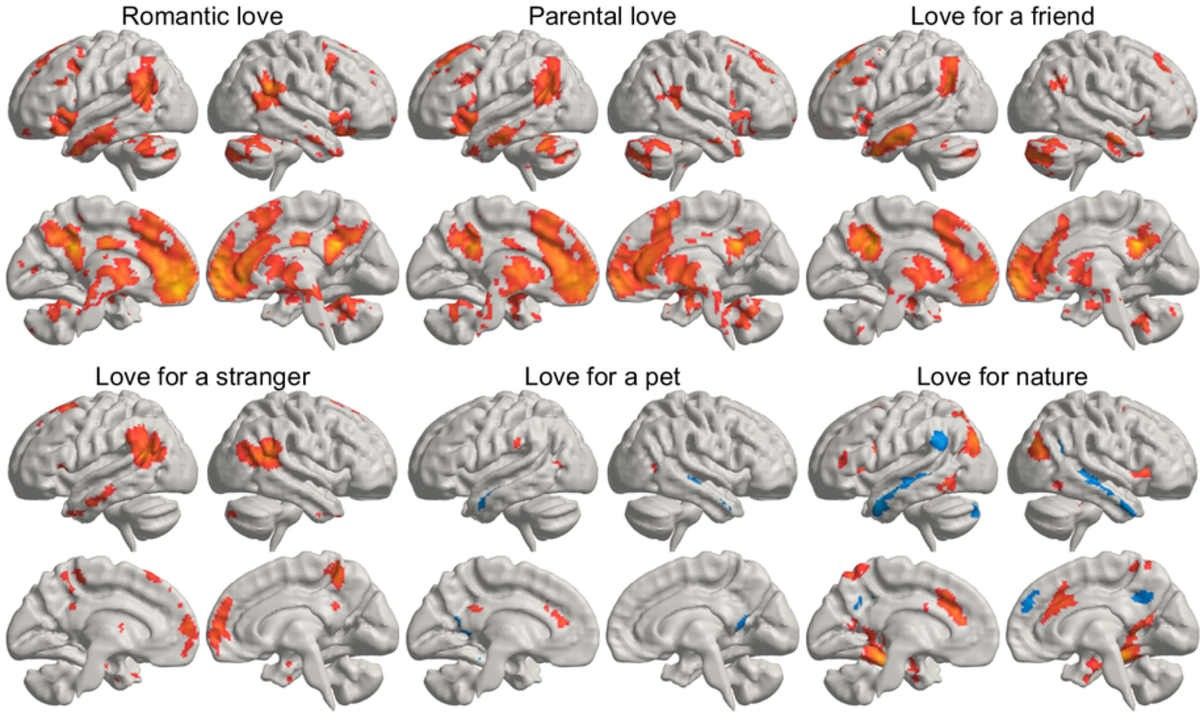
Image Source:
Image Source: Pärttyli Rinne ad others, Aalto University

According to the study, romantic and parental love were the two highest-rated categories in all seven dimensions. On the other hand, love for strangers came in the least rated categories. Furthermore, the researchers concluded that love of nature activated the reward system and visual areas of the brain, but left the social brain areas unlighted. Researchers also created a brain map with the corresponding areas that lighted up during different types of love stories or narrations. “The most widespread love-related activation was observed for closest relationships in the insula, striatum, thalamus, and brainstem. Activations were also found in the cerebellum, midline regions, and medial frontal cortices,” they wrote in the paper.


via GIPHY


According to the press release, the team believes that understanding the concept of “love” will help them delve deeper into explaining the neural mechanisms and philosophies behind subjects like the nature of love, consciousness, and human connection. They also hope that the study will open doorways to enhance the psychology-based and medical treatments for conditions like attachment disorders, depression, or relationship issues.

  • Scientists puzzled by Earth’s ‘heartbeat’ that causes tremors every 26 seconds
    The earth has a pulse and science isn't sure why. Photo credit: Representative Cover Image Source: Pexels | Adrien Olichon| Edited
    , ,

    Scientists puzzled by Earth’s ‘heartbeat’ that causes tremors every 26 seconds

    All explanations including ocean waves, volcanoes, and fractured sediments have been ruled out, leaving the mystery behind seismic tremors every 26 seconds unsolved.

    Although Earth might seem like a stable, flat surface where we live our lives, seismologists have discovered that it’s far from passive. In fact, Earth has a ‘heartbeat’ that pulses every 26 seconds, according to Discover Magazine. Known as “microseisms,” these faint seismic tremors resemble tiny earthquakes, though they aren’t exactly the same. For decades, scientists have been baffled by these mysterious tremors, and despite many theories, no definitive explanation has been found.

    volcanic activity, undersea resonance
    Representative Image Source: Unsplash | NASA

    In humans, a heartbeat is produced by electrical signals that cause the heart muscles to contract and expand. But for Earth, the source of its mysterious ‘heartbeat’ remains unknown. This phenomenon was first documented in the early 1960s by geologist Jack Oliver, who suggested that the pulse might originate from somewhere in the southern or equatorial Atlantic Ocean. However, he lacked the sophisticated instruments needed to investigate further. “Jack didn’t have the resources in 1962 that we had in 2005 — he didn’t have digital seismometers, he was dealing with paper records,” Michael Ritzwoller, a seismologist at the University of Colorado, Boulder, told Discover Magazine. Since then scientists have spent a lot of time listening to this pulse and trying to solve the mystery.

    via GIPHY

    Lars Eivind Augland, associate professor in the Department of Geosciences at the University of Oslo, found the phenomenon of a 26-second pulse fascinating. “Yes, you may call it a kind of pulse. The Earth’s crust has regular tremors. They are so small that they do not pose a threat as real earthquakes can,” he told Yara International. Augland explained that every 26 seconds, the heartbeat of Earth is recorded by seismic station computers around the world. These blips are most noticeable in West Africa, North America, and Europe, he said. Geologists and seismologists have given varied explanations behind the occurrence of this phenomenon, including ocean waves, volcanoes, and fractures in sediments.

    “Originally, the micro-quakes, or the pulse detected at intervals of 26 seconds, were explained by wave activity in the Gulf of Guinea in West Africa. Special depth conditions, the geometry of the ocean floor, and the coast have been pointed out as possible causes. Due to how the waves hit and create resonance on the seabed, they could, in turn, propagate as earthquake waves in the Earth’s crust,” explained Augland.

    sao tome geology
    Representative Image Source: Pexels | Earano

    In 2013, during the Seismological Society of America conference, a student named Garrett Euler also said the same thing, furthering the source location of the pulse to the region called “Bight of Bonny” in the Gulf of Guinea. He elaborated his hypothesis by adding that waves hitting and crashing against the coast might be the probable reason for this pulse. But this explanation was soon ruled out by most experts.

    Apart from ocean waves, a second explanation behind this pulsation was believed to be “volcanoes.” The same year, Yingjie Xia from the Institute of Geodesy and Geophysics in Wuhan, suggested the cause was actually volcanoes, not waves. He explained this by saying that the island of São Tomé in the Bight of Bonny was close to the volcano.

    ocean wave resonance,earth science mysteries
    Representative Image Source: Pexels | Mauro Ignacio Torres

    After ruling out waves and volcanoes, Augland proposed a third explanation: sediment cracks. “A third explanation can be found in the latest study published in the renowned journal Earth and Planetary Science Letters, which states that fluid flowing through fractal fissure networks in sediments under the seafloor is the cause of the tremors,” Augland told Yara International, further specifying that none of the three explanations have any supporting evidence.

    via GIPHY

    Despite its puzzling nature, the 26-second pulse is not something unusual. According to BRIGHT SIDE’s YouTube video, Earth doesn’t only have a heartbeat but also a humming sound. Some people may notice it, and some may not, but this high-frequency buzzing sound called “The Hum” is prevalent throughout the planet. Like the mysterious ‘heartbeat,’ geologists have also tried to explain this “mysterious hum or buzz” but none has proved true to their satisfaction.

    https://youtube.com/watch?v=ZBkOwyhq7Hg%3Fsi%3DKssLS49BY6VdPW8w

    This article originally appeared last year.
  • In Earth’s quietest room, even 45 minutes are unbearable for anyone
    Cover Image Source: Orfield Laboratories Photo credit: orfieldlabs.com
    , ,

    In Earth’s quietest room, even 45 minutes are unbearable for anyone

    Standing in the room gives people creeps, making them feel as if they’re losing their spatial balance and orientation.

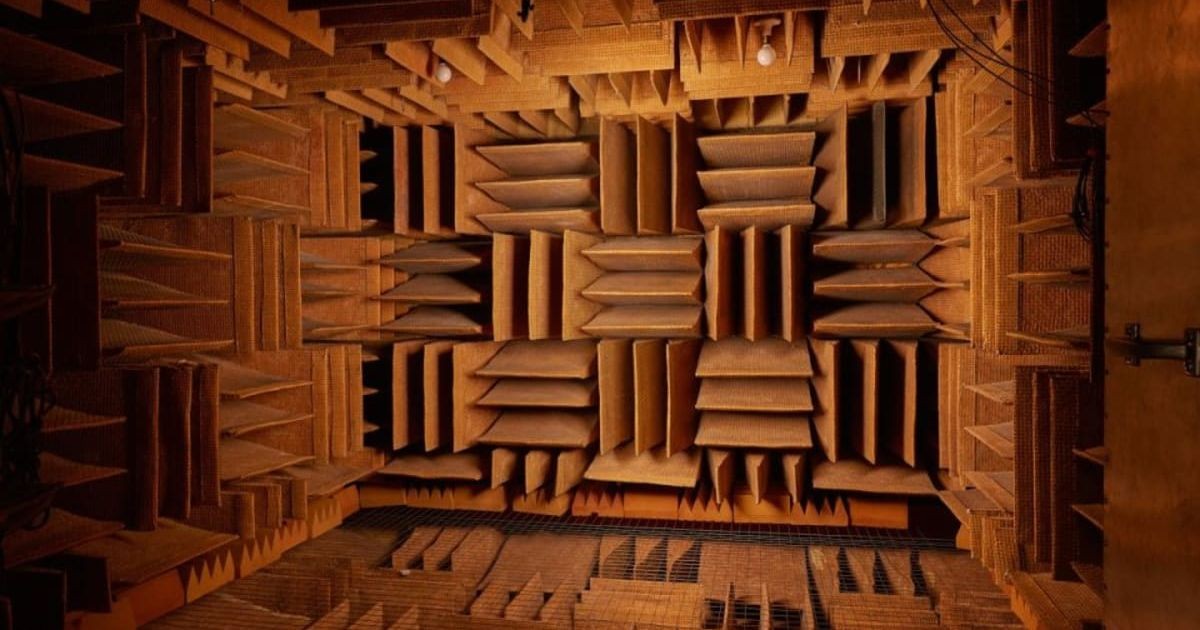
    Can silence drive us mad? This question arises from a unique room in Minneapolis, where visitors report eerie sensations and disorientation due to its profound silence. They often hear faint ringing in their ears, and so far, no one has lasted more than 45 minutes.

    Holding the Guinness World Record for the quietest place on Earth, the anechoic test chamber at Orfield Laboratories has a background noise level of -24.9 decibels. The human audible range is from zero to 120 decibels, so a sound of negative decibels is inaudible by humans.

    via GIPHY

    An anechoic chamber, meaning “no echo,” achieves profound silence through its design. Fiberglass wedges coat the walls, floors, and ceilings, absorbing any internal sounds, while thick layers of brick and steel reinforce the soundproofing. This meticulous design guarantees complete isolation from external noise.

    The maximum someone has stayed inside this chamber is 45 minutes. The room is so quiet that a person inside it will hear their heartbeats, even the sounds of their organs, Steven Orfield, the lab’s founder, told Hearing Aid Know. “We challenge people to sit in the chamber in the dark – one person stayed in there for 45 minutes. When it’s quiet, ears will adapt. The quieter the room, the more things you hear,” he said, adding, “In the anechoic chamber, you become the sound.”

    But the room isn’t designed for the sake of distressing or tormenting people. NASA regularly sends astronauts here to help them practice adaptability to the silence of space. Many people also visit the room to meditate, Orfield told CBS.

    via GIPHY

    Yet, for most people, the room offers an eerie and unsettling experience, as it can disrupt one’s sense of balance and orientation. “How you orient yourself is through sounds you hear when you walk. In the anechoic chamber, you don’t have any cues,” Orfield said. “You take away the perceptual cues that allow you to balance and maneuver. If you’re in there for half an hour, you have to be in a chair.”

    Like Orfield Laboratories, the Microsoft headquarters in Redmond, Washington is also an anechoic place. It is the previous Guinness World Record holder for being the “quietest place on earth.” The room is designed in an onion-like structure that isolates it from the rest of the building and the outside world. Here too, people cannot stand the silence for too long, not more than 55 minutes to be precise.

    Explaining to CNN, Hundraj Gopal at Microsoft said that in the real world, our ears are constantly subject to some level of sound, so there is always some air pressure present on the ear drums. But when someone enters the anechoic room, this air pressure zips away due to the total absence of sound reflections. In a room like this, there is no interference of noise.

    via GIPHY

    Ideally, silence is intended to pacify and soothe; however, its unsettling effect in these rooms is both uncanny and intriguing. For centuries, philosophers and poets have written that “silence is not empty,” and these anechoic rooms seem to provide evidence of this.

    This article originally appeared last year.

  • Stephen Hawking’s simple response when asked if he believed in the existence of God
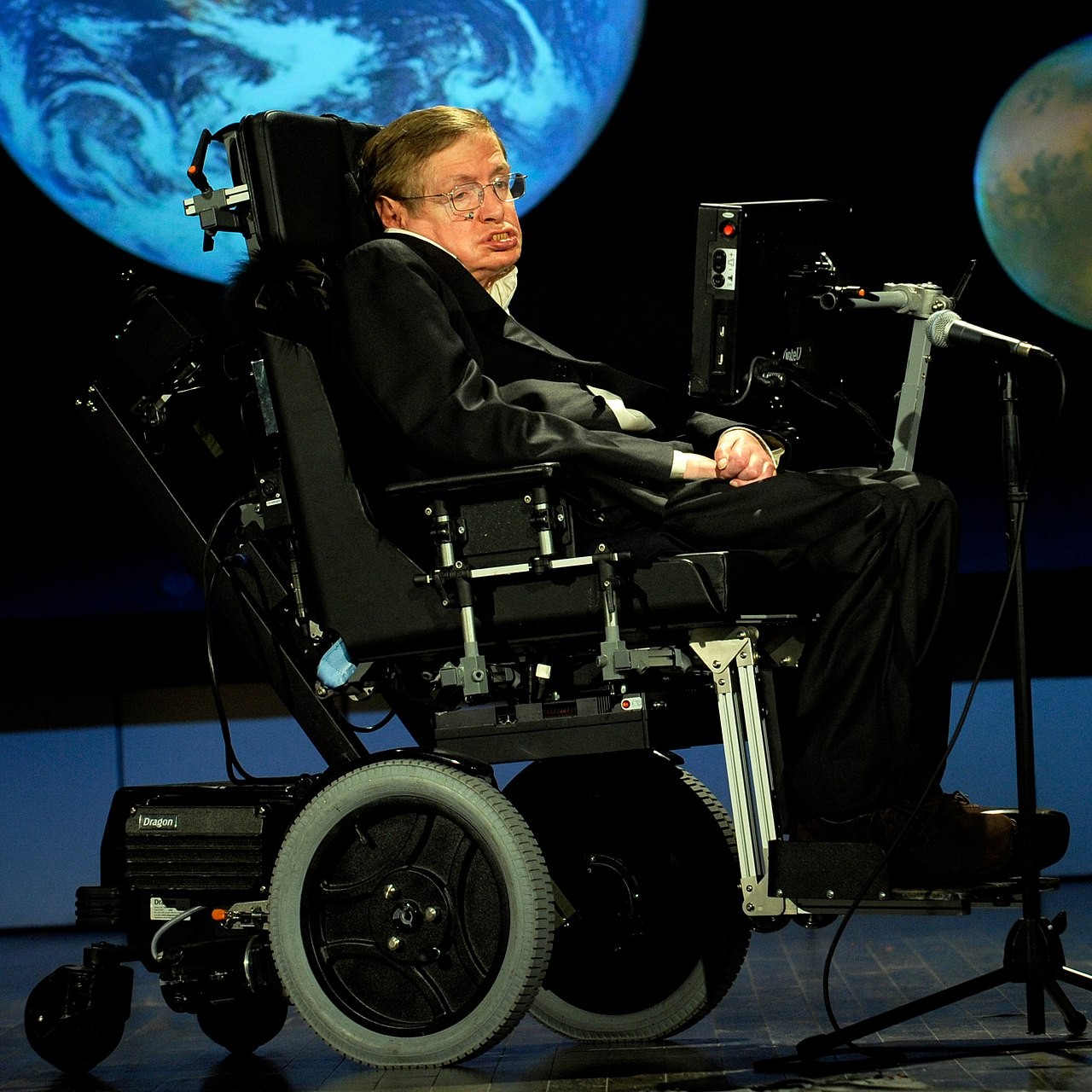
    Stephen Hawking seemed to have answers for everything. Photo credit: Stephen Hawking (Wikicommons)
    , ,

    Stephen Hawking’s simple response when asked if he believed in the existence of God

    The renowned scientist shared his views on God in his book ‘Brief Answers to the Big Questions.’

    The existence of God has been a point of debate for centuries, examined through both religious beliefs and scientific inquiry. Theoretical physicist Stephen Hawking, known for his groundbreaking work in cosmology, addressed this question in his final book, Brief Answers to the Big Questions.

    Although Hawking’s book was mostly completed before he passed, his family and academic colleagues helped finish it posthumously. In it, Hawking explored his thoughts on God’s existence, a topic he often faced as a scientist. Reflecting on his own disability, he remarked, “For centuries, it was believed that disabled people like me were living under a curse that was inflicted by God. Well, I suppose it’s possible that I’ve upset someone up there, but I prefer to think that everything can be explained another way, by the laws of nature.” His words reflect a belief in science as a way to understand the universe without needing to invoke divine forces.

    Stephen Hawking
    Stephen Hawking Stephen Hawking (Wikicommons)

    Image Source: Professor Stephen Hawking attends the gala screening of “Hawking” on the opening night of the Cambridge Film Festival held at Emmanuel College on September 19, 2013 in Cambridge, Cambridgeshire. (Photo by Karwai Tang/Getty Images)

    He added that people like him, who believe in science, “believe that there are certain laws that are always obeyed. If you like, you can say the laws are the work of God, but that is more a definition of God than a proof of his existence.”

    Hawking refused to acknowledge the existence of God with his most direct, personal answer as he outrightly said, “It’s my view that the simplest explanation is that there is no God. No one created the universe and no one directs our fate.”

    The late astrophysicist had a prestigious career and made enormous contributions to science. He was commended for his work on the physics of black holes. Hawking proposed that black holes emit subatomic particles until they eventually explode. He also proposed the multiverse theory, which states that our universe is one of many parallel universes existing in a fractal-like multiverse, published in the Journal of High Energy Physics.

    The genius scientist struggled with health complications throughout his adult life. At 21, he was diagnosed with Amyotrophic Lateral Sclerosis (ALS), which is a type of motor neuron disease. Despite the life-threatening disease, Hawking managed to live much of his life in a motorized wheelchair, communicating mostly with the assistance of a portable system mounted on its arms.

    The renowned scientist passed away at the age of 76 on March 14, 2018, in his home. A year before that, he said he was thankful for his extended life. “I never expected to reach 75, so I feel very fortunate to be able to reflect on my legacy,” he said in an interview with BBC.


    This article originally appeared last year.

Explore More Pubninja Stories

Environment

Scientists puzzled by Earth’s ‘heartbeat’ that causes tremors every 26 seconds

Exploration

In Earth’s quietest room, even 45 minutes are unbearable for anyone

Past Events

Stephen Hawking’s simple response when asked if he believed in the existence of God

Heroes

Family that walks on all fours has left scientists perplexed