I have a theory that every person is constantly pulled—almost by some invisible magnetic force—to one particular place that feels safe and magical and misty with nostalgia. Maybe it’s the gazebo where you got married or the garage where you started your first band. It feels like, if you just get back there, the white noise will gently dim and life will briefly make sense again.
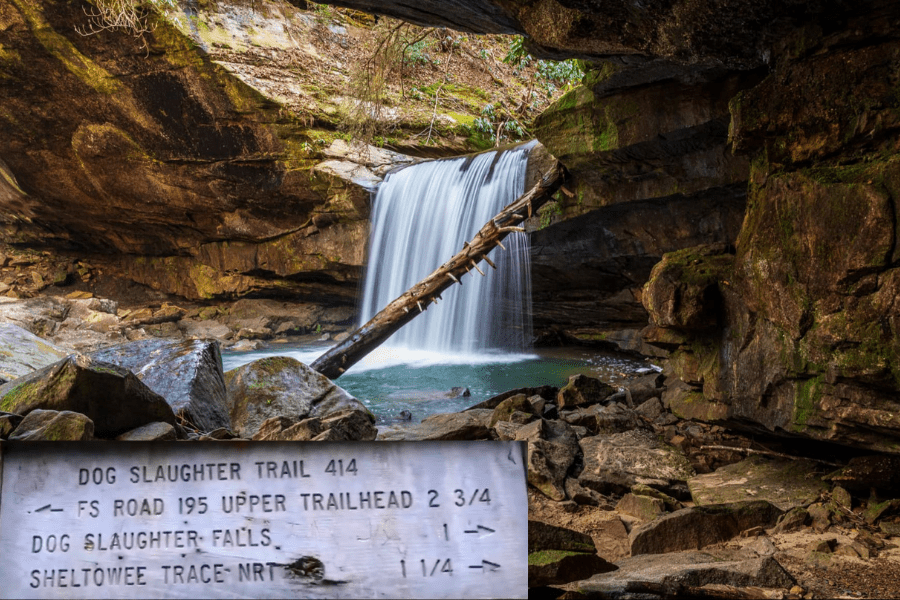
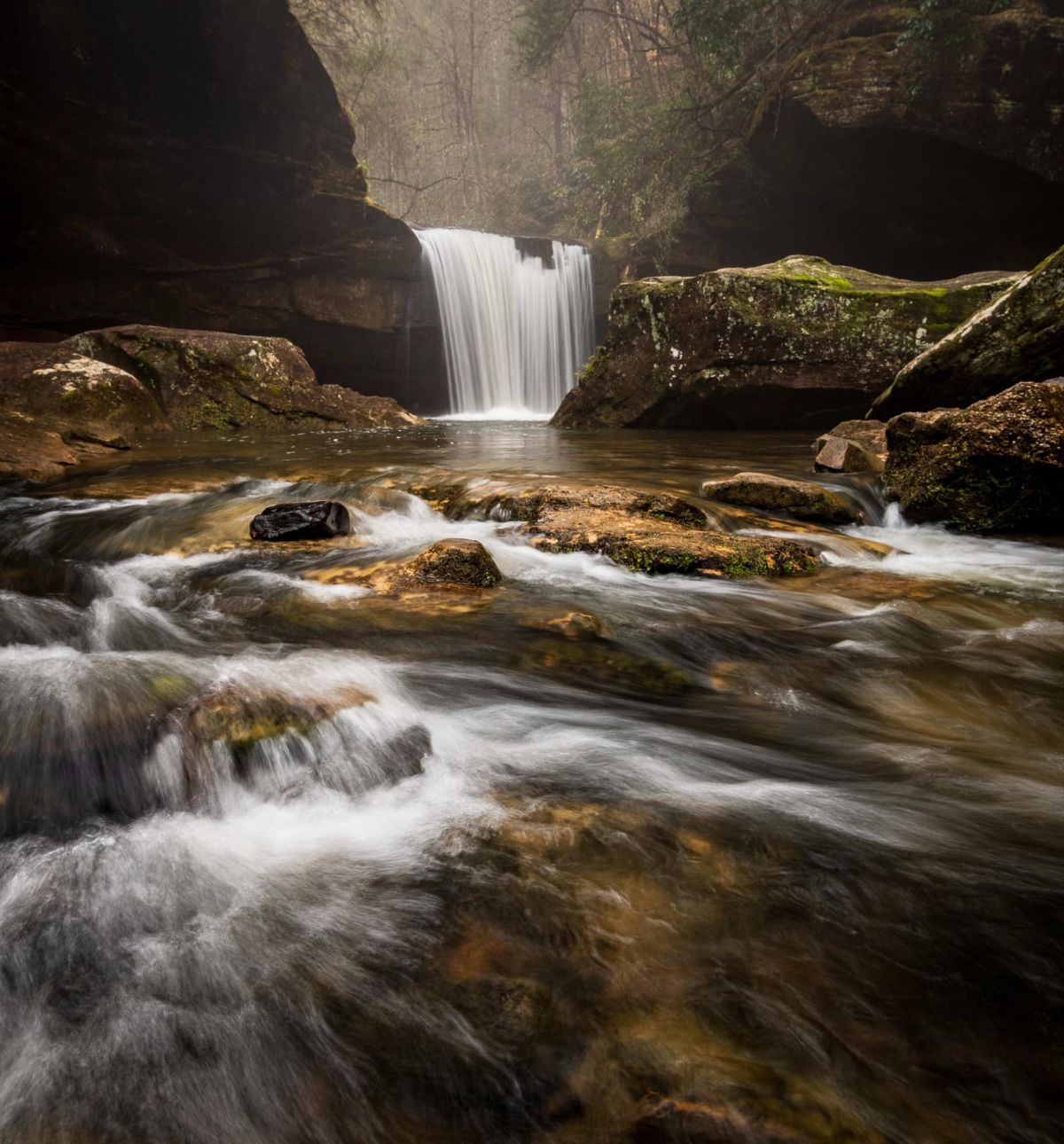
For me, that place is the flat part of a nondescript boulder positioned opposite a 15-foot waterfall with a very disturbing name.
I first visited Dog Slaughter Falls as a middle-schooler, and I was adamantly not stoked about the idea. At that time, I was a shy, somewhat artsy kid searching for meaning in the conservative Bible Belt town of Williamsburg, Kentucky. I was still a lump of unformed human clay—largely consumed by rock music and entirely disinterested in matters relating to the shoebox church my parents drug me to each Sunday. But I was also a Certified Strait-Laced Good Boy, so I entertained my mom’s pitch: an afternoon of hiking with a group of older folks, guided by the botanical knowledge of a nature-loving priest.
Turns out this was more of a demand than an invitation, so I invited my friend Tyler along for this frolic from hell—at least I could suffer alongside a kindred spirit. I wasn’t expecting to enjoy this foolishness, let alone have it alter my brain chemistry in a real, profound way. But life is strange.
Dog Slaughter Falls is located within Daniel Boone National Forest, which sprawls across 708,000 acres and 21 counties in Eastern Kentucky. But even if you’re not from the area, you still might be familiar with its star attraction: the massive and majestic Cumberland Falls, one of the only places on Earth where you can regularly see a “lunar rainbow”—a phenomenon created by moonlight rather than sunlight.
Visiting the so-called “Niagara of the South” was a staple of my formative years. Outside of buying scratch-off tickets and meandering around Wal Mart, there really wasn’t much to do in Williamsburg, so we frequently made the 20- or 30-minute trip up to Corbin, windows rolled down, cranking whatever new indie-rock album we were obsessed with. I vividly remember road-testing Modest Mouse’s Good News for People Who Love Bad News as we navigated those windy roads late at night, my senses heightened by the darkness and perpetual motion. One time, my friend Calep showed up with a burned copy of Brand New’s The Devil and God Are Raging Inside Me—hearing “Jesus Christ” in that setting felt legitimately cinematic. During that era, my friend Rishi and I, having borrowed an unwieldy camcorder from a classmate, trekked down to the Falls’ beach area and, utilizing a form of forced perspective, staged a tragic suicide scene from our (still-unfinished) amateur film It’s Great to Be in Cincinnati.
I’ve always felt a restorative force at Cumberland Falls, and I know a lot of people who feel similarly. Also, as a restless kid with big-city dreams, I felt trapped in my hometown, but living near the Falls was a badge of honor—something I could name-drop to a stranger in conversation and feel vaguely proud. But…it was also a state park swarmed with tourists—it belonged to everyone. Dog Slaughter, on the other hand, felt like a secret.
Let’s talk about the name—or, more specifically, how little we know about it. According to Kentucky State Parks, the origin of the grisly “Dog Slaughter” moniker “remains a mystery,” despite regular questions from visitors. The Independent Herald, a newspaper located in nearby Oneida, Tennessee, has a couple theories: One, which I also heard as a kid, is that “unwanted pets were once killed there.” Yeah, pretty horrifying! Another: “that hunting dogs were once slain by a beast unknown at this site—maybe a wolf, maybe a bear … some even say Bigfoot.” (This also calls to mind the local legend: the Mulberry Black Thing, but we’ll save that one for another day.)
I reached out to some local experts, thinking maybe, just maybe, they knew a deeper truth obscured from the general public. The responses varied.
Jehan Abuzour, parks program services supervisor (previously park naturalist) at Cumberland Falls State Resort Park since September 2023, is aware of two stories. (Dog Slaughter is technically not located on park property, though there is a connecting trail.) “I’ve heard that [frontiersman] Daniel Boone wrote in his journal about how he brought his hunting dogs with him in the area and they chased a raccoon, and the raccoon went under the lip of the Dog Slaughter Falls waterfall,” she says. “The hunting dogs didn’t see the cliff, and they went over it and died. Daniel Boone supposedly named it Dog Slaughter Falls. The other story is pretty broad: Basically there was a group of early settlers of Kentucky, and they encountered a pack of wild dogs out there at the falls.“
Pamela Gibson, former trails maintenance supervisor and volunteer coordinator at Cumberland Falls State Park, calls Dog Slaughter a “local landmark”—but with a name that invites a lot of complaints. “According to what the Park had written, Dog Slaughter Falls was named for an incident that happened before the area was very populated,” she says. “Story goes, the locals were out hunting [raccoons] in the area using dogs. The dogs had the coons pinned in the creek, when the raccoon got one of the dogs in the water, drowning several dogs. Everyone knows dogs do not stand a chance with a raccoon in the water.”
Connie Howard has been hiking there for over four decades and lives in a cabin near the trailhead. (Speaking of which, she’s had “many hikers who have gotten lost knock on [her] door during the night.”) But she doesn’t think “anyone is sure” how Dog Slaughter got its name. “The old timers, long deceased, told me it was because of hunting dogs being killed by a mysterious beast that lived in the area,” she says. “Who knows?”
The whole “slaughter” branding may intimidate some people from venturing out there—notably, on the horror front, it even inspired a Creepypasta involving a camping trip, a little girl’s diary, and a mysterious creature. But the hike, at least in my travels, has been the opposite of unsettling. Then again, I’ve always been out there with at least one other person—or, in the case of my first time, with a large group of people I mostly wanted to avoid.
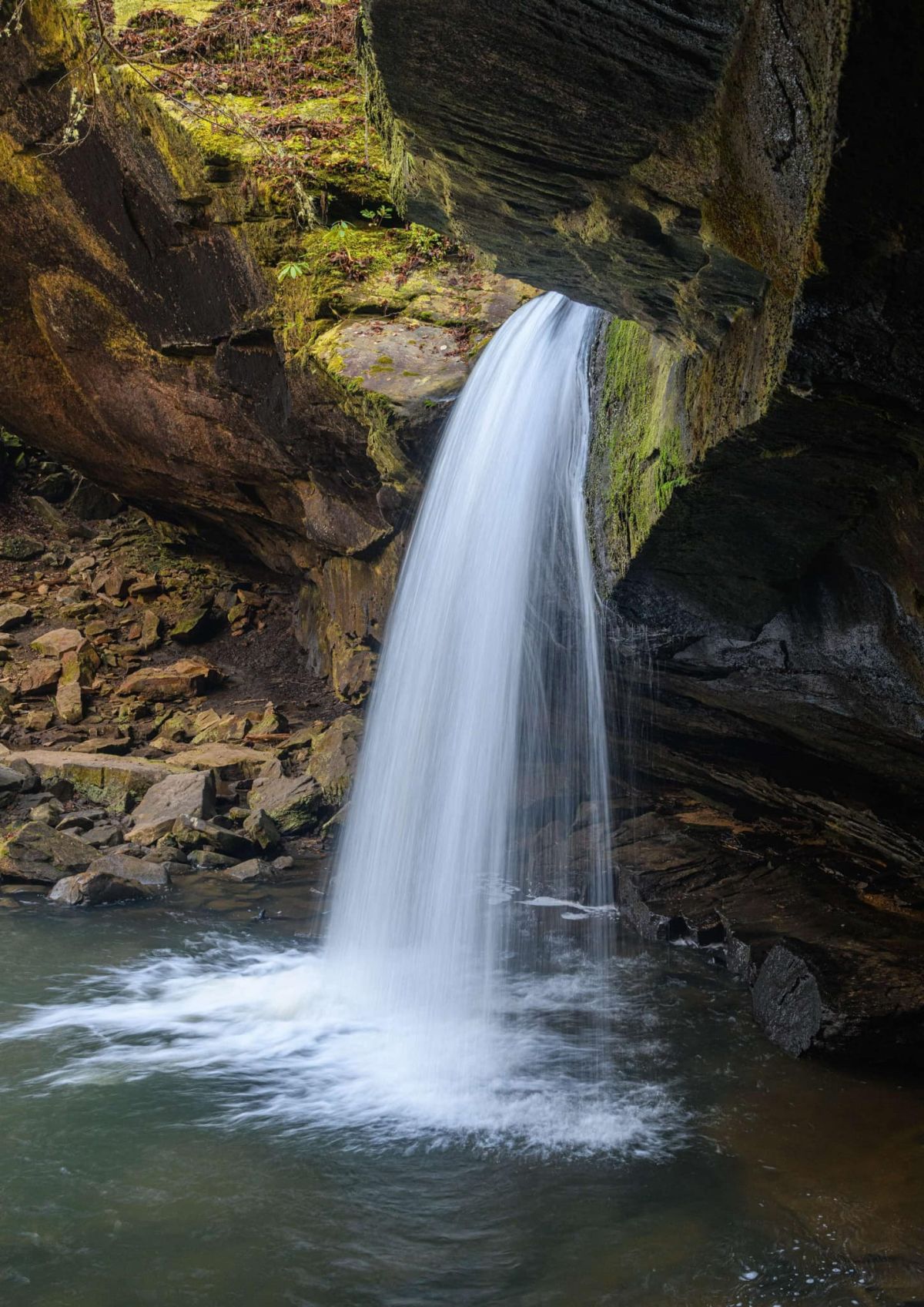
Tyler and I jostled in my family’s minivan as it slowly rumbled roughly three miles down a gravel road. I remember Shania Twain’s country-pop hit “Man! I Feel Like a Woman” playing on the radio, its signal shifting more to static with each bump—it felt like an omen, but I wasn’t sure what kind. We arrived at an unmarked pull-off area overseen by a huge rock, and all of the churchgoers piled out of their cars and onto the trail, with Tyler and I shuffling to the rear. Sensing our awkwardness, a rowdy (and, frankly, somewhat frightening) 50-something man we’ll call Jerry decided to become our unofficial tour guide.
As the rest of the hikers moseyed along the shady, ultra-green, 2.5-mile path, stopping periodically to gaze at flowers, our out-of-nowhere buddy countered that peacefulness with lots of antics. Multiple times, he shouted caveman gibberish with a cavernous roar; at one point, he frantically jumped on a downed tree that crossed along Dog Slaughter Creek, almost daring it not to break; and, in what remains the funniest thing I’ve ever seen, he tripped over a rock, his body soaring a Superman-like free-fall before smoothly skidding into fresh mud. He arose, wiped his eyes, and shouted manically. Jerry was having himself a day.
Meanwhile, I was falling in love—even if I was embarrassed to admit it at the time. Despite the chaos, I felt serene among the fizzy creek sounds and creeping moss and cold rocks. During a picnic lunch, we all gathered on that massive boulder, a short swim away from the base of the falls, and I was hypnotized by the unending rush of water. “This is always just…out here,” I thought. And I’ve dusted off that disbelief every time I’ve returned over the following two-plus decades, often joined by my wife (Jen) and our Brittany Spaniels (Tegan and the late Gabriel).
I’m an anxious, depressive person by nature—I have trouble slowing down, living in the now, savoring the good moments before they slip through my fingers. But I crave the zen-like tranquility I feel at Dog Slaughter. I always leave feeling blissfully still—as if I’ve stopped the flood, even momentarily, to gaze at one outside myself.