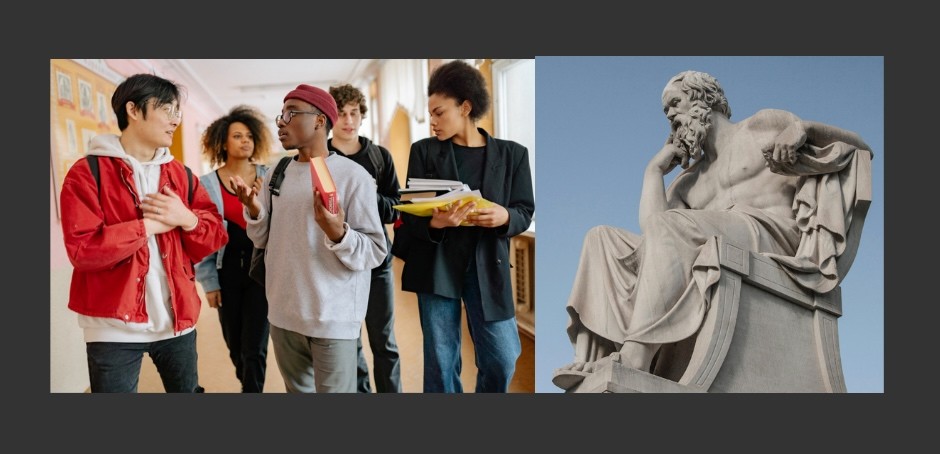
Philosophy majors rank higher than all other majors on verbal and logical reasoning, according to our new study published in the Journal of the American Philosophical Association. They also tend to display more intellectual virtues such as curiosity and open-mindedness.

Philosophers have long claimed that studying philosophy sharpens one’s mind. What sets philosophy apart from other fields is that it is not so much a body of knowledge as an activity – a form of inquiry. Doing philosophy involves trying to answer fundamental questions about humanity and the world we live in and subjecting proposed answers to critical scrutiny: constructing logical arguments, drawing subtle distinctions and following ideas to their ultimate – often surprising – conclusions.

It makes sense, then, that studying philosophy might make people better thinkers. But as philosophers ourselves, we wondered whether there is strong evidence for that claim.

Students who major in philosophy perform very well on tests such as the Graduate Record Examination and Law School Admission Test. Studies, including our own, have found that people who have studied philosophy are, on average, more reflective and more open-minded than those who haven’t. Yet this doesn’t necessarily show that studying philosophy makes people better thinkers. Philosophy may just attract good thinkers.

Our latest study aimed to address that problem by comparing students who majored in philosophy and those who didn’t at the end of their senior year, while adjusting for differences present at the start of their freshman year. For example, we examined students’ performance on the GRE, which they take toward the end of college, while controlling for scores on the SAT, which they take before college.

We did the same when analyzing survey data collected by the Higher Education Research Institute at the start and end of college. These surveys asked students to, for example, rate their abilities to engage with new ideas or have their own ideas challenged, and how often they explored topics raised in class on their own or evaluated the reliability of information.

All told, we looked at test and survey data from over 600,000 students. Our analysis found that philosophy majors scored higher than students in all other majors on standardized tests of verbal and logical reasoning, as well as on self-reports of good habits of mind, even after accounting for freshman-year differences. This suggests that their intellectual abilities and traits are due, in part, to what they learned in college.

Why it matters

Public trust in higher education has hit record lows in recent years, according to polling by the Lumina Foundation and Gallup. Meanwhile, the rapid advance of generative AI has threatened the perceived value of a traditional college degree, as many previously vaunted white-collar skills are at risk of being automated.

Yet now more than ever, students must learn to think clearly and critically. AI promises efficiency, but its algorithms are only as good as the people who steer them and scrutinize their output.

The stakes are more than personal. Without citizens who can reason through complex issues and discern good information from bad, democracy and civic life are at risk.

What still isn’t known

While our results point to real growth in students’ intellectual abilities and dispositions, they do not capture everything philosophers mean by “intellectual virtue.” Intellectual virtue is not just a matter of possessing certain abilities but of using those abilities well: at the right times, for the right reasons, and in the right ways.

Our measures do not tell us whether philosophy majors go on to apply their newfound abilities in the service of truth and justice or, conversely, for personal gain and glory. Settling that question would require gathering a different kind of evidence.

Michael Vazquez is a Teaching Assistant Professor of Philosophy, University of North Carolina at Chapel Hill

Michael Prinzing is a Research and Assessment Scholar, Wake Forest University

This article originally appeared in The Conversation
  • A 6-year-old girl thought skateboarding was just for boys. One stranger at the skate park spent an hour proving her wrong.
    A young skater performs a trickPhoto credit: Canva

    According to data tracked by the Duke of Edinburgh’s Award program, the number of young women and girls who identify skateboarding as their chosen activity rose 800% between 2017 and 2022. At the international competition level, according to a peer-reviewed study published in early 2025, the number of female competitors has quadrupled since 2016. Right now, the best skaters on the competitive circuit are teenage girls, some as young as 15.

    None of that was true yet when Jeanean Thomas (@JeaneanThomas) took her 6-year-old daughter Peyton to a skate park in Cambridge, Ontario, in October of 2015. But the moment that happened that afternoon has been quietly circulating the internet ever since, and it keeps finding new audiences because the thing it’s really about hasn’t changed at all.

    Thomas, a firefighter, had spent months convincing Peyton that skateboarding wasn’t just for boys. “She’d only ever seen boys skateboard so she just assumed that it was a boy sport,” Thomas told Today. When they finally arrived at the park, her resolve nearly broke. It was full of teenage boys, smoking and swearing. Peyton wanted to turn around immediately.

    Thomas did too, if she’s being honest. “I secretly wanted to go too,” she later wrote, “because I didn’t want to have to put on my mom voice and exchange words with you. I also didn’t want my daughter to feel like she had to be scared of anyone, or that she wasn’t entitled to that skate park just as much as you were.”

    So they stayed. Peyton slipped onto the board and started falling. And then one of the boys skated over.

    “I heard you say, ‘Your feet are all wrong. Can I help you?’” Thomas wrote in a letter she posted to X that night, addressed to the teenager she never got to thank in person. “You proceeded to spend almost an hour with my daughter showing her how to balance and steer and she listened to you. I even heard you tell her to stay away from the rails so that she wouldn’t get hurt.”

    skate park kindness viral story, girls skateboarding, Jeanean Thomas skate park letter, Ryan Carney Cambridge Ontario, teenage boy helps girl skate, female skateboarders rising, skateboarding gender stereotypes, heartwarming parenting story, kids and kindness, breaking gender stereotypes skateboarding
    A young woman on roller skates flies off the ramp. Photo Credit: Canva

    His friends made fun of him for it. He kept going anyway.

    “I want you to know that I am proud that you are part of my community and I want to thank you for being kind to my daughter,” Thomas wrote. “She left with a sense of pride and with the confidence that she can do anything, because of you.”

    The letter went viral almost immediately. It later emerged, through reporting by the Cambridge Times, that the young man wasn’t a teenager at all. His name was Ryan Carney, a 20-year-old skate coach who worked at an indoor park in nearby Kitchener. He was baffled by the attention. “If I didn’t know what the heck I was doing, and I was in a place that could be intimidating at that age, I’d want someone to help me,” he told CBC News. “That’s all I did.”

    When they left the park, Peyton had gone from slipping off the board entirely to riding up and down ramps. She asked to go back every day after that.

    The culture Peyton stepped into that afternoon was one that had actively excluded girls for decades. What Carney did, without thinking much of it, was exactly the kind of thing that changes a kid’s relationship to a sport before she’s old enough to know she was supposed to be excluded from it. The 800% participation increase didn’t come from nowhere. It came from moments like this one, scaled up, repeated, normalized.

    “I just seen a little girl struggling to enjoy her time there,” Carney said. “I wanted to see her leaving wanting to skateboard again.”

    She did.

    This article originally appeared last year. 

  • Neuroscientist reveals the 3 dead giveaways someone is pretending to be smarter than they really are
    Are they full of it or not?Photo credit: Canva

    Neuroscientist reveals the 3 dead giveaways someone is pretending to be smarter than they really are

    And one way to have a great intellectual conversation that doesn’t turn into a fight.

    Getting information through quality conversation can be enjoyable or a struggle. Figuring out solutions and fielding valuable expert opinions can be difficult to discern when the person you’re talking to (or debating with) seems suspect. Fortunately, a neuroscientist online has laid out what to look out for to see if your conversation partner is actually intellectual or just talking out of their…well, you know.

    Neuroscientist turned musician/comedian Alex Riordan discussed how to spot pseudo-intellectuals and how they differentiate themselves from actual intellectuals. For Riordan, who spends ample time with his colleagues at Princeton University as well as his degree-less intellectual friends (because you don’t need to go to college to be intelligent), he’s identified three signs that helped him separate the fake-it-til-you-make-its from actually thoughtful individuals.

    https://www.tiktok.com/@alex_riordan_/video/7163445028688301354

    Pseudo-intellectuals will talk past you

    Riordan mentions that pseudo-intellectuals will often go out of their way to use colorful rhetoric and terms to try to talk past you and get you to talk past them. To expand on Riordan’s point, the purpose is a means to bait you into an argument by cutting you off before fully explaining your point or trying to move the conversation past your points to focus in on their own point. They may use tactics such as whataboutism, a tactic that asks, “But what about ______?” to shift the focus of the conversation from one issue to another in order to distract or deflect from initial point.

    They aim to ‘win,’ not aim to understand

    The folks that aim to appear smarter than they truly are don’t have any interest in coming to an understanding with their conversation. They want to win. This is common in what Riordan calls “debate bro tactics.”. Being right isn’t as important as appearing right, regardless of any logical holes or pushback that they cannot rationally defend.

    The Dunning-Kruger effect

    Riordan briefly mentions the Dunning-Kruger effect as a way to spot if someone is talking nonsense. The Dunning-Kruger effect is a cognitive bias in which people overestimate their knowledge and/or abilities in a specific area. When they encounter a new subject, they immediately think they have a complete grasp of it and lack the self awareness to see their own limitations. Once they read an article by an actual expert that conflicts with their understanding, they reject it and assume they’re right despite their lack of education, skills, or actual knowledge.

    @aliabdaal

    Why smart people think they’re not smart ? The Dunning-Kruger effect is real. The more you know, the more you realise how much you don’t know – and it can make you feel like you’re falling behind, even when you’re not. Meanwhile, those with less knowledge often feel more confident because they’re unaware of what they’re missing. Classic case of small fish, big pond vs big fish, tiny puddle ? Ever felt this way? Let me know in the comments ?

    ♬ original sound – Ali Abdaal – Ali Abdaal

    If a person in a conversation demonstrates those behaviors, you may want to politely shut it down. However, even if with a person who knows what they’re talking about, conversations can get heated and people can devolve into these pseudo-intellectual behaviors. Fortunately, Riordan shared one great way he and his colleagues keep the conversation focused on understanding and respect.

    Ask clarifying questions

    Asking clarifying questions is a habit Riordan and his colleagues and friends practice to curb any pseudo-intellectualism and arguments that might arise from it. They do so because asking for clarification goes against all of the previously mentioned tactics of fake know-it-alls. It doesn’t claim to know everything, it’s aimed for understanding rather than “winning,” and acknowledges that you may not know everything about the subject at hand.

    Asking clarifying questions, especially the right ones, shows your conversation partner that you’re curious about them and their thoughts, which encourages them to feel more connected with you. If you disagree with a person’s point and respond with a clarifying question it allows you to see where they’re coming from, find common ground, or learn something you hadn’t considered before. In some cases, answering clarifying questions helps your conversation partner to notice errors or discrepancies in their own thinking that may change their conclusions to line up with yours.

    Some examples of clarifying questions include:

    – What did you mean about ____?

    – Could you further elaborate on that?

    – I heard you say ____, am I interpreting that correctly?

    – Are there specifics about ____?

    – Can you break that down into detail for me?

    Whether you’re conversing about politics, the universe, or what the best pizza topping is, leading with curiosity can ensure that everyone is not only enjoying the conversation, but are learning legitimate truths as well.

  • Therapist explains ‘Admin Nights’ hack for turning tedious ‘to do’ lists into a brilliant game night
    Having friends around can help you get boring work done.Photo credit: Canva

    It can be hard to commit to the routines of exercise, housekeeping, and the other to-dos of your day-to-day life, but for many people the hardest part is the “household admin work.” This is the boring, drudging, and often bureaucratic tasks of answering emails, paying bills online, cancelling subscriptions, making appointments, etc. But what if you could make it a party?

    This concept has led to a growing trend called “Admin Nights” in which people gather their friends together for snacks, drinks, and hanging out while working on administrative household tasks. Admin Nights have quickly turned the chore of household admin work into a weekly or monthly chill hangout with friends.

    @maddyagers

    I am LOVING the idea of admin nights. Especially in a high inflation year. MAKE BUREAUCRACY SEXY ? #friends #admin #economic #inflation #tiktokbudgetingcontest

    ♬ Pursue what you like – LMS

    Admin Nights have other benefits aside from making digital decluttering more enjoyable, such as forging closer bonds with your friends.

    “I love this trend because most of us wish we had more time to spend with friends, so turning administrative tasks into an opportunity to do something we long to do is a great life hack,” licensed therapist Anindita Bhaumik tells GOOD. “An admin night is a great idea for a low-cost friend hang. You can catch up with each other while checking tasks off your list.”

    “It will likely spur on important updates that friends might not get around to sharing, such as the health concerns behind the appointment they’re making, how work is going, or how they’re doing financially. This can be an organic way to practice authenticity with one another and support each other,” Bhaumik added.

    @nvmoss

    When admin night makes it out the group chat ? ✨

    ♬ frank christmas – cam

    With the understanding you’ll need to establish some ground rules to stay on task, Admin Nights could make you more efficient in your mundane administrative tasks. Bhaumik and others state that Admin Nights are a form of “body doubling” which could ensure that you get everything done with more focus. Body doubling is a psychological hack in which most people tend to stay on task when someone else is in the same room as them, even if they don’t interact with one another. It’s partially why many work offices have open floor plans.

    “The beautiful thing about body doubling is it works both ways,” said Bhaumik. “One person isn’t responsible for the other; rather, both (or the group) benefit from working on tasks together. This can even be accomplished virtually, by holding admin nights on a video call, for example.”

    @nicolecappetta

    monthly admin date NEW YEAR edition ✨ using my NEW Admin Date Planner ✨ we set goals for the year and a support structure to help us reach those goals. 2026 is gonna be a good year ! also bagels are from Sincerely Bagel which is the best bagel I’ve had in PDX to date. I get the kimchi cheddar with scallion cream cheese ? . . . #TikTokCreatorSearchInsightsIncentive

    ♬ EVERLASTING LOVE – GROWS

    If you want to try to host a successful Admin Night, it’s fortunately pretty simple. Shoot out texts or emails to friends you think would like this concept, figure out a date, go simple with snacks or ordering a pizza, and make sure your home has plenty of couches, blankets, etc. to keep the vibe comfy. Depending on your friend group and how they work, you may want to investigate various “Chill Music to Study To” playlists to have on while you all concentrate on your tasks.

    Admin Nights could just change the game and turn boring or anxiety-ridden work into the most fun and relaxing day of your week.

Explore More Ideas Stories

Ideas

Neuroscientist reveals the 3 dead giveaways someone is pretending to be smarter than they really are

Ideas

Therapist explains ‘Admin Nights’ hack for turning tedious ‘to do’ lists into a brilliant game night

Ideas

Communications expert reveals 3-step method to ensure people always follow your instructions

Ideas

Big tech geniuses say the best way to learn complex subjects is to think like a kindergartner