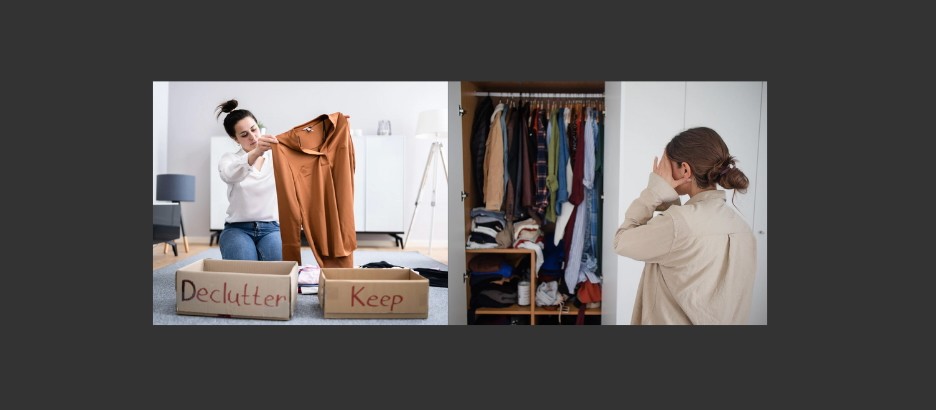
I recently helped my mom sort through boxes she inherited when my grandparents passed away. One box was labeled – either ironically or genuinely – “toothpick holders and other treasures.” Inside were many keepsakes from moments now lost to history – although we found no toothpick holders.

My favorite of the items we sorted through was a solitary puzzle piece, an artifact reflecting my late grandmother’s penchant for hiding the final piece to a jigsaw puzzle just to swoop in at the last moment and finish it.

After several hours of reminiscing, my mom and I threw away 90% of what we had sorted.

“Why did I keep this?” is a question I hear frequently, both from my family and friends and from patients. I am a licensed clinical psychologist whose research focuses on the characterization, assessment and treatment of hoarding disorder, particularly for adults 60 years of age or older. As such, I spend a great deal of my time thinking about this question.

What drives the need to keep stuff?

Hoarding disorder is a psychiatric condition defined by urges to save items and difficulty discarding current possessions. For adults with “clinically severe” hoarding disorder, this leads to a level of household clutter that impairs daily functioning and can even create a fire hazard. In my professional experience, however, many adults struggle with clutter even if they do not meet the clinical criteria for hoarding disorder.

Holding on to things that have sentimental value or could be useful in the future is a natural part of growing older. For some people, though, this tendency to hold on to objects grows over time, to the point that they eventually do meet criteria for hoarding disorder. Age-related changes in executive function may help explain the increase in prevalence of hoarding disorder as we get older; increasing difficulty with decision-making in general also affects decisions around household clutter.

The traditional model behind hoarding disorder suggests that difficulty with discarding comes from distress during decision-making. However, my research shows that this may be less true of older adults.


clutter, decluttering, stress, anxiety, life hacks
Time to declutter Kurt Whitman/Education Images via Getty Imagesu00a0via The ConversationWhen I was a graduate student, I conducted a study in which we asked adults with hoarding disorder to spend 15 minutes making decisions about whether to keep or discard various items brought from their home. Participants could sort whatever items they wanted. Most chose to sort paper items such as old mail, cards or notes.We found that age was associated with lower levels of distress during the task, such that participants who were older tended to feel less stressed when making the decision about what to keep and what to discard. We also found that many participants, particularly those who were older, actually reported positive emotions while sorting their items.In new research publishing soon, my current team replicated this finding using a home-based version of the task. This suggests that fear of making the wrong decision isnu2019t a universal driver of our urge to save items.

When I was a graduate student, I conducted a study in which we asked adults with hoarding disorder to spend 15 minutes making decisions about whether to keep or discard various items brought from their home. Participants could sort whatever items they wanted. Most chose to sort paper items such as old mail, cards or notes.

We found that age was associated with lower levels of distress during the task, such that participants who were older tended to feel less stressed when making the decision about what to keep and what to discard. We also found that many participants, particularly those who were older, actually reported positive emotions while sorting their items.

In new research publishing soon, my current team replicated this finding using a home-based version of the task. This suggests that fear of making the wrong decision isn’t a universal driver of our urge to save items.

In fact, a study my team published in August 2024 with adults over 50 with hoarding disorder suggests that altruism, a personality trait of wanting to help others, may explain why some people keep items that others might discard. My colleagues and I compared our participants’ personality profiles with that of adults in the general population of the same gender and age group. Compared with the general population, participants with hoarding disorder scored almost universally high on altruism.

Altruism also comes up frequently in my clinical work with older adults who struggle with clutter. People in our studies often tell me that they have held onto something out of a sense of responsibility, either for the item itself or to the environment.

“I need it to go to a good home” and “my grandmother gave this to me” are sentiments we commonly hear. Thus, people may keep things not out of fear of losing them but because saving them is consistent with their values.


Leaning into values

In a 2024 study, my team demonstrated that taking a values-based approach to decluttering helps older adults to decrease household clutter and increases their positive affect, a state of mind characterized by feelings such as joy and contentment. Clinicians visited the homes of older adults with hoarding disorder for one hour per week for six weeks. At each visit, the clinicians used a technique called motivational interviewing to help participants talk through their decisions while they sorted household clutter.

We found that having participants start with identifying their values allowed them to maintain focus on their long-term goals. Too often, people focus on the immediate ability of an object to “spark joy” and forget to consider whether an object has greater meaning and purpose. Values are the abstract beliefs that we humans use to create our goals. Values are whatever drives us and can include family, faith or frivolity.

Because values are subjective, what people identify as important to keep is also subjective. For example, the dress I wore to my sister’s wedding reminded me of a wonderful day. However, when it no longer fit I gave it away because doing so was more consistent with my values of utility and helpfulness: I wanted the dress to go to someone who needed it and would use it. Someone who more strongly valued family and beauty might have prioritized keeping the dress because of the aesthetics and its link to a family event.

Additionally, we found that instead of challenging the reasons a person might have for keeping an item, it is helpful to instead focus on eliciting their reasons for discarding it and the goals they have for their home and their life.

Tips for sweeping away the old

My research on using motivational interviewing for decluttering and my observations from a current clinical trial on the approach point to some practical steps people can take to declutter their home. Although my work has been primarily with older adults, these tips should be helpful for people of all ages.

Start with writing out your values. Every object in your home should feel value-consistent for you. For example, if tradition and faith are important values for you, you might be more inclined to hold onto a cookbook that was made by the elders at your church and more able to let go of a cookbook you picked up on a whim at a bookstore.

If, instead, health and creativity are your core values, it might be more important to hold onto a cookbook of novel ways to sneak more vegetables into your diet.

Defining value-consistent goals for using your space can help to maintain motivation as you declutter. Are you clearing off your desk so you can work more efficiently? Making space on kitchen counters to bake cookies with your grandchildren?

Remember that sometimes your values will conflict. At those moments, it may help to reflect on whether keeping or discarding an object will bring you closer to your goals for the space.

Similarly, remember that values are subjective. If you are helping a loved one declutter, maintain a curious, nonjudgmental attitude. Where you might see a box filled with junk, your grandmother might see something filled with “toothpick holders and other treasures.”

For additional resources and information on hoarding disorder, visit the International OCD Foundation website.

Mary E. Dozier is an Assistant Professor of Psychology, Mississippi State UniversityThis article originally appeared on The Conversation

  • This  hand-written Walmart note about employee hours is a real head-scratcher
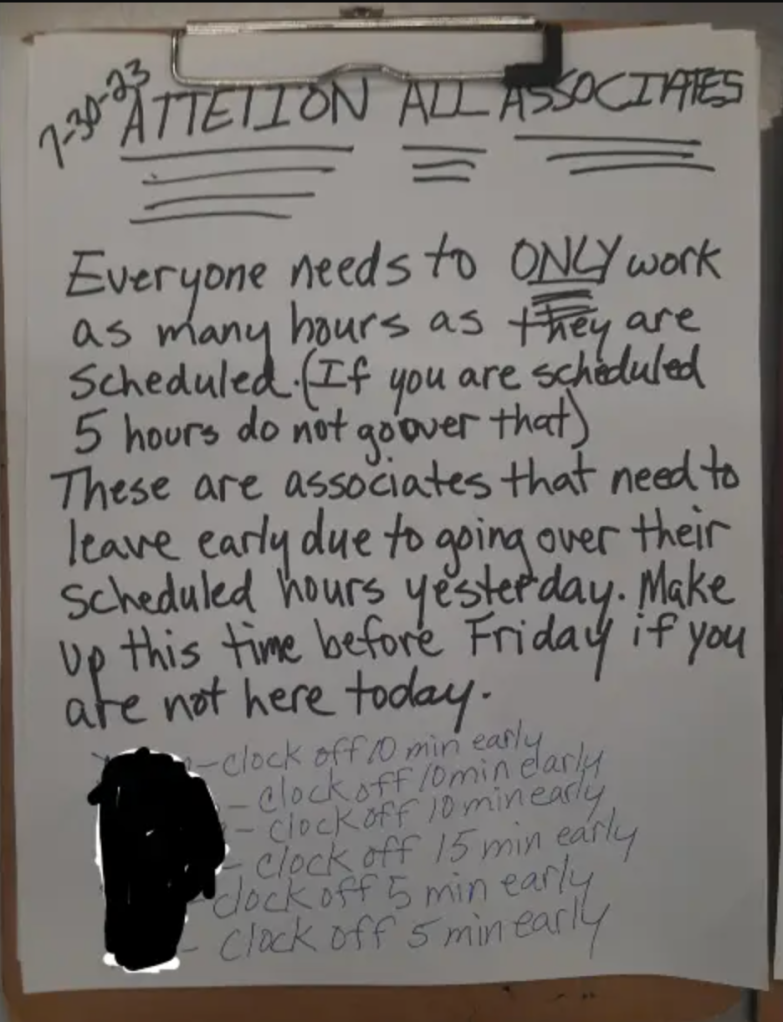
    A note from a Walmart manager to the employteesPhoto credit: u/Grizzlypupper / Reddit

    A handwritten notice posted at a Walmart store has gone viral, and the more people read it, the more complicated the conversation got.

    The sign, photographed and shared to r/walmart by user u/grizzlypupper in April 2024, begins plainly enough: “Attention all associates. Everyone needs to only work as many hours as they are scheduled. (If you are scheduled 5 hours do not go over that.)” So far, standard retail stuff. But the notice then lists six employees by name and tells each of them to leave early to compensate for a few minutes they’d already worked over their scheduled shifts the day before. One worker was told to clock out ten minutes early. Several others were directed to shave off five minutes.

    The response on social media was immediate. Some workers defended the practice as straightforward scheduling management, arguing that staying over even a few minutes without authorization creates payroll headaches. Others found the optics jarring, given that most of the workers named had gone over by less than fifteen minutes, seemingly out of dedication rather than negligence.

    Walmart, workers rights, overtime, labor laws, workplace
    A note from the manager to the employees. Photo Credit: @Grizzlyupper/Reddit

    But the comment that drew the most attention came from someone who identified themselves as a current Walmart employee, as reported by Distractify in their coverage of the post. According to that commenter, the notice may actually violate Walmart’s own corporate policy. “Associates can report it to the wage and hour hotline,” they wrote, “and I’m pretty sure they will have to pay out the OT. I know for such a petty amount like this it won’t make a difference on your paycheck, but it’s about the principle.”

    Walmart’s own ethics page states explicitly that the company is “committed to complying fully with all applicable laws and regulations dealing with wage and hour issues, including off-the-clock work” and overtime pay. Whether a store-level manager directing employees to offset previously worked minutes crosses that line is a question workers would need to raise through official channels.

    It’s not the first time Walmart has faced scrutiny over hour management. As Market Realist noted in covering the story, the Pechman Law Group has documented at least two separate lawsuits from former Walmart employees alleging the company skimped on overtime pay, in one case by allegedly adjusting time clock records manually to avoid paying the time-and-a-half rate that kicks in over 40 hours.

    Walmart, workers rights, overtime, labor laws, workplace
    A cashier takes payment from a customer. Photo credit: Canva

    Walmart has not commented publicly on the specific notice. The store location was not identified in the Reddit post.

    For many workers in the comments, the frustration wasn’t about the policy itself but the execution. “When they cut our hours, it’s like one or a half an hour each day,” wrote u/Wooden_Tomato919. “Just give me a whole half day off. But that would benefit me, not them.” Another user, u/JediFed, offered a manager’s perspective: “If I need another 10 minutes to clean everything up, I should take that 10 minutes and clean everything up.”

    A notice meant to manage labor costs ended up raising a question that goes a bit further than scheduling: if an employee works the time, are they owed the pay? Under the Fair Labor Standards Act, for most hourly workers, the answer is yes.

    This article originally appeared last year.

  • Love educator shares how awkward flirting can be turned into a romantic superpower
    A couple flirts on the dance floor.Photo credit: Canva

    In a recent TED Talk, love coach Francesca Hogi shared how even your awkward flirting can be a superpower. Sometimes mistaken as off-putting, flirting actually offers a powerful gateway to real human connection.

    By reframing flirting as an act of curiosity, she explains how anyone can kickstart attraction and open the door to lasting love. In an impassioned presentation, Hogi demystifies flirting and explains why building attraction matters.

    Flirting can be a superpower

    Hogi explains that for 12 years she’s been helping people fall in love as both a matchmaker and a coach. “As a love professional, I can assure you that many dating problems can be solved with flirting,” Hogi says. “If you’re single, it helps you to connect and fall in love. If you’re partnered, it helps you to reignite or maintain the spark of chemistry that brought you together in the first place.”

    Many might have concerns about their ability to flirt. Will they be received well, or are they even doing it right? Hogi explains, “I’ve got good news for the introverts out there. You don’t have to be extroverted to be a magnet for connection. In fact, I believe that introverts have a secret advantage when it comes to flirting because your efforts at being more open feel more genuinely inspired by another person and therefore special.”

    She shares that flirting can give you confidence and courage. She also acknowledges that feeling awkward is normal. “Confidence with flirting comes from knowing yourself, your intentions, reading the room, discerning other people’s reactions, and adapting accordingly,” she says. “Sometimes it’s going to be awkward, sometimes it’s going to be embarrassing, and that’s okay.”

    flirtation, connection, mental health, good vibes, sexuality
    A couple enjoys flirting.
    Photo credit: Canva

    Healthy flirting

    “Flirting gives you more agency over human connection,” says Hogi.

    She then describes the two foundational principles of healthy flirting. The first is presence: being in the moment and avoiding distractions like a phone or the surrounding environment. The second is enthusiasm. Getting the right vibe while being enthusiastic goes a long way toward mastering the art of flirting. These principles have a strong effect on other people.

    Hogi explains that expressing positive intentions has a large impact on outcomes:

    “You have the ability to leave other people feeling good for having interacted with you…Even your unspoken appreciation for a shared moment of connection, no matter how brief, can often be felt. Lean into being the version of you who leaves other people with a smile on their face and notice how much more magnetic you become.”

    community, expression, humor, self-confidence, self-esteem
    A flirtatious interaction.
    Photo credit: Canva

    Hogi inspires the crowd

    People seem quite taken with Hogi’s energy and charisma. Some of the comments expressed admiration for her vibe and flirtatious delivery on stage. Hogi was sharing her own version of flirting as a superpower:

    “Even this presentation feels like shes flirting…especially her laughs”

    “She is such a good public speaker, ten minutes of speech with no filler words whatsoever”

    “Flirting is a way making one feel seen and acknowledged.”

    “Where were you, Francesca, when I needed these words? Like, 40 years ago? Never too late, right?”

    “Had me clapping in the end! She’z good”

    “I feel better about my flirting abilities after watching this now.”

    “She’s good , reading her body language generally teaches me more about flirting than learning it itself”

    gender, attraction, laws of attraction, social skills, personality traits
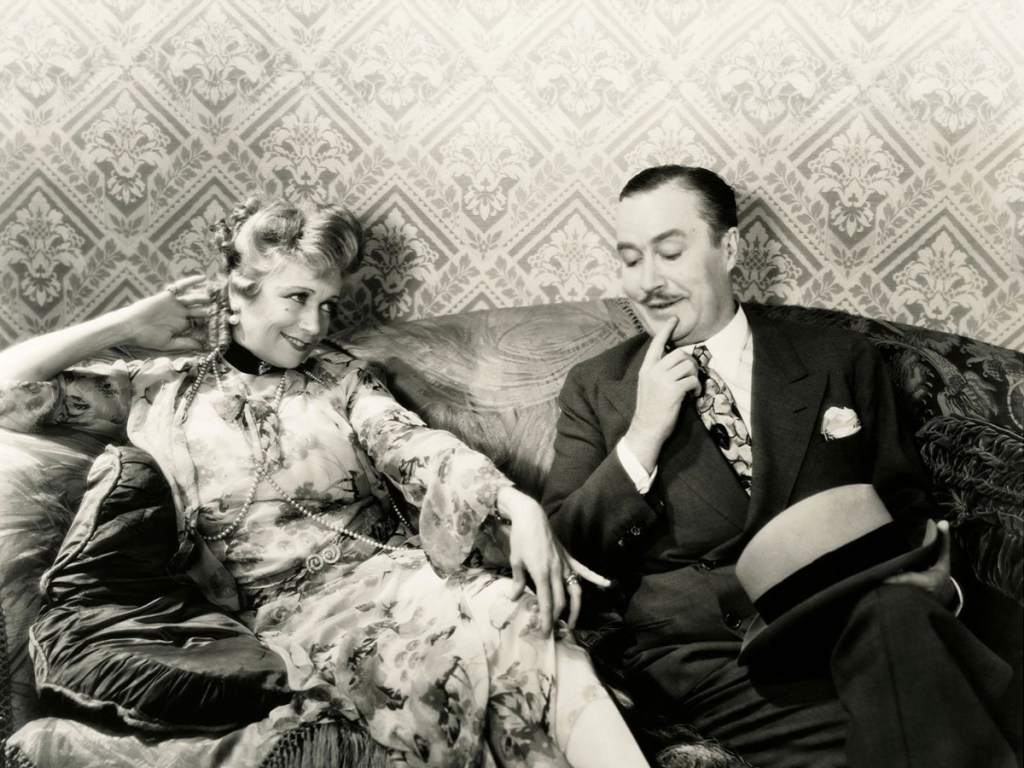
    A vintage photo of a couple flirting.
    Photo credit: Canva

    The power behind a flirtatious connection

    Flirting can have a powerful effect on both the initiator and the person on the receiving end. It isn’t necessarily about romance or sex. It helps build and strengthen relationships in everyday life.

    A 2025 study on ResearchGate analyzed where and how people flirt. The results suggested that people who flirt can improve with practice. The best flirting involved humor, confidence, and social skills. A 2026 study on ScienceDirect found that flirting can be an effective way for people to express their personality and individual differences. While personality traits and sex were linked to how often and how skillfully people flirted, these influences had only modest effects on overall outcomes.

    Hogi suggests flirting requires nuance and a little bit of courage. Practice prepares you for any occasion. “Attentiveness, compliments, playfulness—there’s nothing complicated about these actions, yet they have the potential to spark and sustain connection over time,” she says. “That’s a true superpower we can all tap into.”

    Hogi and the research suggest flirting isn’t just a trivial social game. It’s a meaningful way to express personality, build connections, and boost self-confidence. Flirting isn’t shallow. It doesn’t need to involve manipulation or outcome-obsessed action. These small everyday acts of courage embolden human connection and reveal individual superpowers in all of us.

  • A 6-year-old girl thought skateboarding was just for boys. One stranger at the skate park spent an hour proving her wrong.
    A young skater performs a trickPhoto credit: Canva

    According to data tracked by the Duke of Edinburgh’s Award program, the number of young women and girls who identify skateboarding as their chosen activity rose 800% between 2017 and 2022. At the international competition level, according to a peer-reviewed study published in early 2025, the number of female competitors has quadrupled since 2016. Right now, the best skaters on the competitive circuit are teenage girls, some as young as 15.

    None of that was true yet when Jeanean Thomas (@JeaneanThomas) took her 6-year-old daughter Peyton to a skate park in Cambridge, Ontario, in October of 2015. But the moment that happened that afternoon has been quietly circulating the internet ever since, and it keeps finding new audiences because the thing it’s really about hasn’t changed at all.

    Thomas, a firefighter, had spent months convincing Peyton that skateboarding wasn’t just for boys. “She’d only ever seen boys skateboard so she just assumed that it was a boy sport,” Thomas told Today. When they finally arrived at the park, her resolve nearly broke. It was full of teenage boys, smoking and swearing. Peyton wanted to turn around immediately.

    Thomas did too, if she’s being honest. “I secretly wanted to go too,” she later wrote, “because I didn’t want to have to put on my mom voice and exchange words with you. I also didn’t want my daughter to feel like she had to be scared of anyone, or that she wasn’t entitled to that skate park just as much as you were.”

    So they stayed. Peyton slipped onto the board and started falling. And then one of the boys skated over.

    “I heard you say, ‘Your feet are all wrong. Can I help you?’” Thomas wrote in a letter she posted to X that night, addressed to the teenager she never got to thank in person. “You proceeded to spend almost an hour with my daughter showing her how to balance and steer and she listened to you. I even heard you tell her to stay away from the rails so that she wouldn’t get hurt.”

    skate park kindness viral story, girls skateboarding, Jeanean Thomas skate park letter, Ryan Carney Cambridge Ontario, teenage boy helps girl skate, female skateboarders rising, skateboarding gender stereotypes, heartwarming parenting story, kids and kindness, breaking gender stereotypes skateboarding
    A young woman on roller skates flies off the ramp. Photo Credit: Canva

    His friends made fun of him for it. He kept going anyway.

    “I want you to know that I am proud that you are part of my community and I want to thank you for being kind to my daughter,” Thomas wrote. “She left with a sense of pride and with the confidence that she can do anything, because of you.”

    The letter went viral almost immediately. It later emerged, through reporting by the Cambridge Times, that the young man wasn’t a teenager at all. His name was Ryan Carney, a 20-year-old skate coach who worked at an indoor park in nearby Kitchener. He was baffled by the attention. “If I didn’t know what the heck I was doing, and I was in a place that could be intimidating at that age, I’d want someone to help me,” he told CBC News. “That’s all I did.”

    When they left the park, Peyton had gone from slipping off the board entirely to riding up and down ramps. She asked to go back every day after that.

    The culture Peyton stepped into that afternoon was one that had actively excluded girls for decades. What Carney did, without thinking much of it, was exactly the kind of thing that changes a kid’s relationship to a sport before she’s old enough to know she was supposed to be excluded from it. The 800% participation increase didn’t come from nowhere. It came from moments like this one, scaled up, repeated, normalized.

    “I just seen a little girl struggling to enjoy her time there,” Carney said. “I wanted to see her leaving wanting to skateboard again.”

    She did.

    This article originally appeared last year. 

Explore More Uncategorized Stories

Society

This hand-written Walmart note about employee hours is a real head-scratcher

Well-being

Love educator shares how awkward flirting can be turned into a romantic superpower

Ideas

A 6-year-old girl thought skateboarding was just for boys. One stranger at the skate park spent an hour proving her wrong.

Well-being

These seven simple phrases could be the secret to deepening trust and romance in your relationship