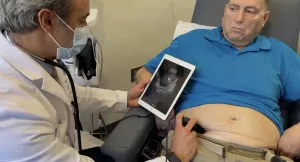
“You look great!”
Um, thanks.
I have been in the hospital a number of times before due to Crohn’s disease flare-ups over the past 18 years. Sometimes I was so sick, I was unable to walk due to pain or weakness or losing blood, but never have I had to face the surgeon’s knife. That would never happen to me! No way! That only happens to other people who are really sick! I’ll never get to that point, I thought. Until I did.
The end of 2014, I was doing a show and I experienced terrific pain during a performance. I thought I may have pulled a muscle, and I thought the pain would go, but it only got worse. I ended up in the emergency room; lo and behold, it was Crohn’s.
[quote position=”right” is_quote=”true”]You can look fabulous, but can be feeling far from it.[/quote]
Even after 18 years, it always took me by surprise when I would have a flare. Apparently there was a small hole in my large intestine that the doctors managed to heal with treatment in the hospital for two weeks, avoiding surgery.
I left the hospital in November 2014, and started to feel better. So, at the end of the year, I spent some time in the States and came back to Australia at the beginning of 2015—carrying on with work and life, all going well.
Funny thing is, when you’re feeling well, you tend to forget you have Crohn’s. And this is where the danger lies, I believe. Because, when you have Crohn’s, even if you’re “feeling well,” that doesn’t necessarily mean you are.
I was back in the hospital again in June 2015, booked for another colonoscopy. As I was going in for the procedure, I bumped into my previous gastroenterologist. He said, “Hello Sylvia! How are you going?” I said, “Not too bad (why do we Aussies always under-play things?). I’m having a bit of a flare, so am going in for a colonoscopy.” He said, “Ok. Well, you look great! A bit thin, but you look great!”
I said, “Thanks.”
A Crohn’s point. You can look fabulous, but can be feeling far from it. Please don’t judge a book by its cover, friends.
I went in for the colonoscopy and my new specialist gave me the results: “Your intestines are so ruptured, we couldn’t even get the camera through; we don’t even know how you’re walking. We need to operate right away because this is potentially life-threatening.”
And there it began. I was one of those people who was apparently so sick, they needed to perform a resection surgery—removing a part of the large intestine—which turned into two surgeries, which turned into three surgeries, removing all of my large intestine, with a temporary ileostomy—the dreaded bag.
This, by the way, is not standard.
Apparently a resection surgery is a resection surgery. And that’s it. You’re in. You’re out. You go home.
My first surgery, however, broke away in my body after a week of recovery. Truly horrific. I have never been in so much pain and I have never felt so frightened in my life. The surgeons had to do an emergency second operation, removing the remainder of my large intestine, and that’s where I ended up with the ileostomy—the bag. Thankfully the ileostomy was only temporary. This sort of major surgical complication only ever happened to the surgeon once before. Also, during my six-week stay in the hospital (which was only meant to be two weeks max) there were further complications. In fact, medical students came around to have a look at me, as a study on “What can go wrong when operating on Crohn’s patients.” Great. They were, by the way, quite strapping doctors, so that was a highlight. I, however, wasn’t in my best form to say the least. I was looking exactly as I was feeling.
[quote position=”left” is_quote=”true”]Your intestines are so ruptured, we couldn’t even get the camera through.[/quote]
Crohn’s can be very tricky, in a number of ways. It can even fool the patient. You may look great. Doctors can even say you look great. You may think you’re feeling great. And that’s hard to monitor, because with chronic illness, you can become so accustomed to being run down and experiencing pain on a regular basis, that your tolerance for pain is actually quite high compared to others not experiencing chronic illness.
Thankfully, now one year later, I am doing well. I’m on a new medication, Humira, which has helped put the disease into remission. And, I hope to continue to stay in remission. And, I know I will never let myself get to that point ever again. The moment there is a hint of anything, I am going straight to the doctor.
So, my learning from all of this is—take this disease incredibly seriously. I don’t think I ever really did, not to the extent I should have. Being a “bit sick,” for me, was the norm. Until now. Please, friends with Crohn’s and family members of those with Crohn’s, don’t judge the disease from how you may look or feel, even if you feel great. Monitor yourself consistently with doctors, specialists—talk about Crohn’s, go to support groups. Ask questions, share. This disease is a very real thing. And, it can take you completely off guard. Lord knows it did with me.