




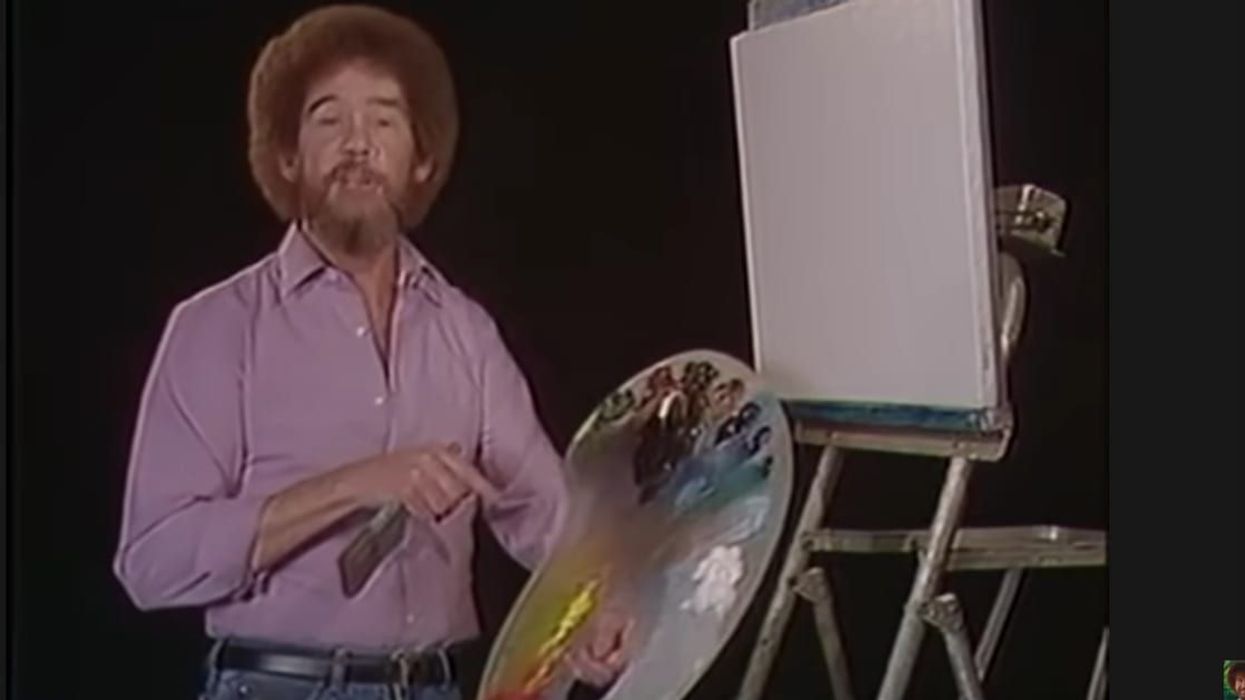

Bob Ross wasn't just a famous painter; he was a man with a heart of gold. Known for his magical ability to transform empty canvases into masterpieces, his show "The Joy of Painting" remains beloved by fans. Though it concluded in 1994, the show's videos remain popular online. In Episode 4 of Season 2, which has recently gone viral, Bob meets a colorblind fan who believes he can't paint. In a warm and inspiring response, Bob demonstrates how to create art using only grey and white.
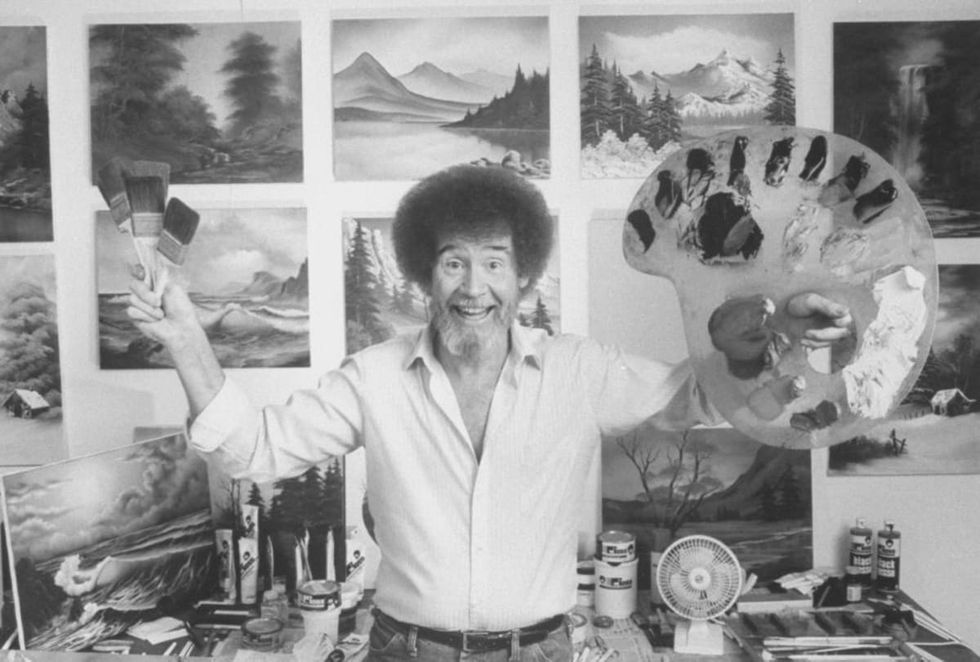 Image Source: TV painting instructor/artist Bob Ross jubilantly holding up paint palette & brushes as he stands in front of wall covered w. his landscape paintings in his studio. (Photo by Acey Harper/Getty Images)
In the episode uploaded on YouTube by "The Joy of Painting" channel, Bob Ross talks about a fan who felt he couldn't paint because he was colorblind. Bob shares, "Just recently, I was doing a demonstration in a mall, and I had a man come to me, and he said, 'Bob, I could never paint because I'm colorblind. All I can see is gray tones.' So, I thought today we'd do a picture in gray just to show you that anyone can paint."
In the next scene, Ross explains how he'll demonstrate a painting using only hues of browns and blues mixed with white. He dips his brush into the palette, and the camera zooms in on the white canvas as Ross instructs, "Keep moving the brush in circular patterns."
 Representative Image Source: Pexels I Photo by Pavel Danilyuk
Ross narrates the painting process as the video continues, demonstrating how to effortlessly dab the paintbrush across the canvas. The first elements emerge with a grey sky and clouds. He then adds mountains, using shades of grey and white.
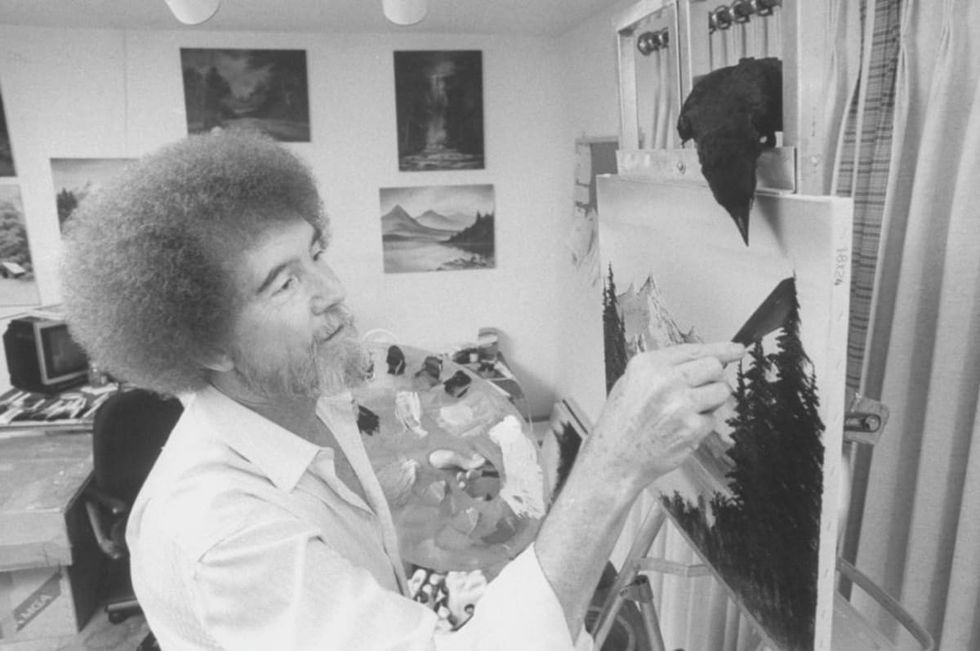 Image Source: TV painting instructor/artist Bob Ross painting one of his landscapes as his pet crow watches closely from its perch on top of an easel in his studio at home. (Photo by Acey Harper/Getty Images)
The American painter tells his viewers that a painting is a "game of angles." He draws a mountain with his palette knife in less than a few minutes. He encourages his viewers, saying, "Isn't that fantastic? That you can make whole mountains in minutes? And you can do it. There's no big secret to it. All you need is a dream in your heart."
In the last segment, he adds elements like trees and a river overlooking the beautifully painted mountains. He adds a small cabin house with the mountains in the backdrop. In the concluding moments of the video, he explains, "There is no limit to any color, any color will work as long as you use the basic method."
"The Joy of Painting," Bob Ross' half-hour instructional TV show, aired from 1983 to 1994 and was widely popular. In each episode, Ross taught landscape oil painting techniques. Sadly, he passed away in 1995 from cancer, but his rich legacy lives on.
The YouTube clip uploaded by the channel has been viewed over 3 million times and has 44,000 likes. People have expressed their reactions towards the painting with words of encouragement. One user, @treyliles117, commented, "Bob Ross wasn't just a painter. He was a magician."
 Image Source: YouTube I @HaploidCell
 Image Source: YouTube I @willvaldez2801
This article originally appeared 4 months ago.













 Ladder leads out of darkness.Photo credit
  Woman's reflection in shadow.Photo credit
  Young woman frazzled.Photo credit



Will your current friends still be with you after seven years?
Professor shares how many years a friendship must last before it'll become lifelong
Think of your best friend. How long have you known them? Growing up, children make friends and say they’ll be best friends forever. That’s where “BFF” came from, for crying out loud. But is the concept of the lifelong friend real? If so, how many years of friendship will have to bloom before a friendship goes the distance? Well, a Dutch study may have the answer to that last question.
Sociologist Gerald Mollenhorst and his team in the Netherlands did extensive research on friendships and made some interesting findings in his surveys and studies. Mollenhorst found that over half of your friendships will “shed” within seven years. However, the relationships that go past the seven-year mark tend to last. This led to the prevailing theory that most friendships lasting more than seven years would endure throughout a person’s lifetime.
In Mollenhorst’s findings, lifelong friendships seem to come down to one thing: reciprocal effort. The primary reason so many friendships form and fade within seven-year cycles has much to do with a person’s ages and life stages. A lot of people lose touch with elementary and high school friends because so many leave home to attend college. Work friends change when someone gets promoted or finds a better job in a different state. Some friends get married and have children, reducing one-on-one time together, and thus a friendship fades. It’s easy to lose friends, but naturally harder to keep them when you’re no longer in proximity.
Some people on Reddit even wonder if lifelong friendships are actually real or just a romanticized thought nowadays. However, older commenters showed that lifelong friendship is still possible:
“I met my friend on the first day of kindergarten. Maybe not the very first day, but within the first week. We were texting each other stupid memes just yesterday. This year we’ll both celebrate our 58th birthdays.”
“My oldest friend and I met when she was just 5 and I was 9. Next-door neighbors. We're now both over 60 and still talk weekly and visit at least twice a year.”
“I’m 55. I’ve just spent a weekend with friends I met 24 and 32 years ago respectively. I’m also still in touch with my penpal in the States. I was 15 when we started writing to each other.”
“My friends (3 of them) go back to my college days in my 20’s that I still talk to a minimum of once a week. I'm in my early 60s now.”
“We ebb and flow. Sometimes many years will pass as we go through different things and phases. Nobody gets buttsore if we aren’t in touch all the time. In our 50s we don’t try and argue or be petty like we did before. But I love them. I don’t need a weekly lunch to know that. I could make a call right now if I needed something. Same with them.”
Maintaining a friendship for life is never guaranteed, but there are ways, psychotherapists say, that can make a friendship last. It’s not easy, but for a friendship to last, both participants need to make room for patience and place greater weight on their similarities than on the differences that may develop over time. Along with that, it’s helpful to be tolerant of large distances and gaps of time between visits, too. It’s not easy, and it requires both people involved to be equally invested to keep the friendship alive and from becoming stagnant.
As tough as it sounds, it is still possible. You may be a fortunate person who can name several friends you’ve kept for over seven years or over seventy years. But if you’re not, every new friendship you make has the same chance and potential of being lifelong.