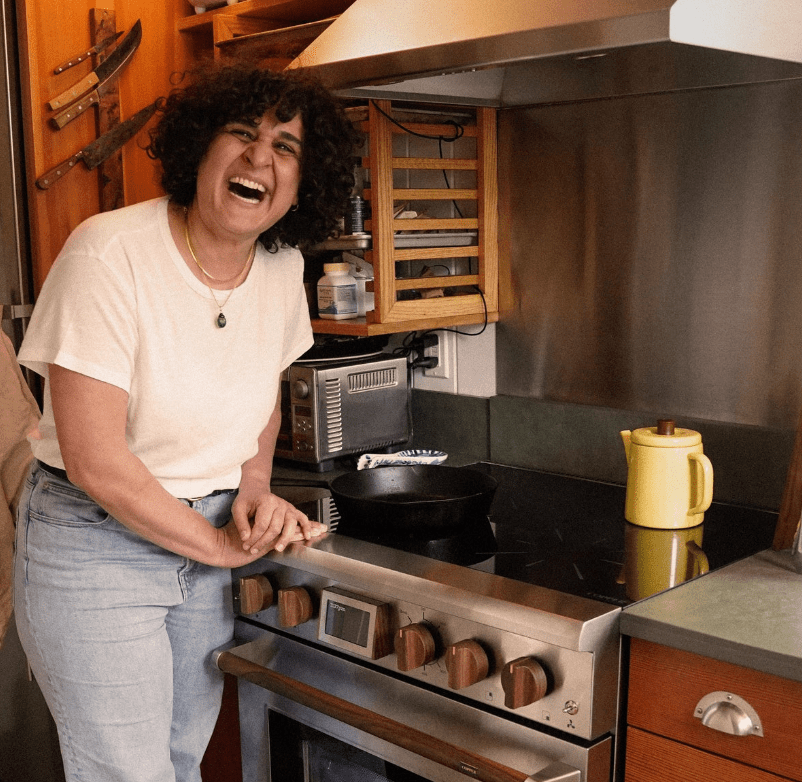
A California start-up named Copper is reviving the discourse between those who cook with an electric stove and folks who swear by gas stoves. The company has created a viable electric stove that runs on 120 volts rather than the standard 240 volts, meaning that it can be used with a standard electric outlet rather than needing an electrician to adjust a kitchen’s wiring.

The stove also has a built-in smart battery that can charge up when electricity rates are lower to avoid incurring charges during peak rates. This means that folks like building co-op treasurer Ed Yaker and fellow renters in the building, as reported by the Associated Press, can cook their food affordably while also not worrying about when his building’s aging gas line is shut off for for repairs.

But there are still advocates that strongly prefer gas stoves. Many of them cite that gas stoves offer better temperature control since you can see the flames when cooking. They also argue that it costs less to heat up a gas stove versus an electric one. The fandom is such that some politicians even balked against a U.S. Consumer Product Safety Commission recommendation for stricter safety regulation of gas stoves in 2023.

While it’s become a topic in “culture war” discourse, gas stove usage probably isn’t as huge as you’d imagine. According to a 2020 report from the U.S. Energy Information Administration, only 38% of American homes use a gas stove, with the vast majority of gas stoves being used in California and New Jersey rather than any traditionally red state. This makes sense as more and more new kitchens are built with electricity in mind to power up refrigerators, dishwashers, microwaves, and other appliances along with kitchen gadgets such as blenders and coffee makers. Also, per Consumer Reports, electric stoves are generally less expensive to purchase than gas stoves by hundreds of dollars.

When it comes to efficiency, electric stoves cook as good if not better than gas stoves. Many professional chefs are switching from gas to electric stoves for this reason. Another reason is that kitchens with electric stoves keep the heat on the food, not the whole kitchen.

“I had a meat thermometer in my chef coat at one old restaurant job, and I looked down one day and noticed that my thermometer read 135F,” executive chef Christopher Galarza told The Guardian regarding his gas stove kitchen. “We were able to drastically reduce the temperature in the kitchen [after switching to electric], which made us all more comfortable. And for me personally, I can tell you that my mental health was better.”

In terms of health of both humans and the planet, there is a growing concern regarding gas stoves. Aside from needing to be mindful of the burners to prevent a fire, gas stoves have been shown to increase the risk of respiratory illness considering that natural gas contains benzene, a known carcinogen, and a study revealing that one in eight childhood asthma cases were caused by gas stove pollution. Methane is also a potent greenhouse gas that impacts the environment, with one American Chemical Society study showing that a year’s worth of methane emissions from all U.S. gas stoves have the same climate impact as the annual CO2 emissions of 500,000 cars.

While there isn’t a call to arms to outright remove gas stoves should you prefer one, there are valid reasons why electric stoves are becoming more common in both regular homes and the restaurant industry. This new standard wall outlet electric stove is just making the concept even more accessible and commonplace.


  • Why Americans give: New research finds 5 distinct profiles for generosity
    Photo credit: Overearth/iStock via Getty Images PlusAbout 82% of Americans said in response to a survey that they give to charity or to people in need.
    ,

    Why Americans give: New research finds 5 distinct profiles for generosity

    A new study suggests Americans remain broadly generous, but their reasons for giving vary sharply.

    Given that fewer Americans are donating and volunteering and that people in the U.S. appear to be losing trust in one another, it may seem like generosity has eroded in the United States.

    The nation’s political, social and economic divides might only strengthen that impression. But my recent research suggests that this belief would be misguided.

    I’m a professor who teaches and conducts research about nonprofits and philanthropy. To understand the diversity of American generosity, I teamed up with Paige Rice and Veronica Selzler, two philanthropy consultants who contributed to the Generosity Commission’s report on U.S. generosity called “How and Why We Give.”

    The Generosity Commission is a nonpartisan group of leaders from across the charitable sector. Its 2023 report shared the results of a national survey of 2,569 U.S. adults.

    Multicolored hearts are scattered on a white background.
    There are many ways to be generous. MirageC/Getty Images

    Drawing on data from that study, we sought to understand how different kinds of people may be motivated to act generously for different reasons and, as a result, express their generosity differently.

    The study defined generosity broadly in terms of efforts or gifts made to support people in need, charitable causes or philanthropic organizations through actions like giving and volunteering. Our study was published in March 2026 in Nonprofit Management & Leadership, a peer-reviewed academic journal.

    The overall propensity to give was about 82% based on responses to this question in the Generosity Commission’s survey: “On average, how much money do you donate each year to people in need, charitable causes, or philanthropic organizations?”

    The survey also asked Americans about how they express their generosity.

    We found that Americans’ generosity varies according to their aspirations, motivations and demographic characteristics. In other words, different kinds of Americans are generous in different ways.

    Using a statistical modeling technique called latent profile analysis, which can find hidden groups of people based on observed data, we identified five segments of American society. They come from the general population, not just existing donors or volunteers.

    Change-minded hopefuls, about 42% of the total, are mostly women and people with low incomes. They genuinely want to help people but are held back mainly by not having enough money.

    Flexible moderates, roughly 35% of the survey’s respondents, are a middle-of-the-road group without strong political or religious motivations. They are open to helping out in a wide variety of ways when given the opportunity.

    Values-driven skeptics, around 11% of those surveyed, are mostly older, conservative, religious and male. They are willing to give money but are worried that charities might not make good use of it.

    Status seekers, approximately 9% of the participants in the survey, are the most generous group. Affluent, educated and religious, they are highly active in giving and volunteering and are motivated by social recognition and personal benefits.

    Frustrated activists, only about 4% of the total, are passionate, liberal and financially strapped. They are often women and people of color. They care deeply about causes and prefer to take direct action rather than giving money.

    These results are based on the analysis of data collected for a 2023 Generosity Commission report.

    Why it matters

    Each of these groups is relatively generous. For example, the percentage of people in each one donating to people in need, charitable causes or philanthropic organizations ranged from a low of 77% – the frustrated activists – to a high of 93% among the status seekers. This shows that Americans with different mindsets exhibit a willingness to help others, even if their aspirations, motivations and demographic characteristics differ.

    For nonprofits looking to attract more donors and volunteers, it may help to understand that different groups of people may have different motivations and concerns. By appealing to each group’s distinct qualities, nonprofits may be able to garner more support for their causes.

    These results are based on the analysis of data collected for a 2023 Generosity Commission report.

    What other research is being done

    Researchers with the Lilly School of Philanthropy at Indiana University and their partners are conducting numerous studies about American generosity.

    For example, in a study published in 2019, those researchers found a sharp decrease in the percentage of Americans who gave to nonprofits following the Great Recession. And their ongoing research on global philanthropy tracks cross-border giving for 47 countries, including the U.S., to document global trends in generosity.

    The Research Brief is a short take about interesting academic work.

    This article originally appeared on The Conversation. You can read it here.

  • Persuasion expert shares the one strategy that’s actually effective at changing people’s minds
    Photo credit: CanvaA woman is unsure how to respond.
    ,

    Persuasion expert shares the one strategy that’s actually effective at changing people’s minds

    It’s nearly impossible to change someone’s mind. So let them do it for you.

    Learning how to communicate effectively and change people’s minds rarely succeeds by forcing your opinion. People are far more likely to adopt beliefs when they feel like they came up with them. Understanding this can make parenting, leading a team, or even trying to win an argument with a friend more effective.

    Chase Hughes, a former United States Navy chief and behavioral expert, told The Diary of a CEO podcast why self-persuasion is an effective strategy for influencing others. He believes it’s “maybe the most dangerous persuasion skill there is.”

    Changing people’s minds

    The most effective communicators influence others by offering small pieces of information that allow the other person to connect the dots themselves. Ideas we feel are our own carry far more weight in decision-making than those given to us by others. Hughes explains the simple approach behind changing people’s minds:

    “I’m gonna put a LEGO right here on the table in front of you. [He points to the right of the table.] And I’m going to put another LEGO right here in front of you. [He points to the left of the table.] And I’m just going to keep having the conversation until eventually your brain is going to go, ‘Oh, I bet those things go together.’ So the idea came from you.”

    Hughes further explains the pattern:

    “I’m going to give you one piece of information and another piece of information, but I will never put them together for you. And the reason is that any idea that you think came from your own mind, you have no ability to resist it.”

    conversations, debate, advocacy, direct persuasion
    Crafting a convincing idea.
    Photo credit: Canva

    Self-persuasion in a real-world situation

    The idea Hughes refers to is called self-persuasion. This form of psychological influence stems from the fact that people are more likely to adopt new beliefs when they feel those beliefs come from within. They are far less likely to be persuaded by external pressure.

    Hughes’ example of placing two LEGO bricks offers a clear visual explanation, but what would a real-life scenario look like? Hughes explains:

    “Let’s say you’re watching the news and they say, ‘Local Austin woman has been reported missing. Neighbors said that earlier this day, people saw her arguing with her boyfriend. Details after the break.’ And your brain is like, ‘I know what happened.’”

    In this example, it’s easy to infer that the boyfriend is likely involved in her disappearance.

    change minds, motivation, inoculation theory, effective strategies
    A couple attempts to convince a skeptical woman.
    Photo credit: Canva

    Self-persuasion is effective at changing people’s minds

    Self-persuasion is powerful because it creates a self-generated process. Individuals feel more personally connected, and even justified. A 2022 study found that people are more influenced when arguments align with their values and beliefs. Messages they may know little about can feel true and even self-driven when they aren’t imposed on them.

    A 2022 study examined self-persuasion as an influence on social norms. When people were given options that aligned with their values, the messages felt more personal and were therefore more convincing.

    Another 2022 study found that when people were asked to argue one side of a debate, they eventually came to believe that side was correct—even if they didn’t believe it at first. This form of self-persuasion can make disagreements harder to resolve because people naturally feel more confident in their own perspective.

    work, mental health, framing effects, conclusions, narrative
    That’s a brilliant idea.
    Photo credit: Canva

    People rarely resist their own conclusions

    Self-persuasion works because it changes who is doing the persuading. Telling a child what to do is very different from a parent explaining why it matters. In business, people are more motivated when they help generate ideas than when they’re given even simple instructions.

    The most effective communication isn’t about delivering perfect arguments. When people connect the dots on their own, the idea doesn’t just land—it sticks. Hughes suggests letting a person’s brain fill in the gaps. Once they do, the conclusion feels like their own. Studies show that this sense of ownership is a powerful motivator for changing minds.

    Watch the full interview with Chase Hughes:

  • A bride collapsed during her own rehearsal dinner toast. The detective who burst in explained everything.
    Photo credit: CanvaBride gives a speech at her rehearsal dinner
    ,

    A bride collapsed during her own rehearsal dinner toast. The detective who burst in explained everything.

    She planned a prank for the rehearsal dinner and cast herself as the victim. The groom had no idea.

    Alexandra Lahde had been a couple of things on the night of her rehearsal dinner: a bride, a hostess, and, briefly, a corpse.

    The 28-year-old barista from Canada had spent months planning the evening at Fairmont Banff Springs, one of the most storied hotels in the country. The decor was themed around old Hollywood glamour and detective fiction, with a vintage typewriter welcome sign, magnifying glass name tags, and moody florals and candles throughout the room. If any of her 30 guests noticed the clues, they kept quiet about it. When Alexandra clinked her wine glass to give a toast, nobody suspected a thing.

    “I just wanted to take a second and thank you all so much for coming here,” she began. Then she started to cough. She tried to continue. She coughed again, clutched the counter beside her, and said, “Oh my God” before dropping to the floor. Two guests who had been in on it from the start called out, “She’s dead. She’s DEAD!” Her husband Ian rushed toward her. Before anyone else could react, a man in a detective costume burst through the doors, flashing a badge. “Nobody move! My name is Bert Hammel. I’m from a bad police department. I’ve been told there’s a murder,” he announced, before looking down at Alexandra’s motionless body. “I can’t feel a pulse. The bride has been poisoned.”

    A dining table at a wedding reception with champagne bottles and flowers.
    Table arrangement at a rehearsal dinner. Photo credit: Canva

    The evening was underway. The actor, Eric from the improv company THEY Improv, had been hired by Alexandra with help from her wedding planner Melissa Alison Events. The murder plot was tied to the Fairmont Banff itself, which has its own legendary ghost bride story. Selected guests had been pulled into a separate room before dinner, briefed on the plot, and given character roles to play. After the faux detective questioned them in front of the group, guests split into teams to solve the mystery.

    Alexandra told People magazine that she had only learned the full script about 15 minutes before her guests arrived, which suited her perfectly. “I find I work best when I have little to no plan, so I went into it pretty blind,” she said, “only having practiced my expression and fall in the bathroom a few times before!”

    The video, captured by videographer Alesia Hardy (@alesiafilms) of Alesia Films, has since gone massively viral. Viewers were particularly impressed by one logistical detail: the detective appeared within seconds of Alexandra hitting the floor, giving the groom and guests no time to spiral into genuine panic. “The fact that the detective was virtually immediate to signal that she was okay and it was a game is the PERFECT way to pull this off,” one commenter wrote.

    This article originally appeared earlier this year.

Explore More Ideas Stories

Ideas

Persuasion expert shares the one strategy that’s actually effective at changing people’s minds

Ideas

A bride collapsed during her own rehearsal dinner toast. The detective who burst in explained everything.

Ideas

Woman at airport quietly pays for dad who couldn’t afford toddler’s $700 ticket

Ideas

A couple sat in an Olympian’s seat and asked her to swap. She has a name for exactly what they were doing.