
The trade war between President Donald Trump’s 145% tariff increase on Chinese goods and China’s reciprocal 125% tariff increase on goods from the United States has created a stir throughout the world. While governments go over what this means for their respective economies, the TikTok community and other social media groups made up of regular consumers and small businesses from both countries are sharing the open-secrets regarding various luxury items.

Many of these videos are from Chinese manufacturers revealing something many already know: that many of their favorite luxury European brands are actually made in China, are packaged in Europe for distribution, then sold at a heavily marked-up price. However, these videos are showing the math and how much disparity there is between the actual cost of manufacturing versus the price tag at a branded store.

“I thought this was common knowledge already,” wrote @PineappleCervix on X.

“Yeah it’s been (to an extent) but this is the first time the Chinese are ACTUALLY CONFIRMING it,” wrote @thecreativexx in response.

This information has gotten traction not just from consumers, but small business owners in both the United States and China. Some Chinese TikTokers are asking American consumers to skip the middleman and buy directly from their factory at a cheaper price.

The comments regarding this influx of revealing videos are varied, with people saying this isn’t really new information and others thinking this is a big deal.

“Now with social media (and TikTok especially), factory-level transparency is going viral. What was once niche supply chain knowledge is now mainstream content,” wrote @LoveleeBubblee on X.


This isn’t the first time that Chinese-made goods and knockoffs were sold directly to U.S. consumers. Americans have taken advantage of Chinese online retailers such as Temu and Shein for direct and duty-free deliveries of a great number of different products from toys to handbags to clothing. While part of Trump’s tariff closes that loophole (among many others), the information from these Chinese manufacturers via TikTok and other means has been seen as individual factories behind dozens of different U.S. and European name brands promoting even more direct sales without using Temu, Alibaba, or any other similar third party distributor.

Small European and American businesses have also been kneecapped by the tariffs since many of them have their products manufactured in China then shipped to the U.S., or they order parts from Chinese factories. While the focus of these Chinese TikTok videos has been to educate consumers, there have been small business owners taking to the Internet to explain to their followers and customers why they have to now raise prices on their products. Many of them feel that they have no choice, with them arguing that they either cannot find quality made products, that the cost of American or European-made products are too expensive, or that there just aren’t any factories in any other countries that can make what they’re looking for.


At this point, the governments of both China and the United States are figuring out a deal. Meanwhile, social media has become a platform for people in the manufacturing, small business, and general consumer camps to get honest about the actual cost of “luxury” items and unite in the hope that something gets figured out in a way that all three camps can benefit.


  • Should paper checks be abolished like the penny?
    Photo credit: CSA Images/Getty ImagesWhile Americans are writing fewer checks, they haven’t abandoned this means of payment.
    ,

    Should paper checks be abolished like the penny?

    Billions are still written each year, even as digital payments take over.

    Germany is getting rid of paper checks at the end of 2027Australia is bidding them farewell by 2030. U.S. President Donald Trump followed up his order killing off the penny with an executive order stopping check writing by the federal government.

    Should the U.S. follow these other countries and broadly eliminate the ability to write checks?

    Years ago, experts predicted that checks would have disappeared by now. However, they are still around, and billions are written each year in the United States.

    Why? The quick answer is that businesses love them. And plenty of Americans still use checks for good reasons. But there is more to the story.

    I am a business school professor and one of the few academics who advocates for the use of cash. While I have long told everyone about the benefits of paper money, I didn’t give paper checks much thought or use them until my mother’s recent death. Then I found myself writing checks to the cemetery, funeral home, gravestone engraver and a host of other places. Plus, I started getting refund checks back from her landlord and insurance companies.

    These experiences made me look more deeply into this form of payment to understand what was happening.

    Fewer checks for bigger bucks

    Every three years the U.S. government runs the Federal Reserve Payments Study by asking banks and credit unions for internal information. This survey tracks everything from how often credit cards are used to the number of checks written.

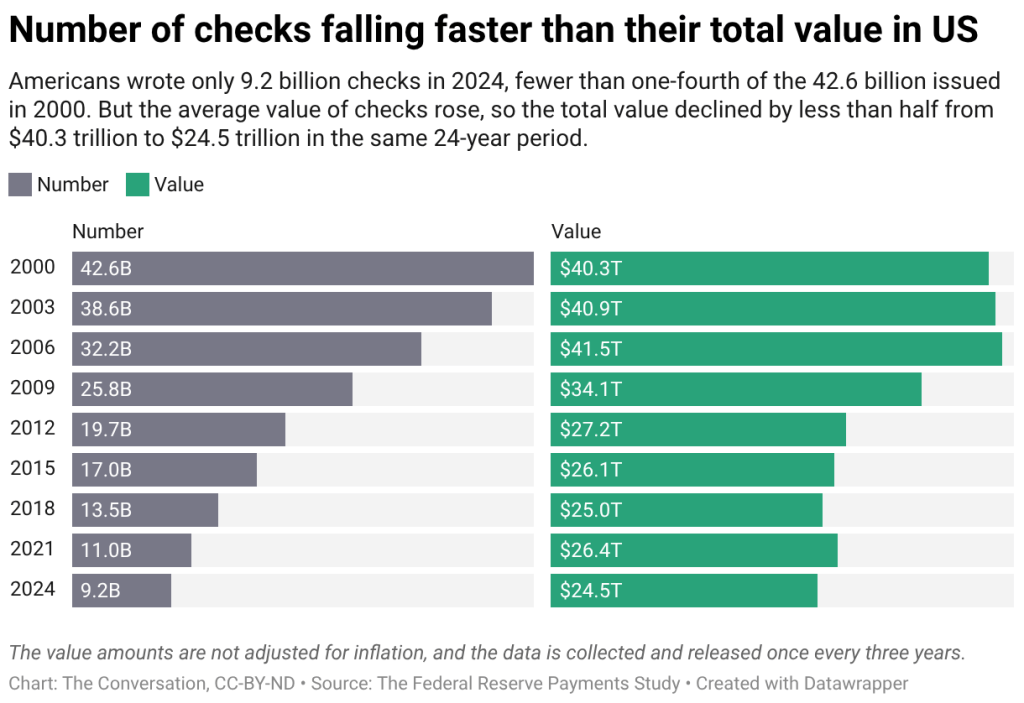
    While check usage has sharply declined in the U.S., a significant number – about 9.2 billion in 2024 – are still written, the data shows. The face value of those checks is probably bigger than you’d expect: more than US$24 trillion, not adjusted for inflation. That is almost as large as U.S. gross domestic product of $29 trillion that year.

    Not everyone can imagine numbers in billions or trillions, so let’s put those figures in more manageable terms.

    A little over 150 checks were written per person in 2000. By 2024, the average had plummeted to 27 checks – slightly more than two per month. However, over that time, the amounts typically scribbled or printed on the face of those checks rose.

    In 2000, the typical check was worth less than $1,000. By 2024, the average amount had more than doubled to $2,600.

    Trends elsewhere are similar. The Bank for International Settlements, which serves as a bank for central banks like the Federal Reserve, has tracked check usage in 25 countries since 2012. Its data shows that in only two other countries is payment by check still commonplace.

    And in both of those countries, check usage has fallen more sharply than in the United States.

    The value amounts are not adjusted for inflation, and the data is collected and released once every three years.

    Who uses checks today?

    While check payments have declined, there are still two big groups of check writers in the United States.

    The Federal Reserve Bank of Atlanta runs the Survey and Diary of Consumer Payment Choice. This survey asks people, rather than banks, for information on their payment habits. Roughly one-third of all respondents stated they used a paper check in the past 30 days.

    An older lady writes out checks to pay bills.
    Older Americans write more checks than younger people. Jupiterimages/The Image Bank via Getty Images

    Not surprisingly, the answers vary by age. About 60% of people 65 and over say they wrote a check. Among those 18 to 24, under 6% said they did.

    It also turns out that a lot of people who think they never write checks actually unknowingly do it all the time. If you pay your bills online, your bank tries to pay them electronically. If it cannot electronically make the payment, the bank cuts a paper check on your behalf. Any online bill payment taking more than a couple of business days to post is being sent by check.

    Another important factor is that small businesses love checks. Over 80% of businesses with sales between $1 and $10 million make payments using checks. Why? Small businesses often require two signatures on a check. The need for signatures means owners have to sign their name before any money goes out the door. This gives them control over money and a clear idea who is getting paid and how much.

    Small businesses also like receiving checks. I wrote a lot of checks after my mother’s death because many of those small businesses I dealt with wanted an extra 3% and sometimes more to cover the cost to them of a credit card payment. Writing paper checks saved me and the businesses a lot of money.

    The future

    While many Americans still write checks, their declining usage clearly underscores that they are not ideal for making payments in all situations.

    One of the biggest problems with checks is that you never know if the check writer has sufficient funds to cover the amount. When an account doesn’t have enough money, the check bounces. The Federal Reserve, which clears about one-third of all U.S. checks, returned about 22 million checks, with a total face value of around $80 billion. While these numbers are large, over 99% of all checks written don’t bounce.

    Another problem with checks is forgery. Thieves steal checks from mailboxes, alter information and then cash them. The most recent figures show about 500,000 annual cases of check fraud in the U.S. Again, while a half-million is large, it is a tiny fraction of the 9.2 billion checks written annually.

    Because of these problems, the Federal Reserve is contemplating leaving the check processing business. In early 2026, it accepted public comments on whether it should wind down, improve or leave alone its check processing unit.

    The unit, which costs about $100 million a year to run, turned a $6.6 million profit in 2024. But its machines need replacing, and the Federal Reserve is wavering on spending the money.

    Front and back of a U.S. half-cent coin.
    The U.S. government stopped minting its half-cent coin in 1857 due to its lack of usefulness. Mark Kostich/iStock via Getty Images Plus

    Should checks be killed off like the penny, which the federal government stopped minting in 2025, and the haypenny, which was worth half a cent and hasn’t been produced since 1857?

    For me, the answer is a clear no. While checks are clearly less important today than in the past, the numbers show that the American people and businesses still use and need checks.

    This article originally appeared on The Conversation. You can read it here.

  • Millions of Illinois residents wake up to find that $2.6 billion of their medical debt has been eliminated
    Photo credit: CanvaMillions in Illinois had their medical debt paid for.

    Regardless of how well or poorly the overall economy is doing, many Americans are saddled with crushing medical debt. Such debt can hold people in a dangerous place: they can’t prosper or build wealth because they’re too deep in the hole, and they might make their health worse by forgoing necessary care in order to save. However, one million residents in Illinois are breathing a sigh of relief knowing their medical debt has been paid for.

    Partnering with officials in Cook County and Undue Medical Debt, Illinois Gov. J.B. Pritzker worked on the Illinois Medical Debt Relief Program based on a Cook County Medical Debt Relief Initiative. The patients needn’t apply for the relief initiative; they just had to be Illinois residents with a household income at or below 400% of the federal poverty level. They could still qualify if they had medical debts equal or more than 5% of their annual household income. If qualified, the resident would receive a confirmation letter that their debt had been paid.

    Debt today, gone tomorrow

    “In Illinois, we believe healthcare is a human right—and affordability is central to that promise,” Lieutenant Gov. Juliana Stratton said in a press release. “No one should ever delay care because of cost or face financial ruin simply because they got sick. The Illinois Medical Debt Relief Program is about lifting that burden, strengthening families, and ensuring every Illinoisan can seek the care they need. When we make healthcare more affordable, we build healthier and stronger communities.” 

    “Combined with our partners here in Cook County, who have erased $1.5 billion, we have delivered more than $2 billion in relief to over a million Illinoisans in all 102 counties of our state, with an average elimination across the state of $1,200 per patient,” Pritzker told The Center Square.

    Another state collaboration with Undue Medical Debt

    If this story sounds familiar, GOOD recently covered the state of Connecticut partnering with Undue Medical Debt in a similar fashion. To put it simply, the strategy UMD and their partners use is to purchase medical debt from bill collectors. They bundle and purchase the debt for a discount and, since they are buying so much debt at once, they’re typically able to negotiate a good deal. This means that they’re able to purchase most debt for pennies on the dollar.

    It’s not without critics

    While this has been bringing relief to many folks, there are still critics. A 2024 National Bureau of Economic Research study found that medical debt erasure didn’t improve the recipients’ overall financial well-being. While no longer having medical debt relieves a burden, it doesn’t automatically raise a person’s wages, assist housing needs, etc. 

    They also argue that having medical debt relieved wouldn’t improve a person’s access to healthcare. A patient may accrue new, additional debt because of ongoing care. A person may also still avoid getting necessary care to avoid a new bill.

    It will be interesting to see if this version of medical debt relief becomes even more common or if different solutions are inspired from it.

  • The states with the highest rates of uninsured drivers and what it costs everyone else
    Photo credit: mojo cp // ShutterstockAn insurance agent explaining a policy to a customer.
    ,

    The states with the highest rates of uninsured drivers and what it costs everyone else

    Coverage gaps leave insured drivers and taxpayers footing the bill.

    Jeff Temple

    Nearly every state requires drivers to carry auto liability insurance, yet millions of motorists are still on the road without it.

    In 2023, 15.4% of U.S. drivers were uninsured, according to the Insurance Research Council, meaning more than 1 in 7 motorists lacked coverage that could pay for injuries or damage they caused in a crash. The rate has increased since 2017 and remains elevated after a pandemic-era jump that affected nearly every state.

    The burden is not limited to those driving without coverage. When an uninsured driver causes a crash, costs can shift to injured people, insured drivers, insurers, public systems, and households already dealing with higher auto insurance prices.

    Temple Injury Law, a Las Vegas personal injury law firm, examined national insurance and crash-cost data to understand where uninsured driving is most common and how those costs ripple beyond the crash scene.

    Mississippi, New Mexico, and D.C. had the highest uninsured-driver rates

    The highest uninsured-driver rate in 2023 was in Mississippi, where 28.2% of motorists were uninsured, according to the IRC. New Mexico followed at 24.1%, and the District of Columbia ranked third at 23.1%. At the other end of the spectrum, the lowest rates were in Maine at 5.7%, Utah at 6.2%, and Idaho at 6.4%.

    Those gaps show how differently the uninsured-driver problem plays out across the country. In Mississippi, the share of uninsured motorists was nearly five times Maine’s rate. Nationally, the National Association of Insurance Commissioners notes that uninsured-motorist rates range from 5.7% in Maine to 28.2% in Mississippi, despite near-universal legal requirements to carry coverage.

    The Insurance Research Council says several factors are associated with state-to-state differences, including economic conditions, insurance costs, and state insurance laws and regulations. That makes uninsured driving both a compliance issue and an affordability issue: A state can require insurance, but that does not guarantee every driver can afford or maintain it.

    Most states require insurance, but enforcement varies

    Auto liability insurance is compulsory in 49 states and the District of Columbia. New Hampshire is the only state without a compulsory auto insurance law, though drivers there must meet financial responsibility requirements in certain circumstances.

    Liability coverage is meant to protect other people when a driver causes a crash. But minimum coverage requirements vary by state, and so do enforcement systems. Some states use electronic insurance verification programs, registration checks, fines, license suspensions, or other tools to discourage uninsured driving. Others rely more heavily on proof-of-insurance checks after traffic stops or crashes.

    The result is a system in which uninsured driving can remain undetected until a collision occurs. By then, the financial problem has already moved from a compliance question to a question of who pays.

    The cost often shifts to insured drivers

    The NAIC describes uninsured motorists as a cost burden on drivers who comply with compulsory insurance laws. When uninsured drivers cause crashes, some of those costs are integrated into uninsured-motorist coverage purchased by insured drivers, which can help pay for injuries or vehicle damage caused by someone without insurance.

    That does not mean uninsured drivers are the only reason premiums rise. Auto insurance prices are affected by many factors, including accident rates, traffic density, vehicle theft, repair costs, medical and legal costs, population density, weather, and state liability requirements, according to the NAIC’s 2023 Auto Insurance Database report.

    Still, uninsured driving adds another layer of risk to an already expensive system. The NAIC reported that the countrywide average auto insurance expenditure was $1,281 in 2023, up 13.98% from the previous year. The countrywide combined average premium rose 14.41% to $1,438.

    For households living close to the edge, those increases can matter. In its 2023 household well-being survey, the Federal Reserve found that not all adults could cover an unexpected $400 emergency expense with cash or its equivalent, underscoring how a relatively small financial shock can force trade-offs for some families.

    Crash costs reach far beyond insurance claims

    The financial consequences of uninsured driving sit inside a much larger crash-cost system. The Bureau of Transportation Statistics estimated that motor vehicle crashes in 2019 incurred $340 billion in economic costs, including medical care, lost productivity, legal and court costs, emergency services, insurance administration, congestion, property damage, and workplace losses. Public revenues covered roughly 9% of all motor vehicle crash costs in 2019, amounting to about $30 billion, or $230 in added taxes for every U.S. household.

    Those figures are not limited to crashes involving uninsured drivers. But they help explain why insurance gaps matter: When the person responsible for a crash lacks coverage, the costs do not disappear. They are absorbed elsewhere. It can be through another driver’s insurance, out-of-pocket expenses, health coverage, legal systems, public services, or uncompensated losses.

    Underinsurance is growing, too

    Uninsured driving is only part of the problem. In 2023, 18% of U.S. drivers were underinsured, meaning they had liability insurance but not enough to cover the injury costs caused by a crash, according to the Insurance Research Council. Combined, IRC found that about 1 in 3 drivers was either uninsured or underinsured.

    That distinction matters for crash victims and insured motorists. A driver may technically comply with state insurance requirements and still carry limits too low to cover serious injuries, medical bills, lost income, or long-term care. IRC noted that rising underinsured-motorist rates are driven by upward pressure on the severity of bodily-injury claims.

    For drivers, the practical risk is similar: Even when another motorist has some insurance, the available coverage may fall short of the crash’s actual cost.

    What the numbers show now

    The latest public data points to a persistent national problem: Uninsured driving remains common, the highest-rate states have uninsured-driver shares above 20%, and underinsurance is rising alongside it.

    For insured drivers, the issue is not only whether another motorist is following the law. It is whether the financial safety net that is supposed to follow every vehicle on the road is strong enough when a crash happens. In states with the highest uninsured-driver rates, that safety net is missing for roughly one-quarter of motorists.

    This story was produced by Temple Injury Law and reviewed and distributed by Stacker.

Explore More Money Stories

Money Culture

Millions of Illinois residents wake up to find that $2.6 billion of their medical debt has been eliminated

Everyday Economics

The states with the highest rates of uninsured drivers and what it costs everyone else

Smart Spending

South Korea creates a website that allows you to pretend to order takeout to get the dopamine rush without spending a dime

Money

US giving grew 3% in 2025, crossing the $600B mark for the first time