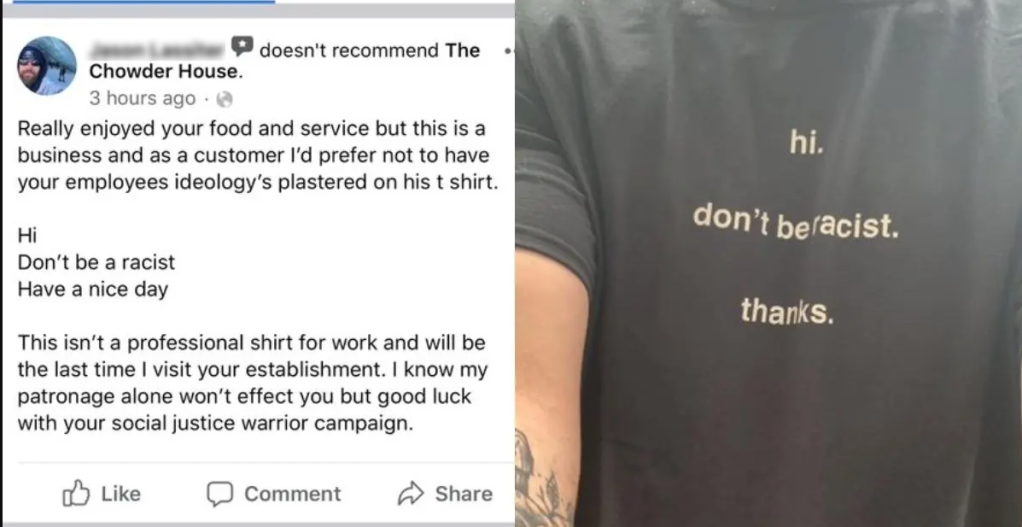
When a customer left a negative review of a restaurant because of a server’s shirt that said “Hi. Don’t be racist. Thanks,” he probably didn’t expect the internet to clap back quite this hard.

The incident took place at The Chowder House in Fairbanks, Alaska, where a server—who goes by @bryantinak on X—wore a shirt carrying that short and powerful message. After the review was posted, @bryantinak shared it on social media along with a selfie in the now-famous shirt. “Someone complained about me wearing my favorite shirt today on our Facebook page, now I can’t wear it at work anymore :.(,” they wrote.

The reviewer, Jason Lassiter, complained, “As a customer I’d prefer not to have your employees’ ideologies plastered on his t-shirt… This isn’t a professional shirt for work and will be the last time I visit your establishment.”


That might’ve been the end of it—except the internet had other plans.

“Someone complained about me wearing my favorite shirt today on our Facebook page, now I can’t wear it at work anymore :.(“
— @bryantinak

As soon as Lassiter’s review hit Facebook, commenters began roasting him for taking issue with a message as basic as “don’t be racist.” According to @bryantinak, “So many people direct messaged the guy that he deleted his bad review.”
anti-racism, restaurant review, fairbanks alaska, viral tweet, social justice, etsy shirts, black-owned businesses, racism, chowder house, positive backlash
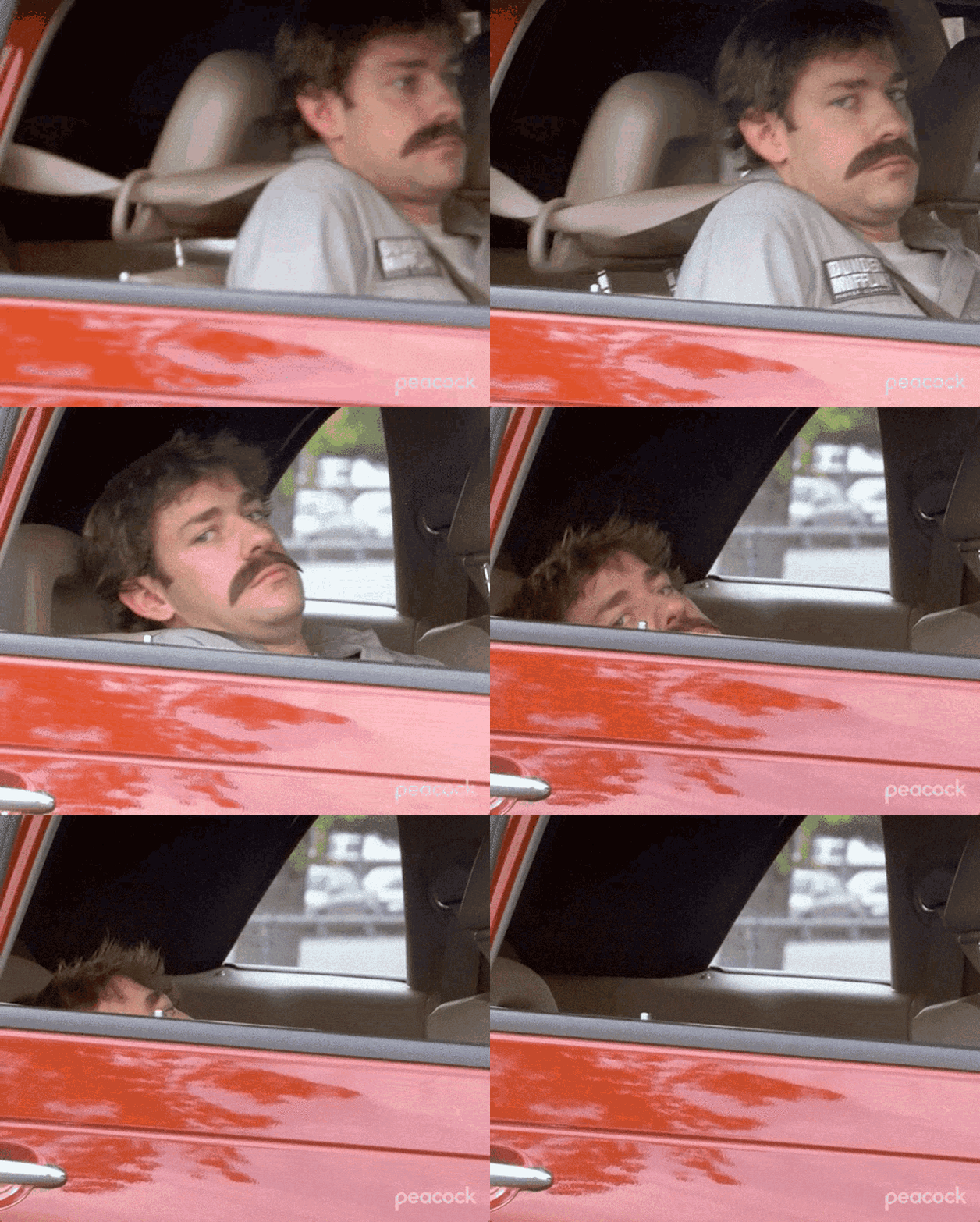
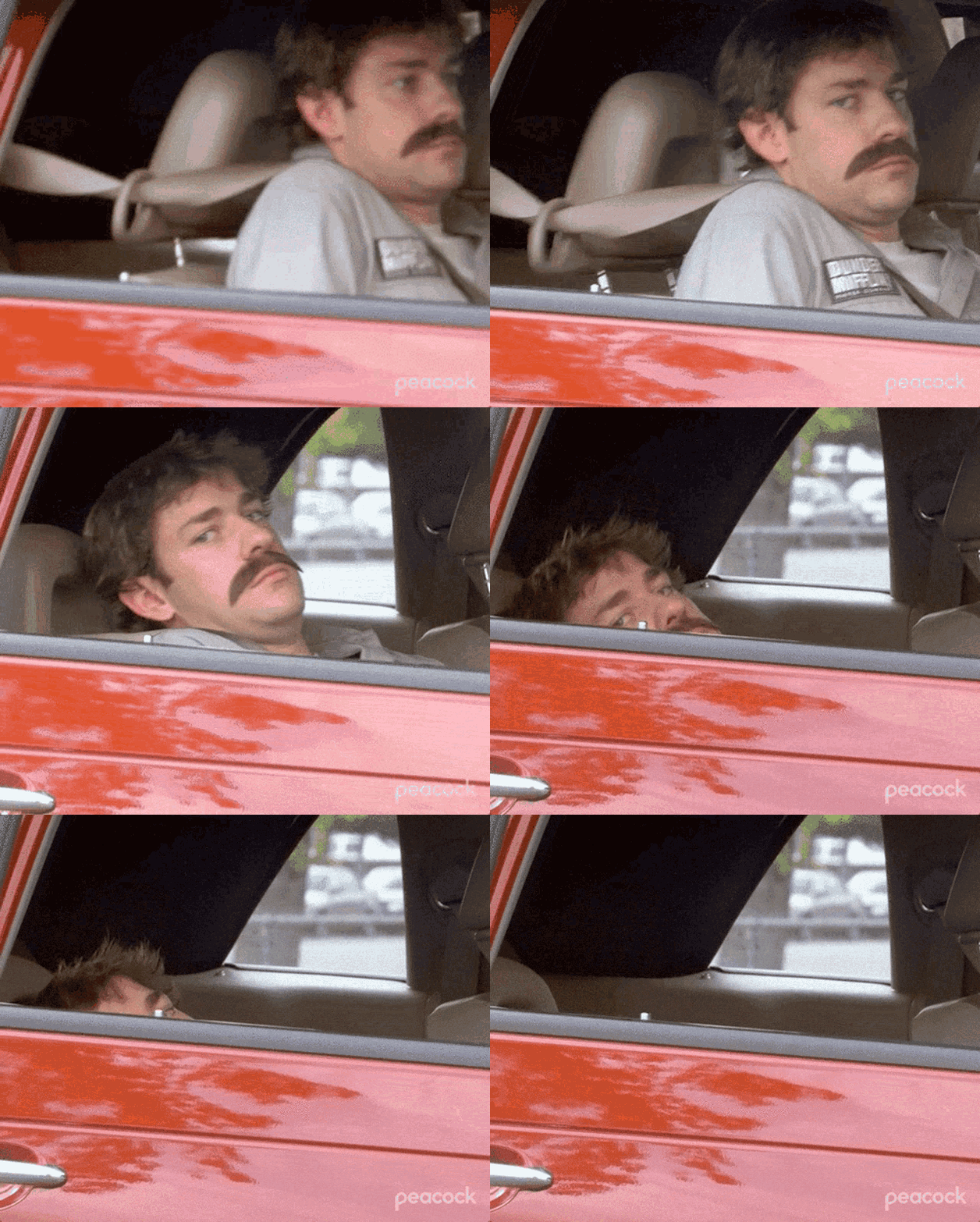
Ashamed man hides media1.tenor.com

Some couldn’t help but point out the irony of calling a shirt that politely discourages racism “unprofessional.” One user wrote, “That’s actually an extremely professional shirt. How much more professional can you get?”

What made things more confusing was that @bryantinak initially thought they were being reprimanded by management for wearing the shirt—understandably so, given the timing of the comment during a busy shift. But they later clarified:

“Talked to my bosses. They were upset at the customer for making an absurd complaint… They have no problem with me wearing the shirt and actually urge me to continue to if I wish to do so.”
— @bryantinak

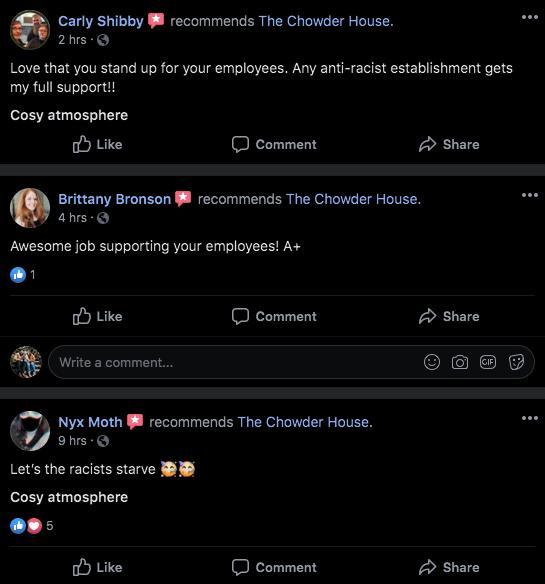
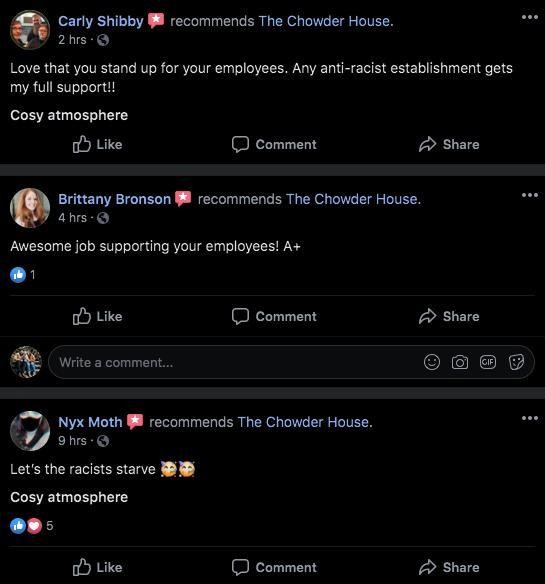
That’s when the tide really turned. Not only did Lassiter’s comment disappear, but The Chowder House’s Facebook page began receiving a flood of positive reviews. One person wrote, “Great place. Lets its employees be decent human beings.”
anti-racism, restaurant review, fairbanks alaska, viral tweet, social justice, etsy shirts, black-owned businesses, racism, chowder house, positive backlash
Commenters had thoughts Reddit

Another praised the food and the message: “Came for the anti-racism, stayed for the chowder… I had delicious racism-free salmon chowder and I’ll certainly be back next time I visit.”

“Came for the anti-racism, stayed for the chowder.”
— Facebook reviewer

@bryantinak mentioned they originally got the shirt from an Etsy shop, but that it seemed like “some fast fashion Etsy bulls–t.” They recommended instead buying similar designs from Black-owned businesses and even shared links to several apparel fundraisers and activist shops.
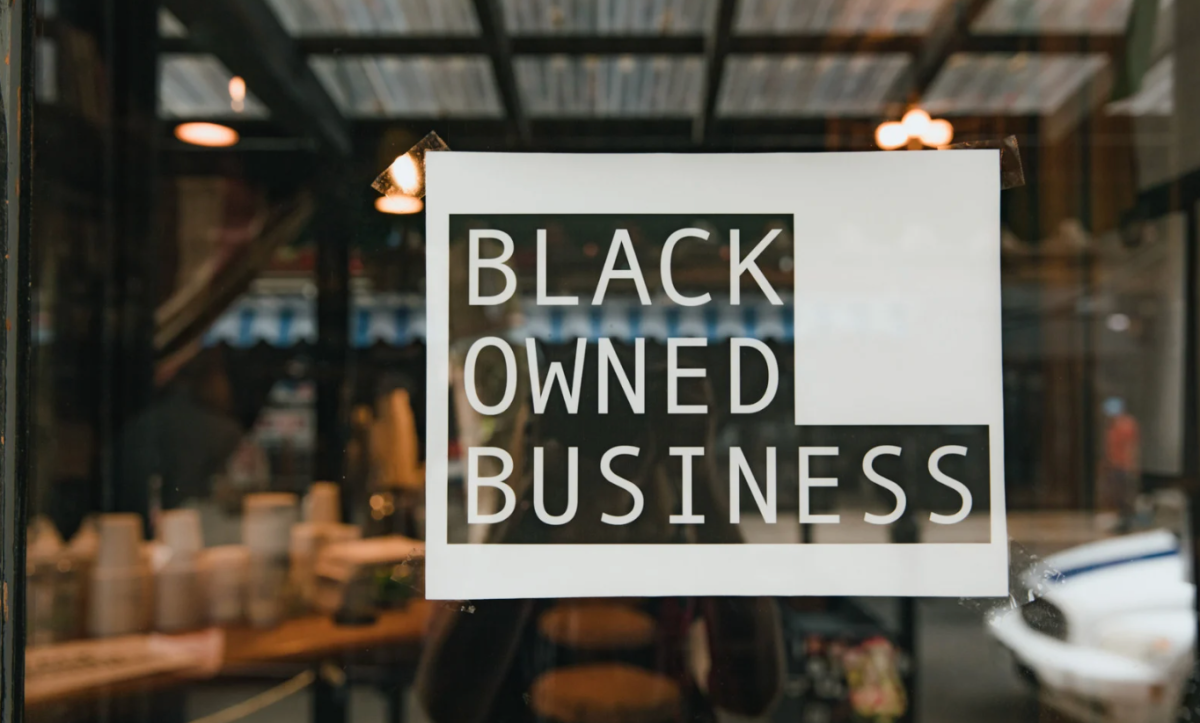
black owned business, anti-racism, restaurant review, fairbanks alaska, viral tweet, social justice
Black owned business sign Canva

The backlash to Lassiter’s review raises an important point—why is saying “don’t be racist” considered “ideological” or “controversial” by some people? If a simple request for basic human decency reads as offensive, it’s worth pausing to consider why.

Thankfully, it sounds like The Chowder House knows where it stands. And so does its staff.

This article originally appeared five years ago.
  • 17 everyday things we do now that the future will find utterly bizarre
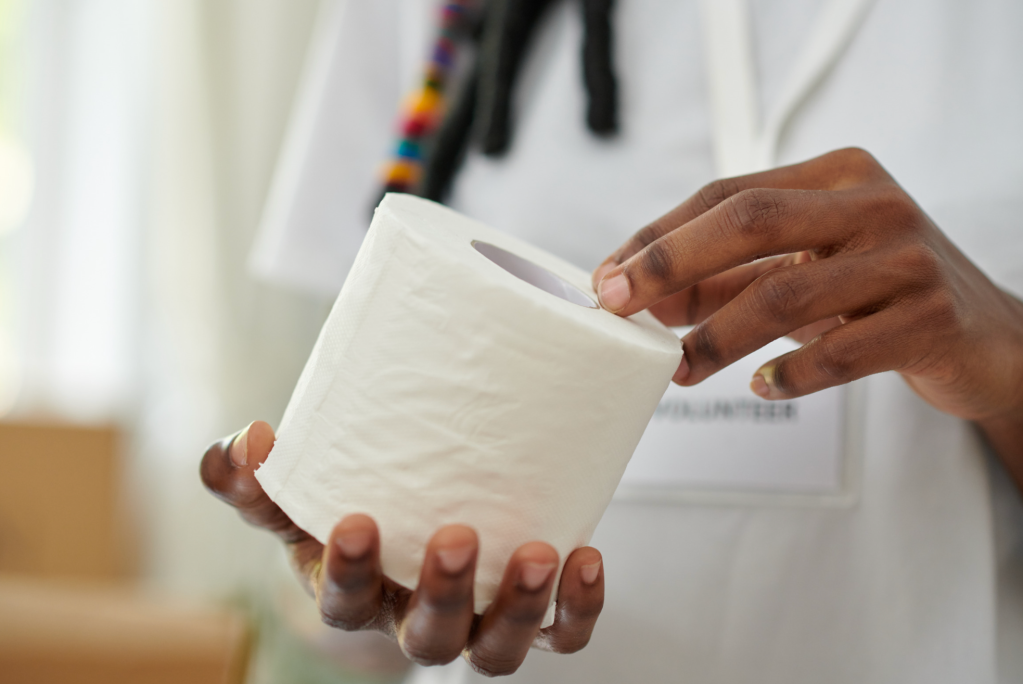
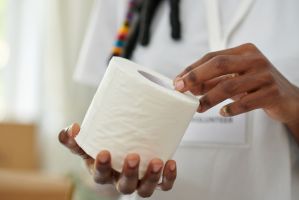
    A doctor holds a roll of toilet paperPhoto credit: Canva
    , , ,

    17 everyday things we do now that the future will find utterly bizarre

    An online community imagined looking back from the year 2075, and their predictions about our current “primitive” habits are surprisingly convincing.

    Hindsight is 20/20, but foresight is a little more complicated. Just as we look back at the Victorian era—with its arsenic makeup and child labor—and shudder, future generations will undoubtedly look back at 2025 and wonder, “What were they thinking?”

    A recent thread on r/AskReddit posed a fascinating thought experiment: “What’s something normal to us in 2025 that by 2075 will be seen as barbaric?”

    The thread exploded with over 4,500 upvotes, generating a mix of hopeful medical predictions, environmental critiques, and harsh truths about our social norms. Here are 17 of the most compelling things we do today that might horrify the history students of tomorrow.

    future predictions, 2075, barbaric habits, Reddit AskReddit, societal change, medical advancements, factory farming, child influencers, future tech, cultural shifts
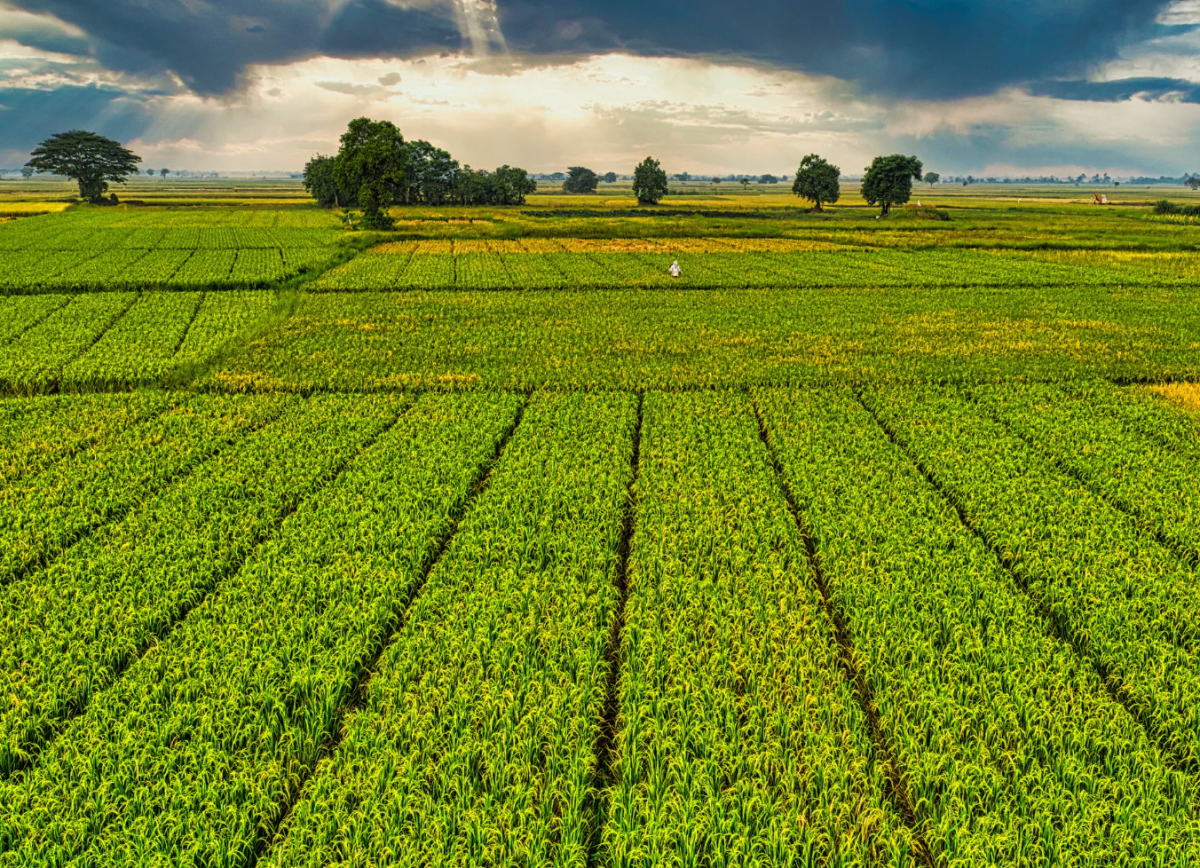
    A factory farm with rows of crops Canva

    The “Primitive” Hygiene & Diet

    1. Wiping with dry paper The concept of chopping down forests to dry-wipe our bodies baffled many users.

    “They cut down trees just to wipe themselves?!” one user imagined a future citizen asking. Another, u/Dramatic-Avocado4687, was blunt: “Wiping our asses with toilet paper.” The Future: High-tech bidets becoming the global standard.

    2. Factory farming This was a top answer. The industrial scale of animal agriculture was predicted to be looked upon with deep shame.

    “The worst hell on earth that humans have ever created,” wrote u/w0ke_brrr_4444.

    The Future: Lab-grown meat that is indistinguishable from the real thing, without the suffering.

    3. Eating animals entirely Some users went a step further, suggesting that 2075 society might be entirely vegetarian.

    “We don’t care because we don’t see it,” u/Zetsubou51 noted about our current disconnect from food sources. “Factory farms are awful for the animals and the people that work in them.”

    future predictions, 2075, barbaric habits, Reddit AskReddit, societal change, medical advancements, factory farming, child influencers, future tech, cultural shifts
    An empty hospital room Canva

    The “Dark Ages” of Medicine

    4. Chemotherapy While it saves lives today, “poisoning the whole body to kill a tumor” will likely look crude to future doctors.

    “We still poison the whole body with chemo and hope the cancer dies first,” noted u/Vocalscpunk.

    The Future: Targeted genetic therapies that delete cancer without making the patient sick.

    5. Drilling into teeth Dentistry involving drills and metal rods might be viewed the way we view Civil War amputations.

    u/nomiis19 offered a hopeful alternative: “Pull the tooth, get injection, grow a new tooth.”

    6. Ignoring women’s pain The medical industry’s historical dismissal of women’s pain was a major point of contention.

    “Not giving anesthesia with placing IUDs,” wrote u/tt_DVM2011. u/ThatRoryNearThePark shared a personal horror story: “Worst pain of my life… couldn’t sit upright for at least 48 hours.”

    7. Medical bankruptcy The idea that getting sick could make you homeless is a concept many hope will be extinct.

    “Medical bankruptcies and for-profit healthcare leaving people to die if uninsured,” wrote u/SarlacFace.

    8. Orthopedic hardware

    “Orthopedic surgery with drills, rods, and screws?” asked u/Orthocorey.

    Future surgeons might view our titanium pins and screws as barbaric carpentry rather than medicine.

    future predictions, 2075, barbaric habits, Reddit AskReddit, societal change, medical advancements, factory farming, child influencers, future tech, cultural shifts
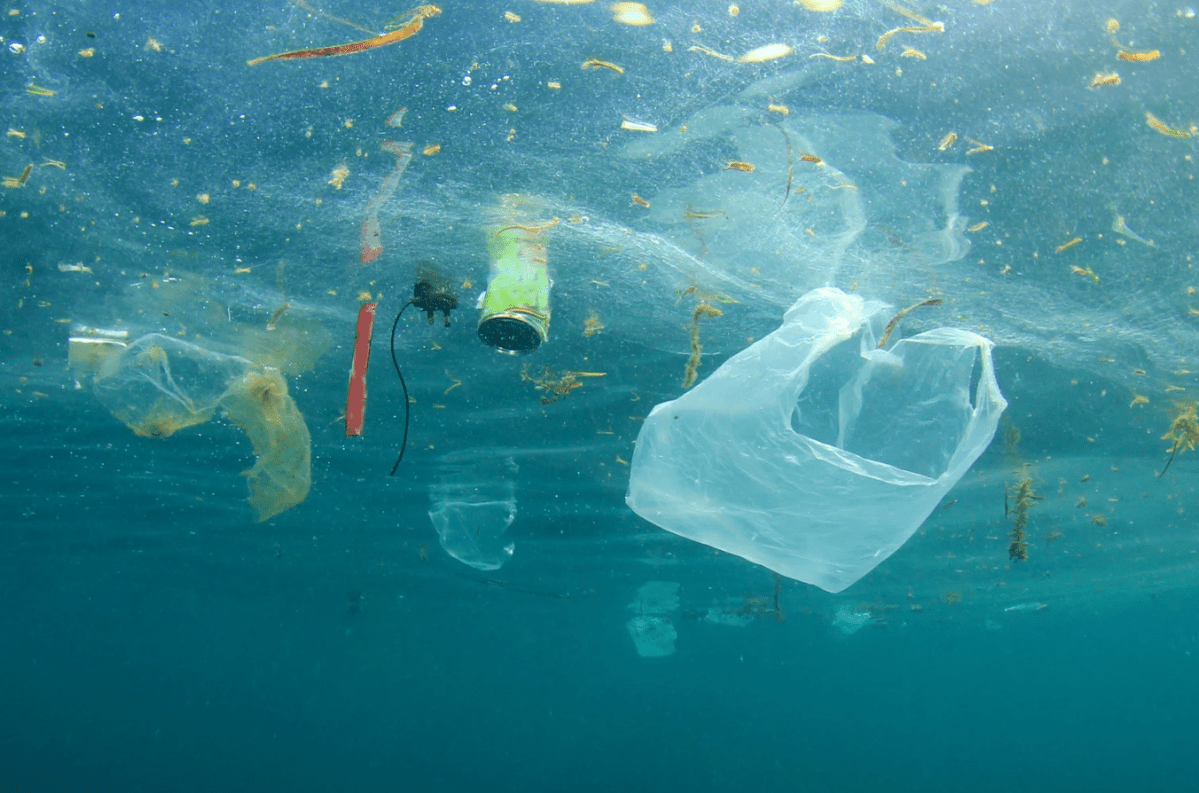
    Trash floating on the surface of the ocean Canva

    The Environmental & Social Reckoning

    9. Single-use plastics We wrap fruit in plastic, drink from plastic, and wear plastic.

    “Plastic everywhere, all the time,” wrote u/letthisbeanewstart. u/MarkNutt25 added that “plastic textiles” and microfibers will likely be viewed as an environmental disaster we willingly wore.

    10. Burning fossil fuels Burning liquefied dinosaurs to move cars will likely seem inefficient and dirty.

    u/loftier_fish offered a grim reality check: “If the answer isn’t ‘using fossil fuels,’ there will be a lot fewer humans to deem anything barbaric in 2075.”

    11. Humans driving cars We let imperfect, distracted, tired apes pilot two-ton metal death machines at 70 mph.

    “Driving yourself will seem barbaric,” predicted u/CranberryCheese1997. The Future: Fully autonomous transport networks that eliminate traffic accidents.

    12. Fast fashion The cycle of buying cheap clothes to wear once and throw away was called out by u/rabbity_devotee for filling landfills and exploiting labor.

    13. Animal entertainment

    “Drugged dolphins in resorts and whales at SeaWorld. Barbaric,” wrote u/w0ke_brrr_4444. Future generations may view zoos and marine parks the way we view old-timey circuses.

    The “What Were We Thinking?” Lifestyle

    14. Child influencers Putting children on the internet for profit before they can consent was a major ethical concern.

    “Hopefully, monetizing your children for social media will seem barbaric,” wrote u/TheWorstWitch.

    15. The 40-hour workweek

    “Working a 9-5 just to survive? Barbaric,” said u/DeathofSmallTalk1. Though u/EvaMayShadee cynically noted, “We’ll probably be working 60-hour weeks by then.”

    16. Doomscrolling Spending our one wild and precious life staring at a glowing rectangle.

    “Spending multiple hours, every day, scrolling mindlessly on social media,” predicted u/cornylilbugger.

    17. The optimistic twist Finally, one user suggested that we might be the civilized ones compared to what is coming.

    “By 2075, we’re gonna be way more barbaric… we’ll fight over everything once food gets scarce,” u/NapoleonDonutHeart warned.

    Let’s hope the optimists win this round.

    This article originally appeared earlier this year.

  • A millionaire went homeless to prove he could make $1M in a year. He lasted 10 months.
    A young man looks down the streetPhoto credit: Canva
    , , ,

    A millionaire went homeless to prove he could make $1M in a year. He lasted 10 months.

    Michael Black gave up his house and savings to prove he could rebound from rock bottom, but a medical emergency forced him to face a harsh reality.

    In July 2020, entrepreneur Michael Black (known online as @mikeblack) made a radical decision. To prove that success is about mindset rather than resources, he voluntarily drained his bank accounts, gave up his apartment, and walked onto the streets with nothing but the clothes on his back.

    His goal was audacious: launch a business from scratch and generate $1 million in revenue within 12 months.

    He called it the “Million Dollar Comeback.” However, with just two months left on the clock, the experiment came to a sudden, painful halt.

    Black’s motivation came from a place of empathy. During the height of the pandemic, he watched friends lose successful businesses overnight.

    “I knew a lot of people who lost everything during the pandemic and they got really depressed,” he explained in a Nas Daily video. He wanted to document a blueprint for resilience, proving that it was possible to bounce back from absolute rock bottom.

    The beginning was brutal. He faced immediate homelessness, relying on the kindness of a stranger who let him sleep in an RV. He slowly clawed his way up, selling free furniture on Craigslist to generate seed money. By day five, he had bought a computer. Within two weeks, he had secured office space.

    But while his business acumen was sharp, his body was breaking down.

    Four months into the challenge, tragedy struck. Black’s father was diagnosed with stage 4 colon cancer. The emotional toll of managing his father’s chemotherapy while trying to survive on the streets (or close to it) began to mount.

    Simultaneously, Black’s own health collapsed. Viewers of his YouTube series didn’t know that between his hustle-focused uploads, he was secretly visiting doctors. He was eventually diagnosed with two autoimmune diseases that caused chronic fatigue and excruciating joint pain.

    In a somber 2021 update, Black announced he was pulling the plug.

    “I have officially decided to end the project early,” he told his followers. “Now, as much as it hurts me to do this, especially with just two months left, I feel like it’s the right thing to do.”

    By the time he quit, Black hadn’t made a million dollars, but he hadn’t failed completely, either. Starting from zero, he had generated $64,000 in revenue—a respectable salary for ten months of work, though far short of his seven-figure goal.

    Ultimately, the experiment taught a lesson different from the one he intended. He set out to prove that “hustle” conquers all, but he learned that health and family are the ultimate non-negotiables.

    “We have been through a lot together,” Black said in his farewell to the project. “We walked miles together and spent late nights in the office… [but] health and family come first.”

    This article originally appeared last year.

  • Chris Hemsworth made ‘one lifestyle change’ amid Alzheimer’s diagnosis that we all need to commit to
    ArrayPhoto credit: Gage Skidmore / Wikimedia Commons
    , ,

    Chris Hemsworth made ‘one lifestyle change’ amid Alzheimer’s diagnosis that we all need to commit to

    He shared how this one change helped him take control of his stress and protect his brain health.

    Chris Hemsworth has opened up about the most prominent change he’s made since learning he’s at high risk for Alzheimer’s disease. The actor, who discovered his genetic predisposition while filming season one of his National Geographic series “Limitless,” said the adjustment wasn’t physical, but it’s something he now considers essential. Hemsworth revealed that he’s started building stillness and solitude into his daily routine, a decision that came after realizing how constant stress could impact brain health. “I don’t want to be in a sprint anymore,” the actor said, as he opened up about finding more time to spend with his loved ones.

    stress and cortisol, brain health, mindfulness habits, solitude practice, sleep routine, screen-free evenings, ice baths, breathwork, surfing therapy, Menu2019s Health, Dr Peter Attia, family time, cognitive decline, healthy aging, Thor actor, Avengers Doomsday
    Chris Hemsworth at the 2024 Cannes Film Festival. Frank Sunu00a0/ Wikimedia Commons

    What he changed after the Limitless revelation

    “There’s good stress… and then there’s continual dumping of cortisol, which is negative. Being in that fight or flight state, which in this modern world, we tend to find ourselves in far too often and for prolonged periods,” he told LADbible. That understanding led him to step back from the nonstop pace he was used to. He described making a conscious effort to slow down and take control of his time and abate signs of cognitive decline. “I sort of pushed back a little bit on the sort of ride I was on, where I felt like I wasn’t in control. I was just being dragged along,” he said.

    What APOE4 means for Alzheimer’s risk

    The change came after Hemsworth learned he carries two copies of the APOE4 gene, one from each parent, which puts him at significantly higher risk of developing Alzheimer’s disease. According to Mayo Clinic, carrying one E4 variant doubles or triples the risk of developing Alzheimer’s diseasesevere onset of the disease. The result, shared by longevity physician Dr. Peter Attia during filming, was kept off camera at first to allow Hemsworth time to process the information, as per Fox News.

    sleep routine, screen-free evenings, ice baths, breathwork, surfing therapy, Menu2019s Health, Dr Peter Attia, family time, cognitive decline, healthy aging, Thor actor, Avengers Doomsday
    Chris Hemsworth speaking at the 2014 San Diego Comic Con International Gage Skidmoreu00a0/ Wikimedia Commons

    Since the diagnosis…

    Though he made headlines for taking a break from acting after the episode aired, Hemsworth clarified that he’s not retiring. He’s returning to play “Thor in Avengers: Doomsday” and will star alongside Barry Keoghan in Crime 101. He explained that the break was part of a broader shift in how he approaches work, stress, and his health. Hemsworth said the news also prompted him to re-evaluate how he spends time with his family. “It made me think about my kids and how they’re growing up and things are changing so dramatically. I want to sit, I want to soak it in. I don’t want to be in a sprint anymore,” he told Dr. Attia. Reflecting on the experience, Hemsworth said the Alzheimer’s disease diagnosis was a reminder and “a realization of the fragility of everything, but also the beauty of things. And how to really take stock in the important relationships and experiences in life, and have them be purposeful.”

    @brutamerica Chris Hemsworth is taking a break from acting after learning he is predisposed to Alzhiemer’s disease, which his grandfather is currently battling. #news #fyp ♬ Love Of My Life – Metrow Ar

    In an interview with Men’s Health, Hemsworth said he’s adjusted his physical routine to match his new priorities. “I’m lifting less frequently than I was, and I’m incorporating more cardio and endurance workouts,” he shared. “I’ve always been pretty consistent with my exercise commitments, but lately I’ve really felt the importance of taking time for yourself without any outside voice or stimulation.”

    He now focuses on sleep, screen-free evenings, and mindfulness practices like ice baths, breathwork, and surfing — habits he says help him reset and stay present to avoid signs of cognitive decline. “My favorite mindfulness work comes from the immersion in physical activities that allow me to be fully present and force me out of my head and into my body,” he said.

    This article originally appeared last year.

Explore More Civic Life Stories

Civic Life

17 everyday things we do now that the future will find utterly bizarre

Civic Life

A millionaire went homeless to prove he could make $1M in a year. He lasted 10 months.

Civic Life

Chris Hemsworth made ‘one lifestyle change’ amid Alzheimer’s diagnosis that we all need to commit to

Civic Life

10 common phrases that are actually incredibly racist