



For years, the cultural narrative around financial struggle was firmly planted on Millennials. Labeled the "Avocado Toast" generation, they were told that if they just worked harder and skipped the latte, a three-bedroom house would eventually appear. But as we move through 2026, a new generation is entering the workforce only to find the same roadblocks. And this time, the walls are even higher.
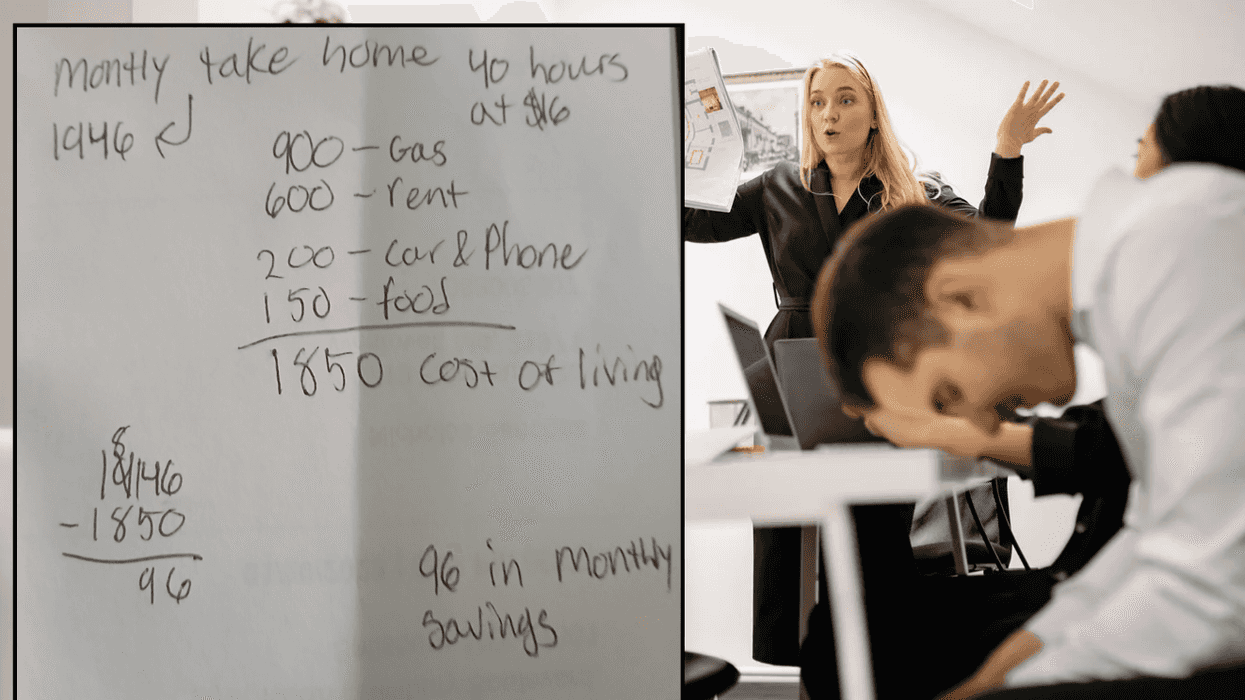
A recent viral post on Reddit has laid bare the mathematical impossibility of modern "entry-level" life. The post, which garnered over 30,000 upvotes in the r/GenZ community, features a young worker who is doing everything "by the book."
They work six days a week in an apprenticeship and live at home with their parents to keep costs down. Yet, even with these advantages, the numbers refuse to add up.
 A young person doing their monthly budgetCanva
The $96 Safety Net
After earning 16 dollars an hour and paying for essentials (including rent to their parents, groceries, a cell phone, and gas for a commute that includes driving family members around), the poster is left with a staggering 96 dollars in savings at the end of the month.
This tiny cushion is currently one mechanical failure away from disappearing. "I’m stressing because my car needs work," the poster shared. "It’s $1,300 for the power steering including labor and probably another $800 for the coolant system problems." For this worker, the "safety net" is effectively nonexistent.
The "Lazy" Myth vs. the Reality of Exhaustion
The most striking part of the story for the thousands of commenters wasn't just the low pay, but the sheer exhaustion of the schedule. The poster noted they are barred from working overtime but are required to work six days a week. Despite this grueling commitment, they are facing a ticking clock: their parents have given them only six months to move out.
While a raise is expected in four months, it amounts to only a single dollar more per hour. In the current economy, a one-dollar raise feels less like a ladder and more like a toothpick. "I’m showing this to the older generations that say we're lazy," they wrote. "I don't want to hear anything."
Why Millennials Are Seeing Red
Instead of responding with "back in my day" anecdotes, Millennials have flooded the conversation with fury and solidarity. They recognize the trap because they have been living in it since the 2008 recession and the inflation spikes of the early 2020s.
The data shared by users and reports from Newsweek highlight several grim realities:
- The Federal Stagnation: The national minimum wage remains stuck at 7.25 dollars per hour, a number that hasn't budged since 2009, back when the oldest Gen Zers were only 12 years old.
- The Living Wage Gap: According to the MIT Living Wage Calculator, even in "low-cost" states like Iowa, a single person needs to make at least 20.89 dollars per hour just to be self-sufficient. In cities like Washington D.C., that requirement jumps to nearly 26 dollars.
For years, media outlets played up a "Gen Z vs. Millennial" divide, focusing on trivial differences in fashion or slang. However, budgets like this one are proving that the two generations have far more in common than they have differences. Both are facing an economy where "purchasing power" has become a relic of the past. By acknowledging that the system (not the worker) is broken, this shared rage is beginning to turn into the collective power needed to demand economic policies that actually make a 40-hour work week enough to live on.
This article originally appeared last year.










 Gif of little dog holding guitar with caption "Time For Tacos" via

 A woman scrolls through a dating appCanva
 A home pregnancy test Canva
 A young woman scrolling on her phoneCanva
 Gig of two cartoon penguins watching TV via
  Gif of a storm trooper flipping through sings that say 'no' via