
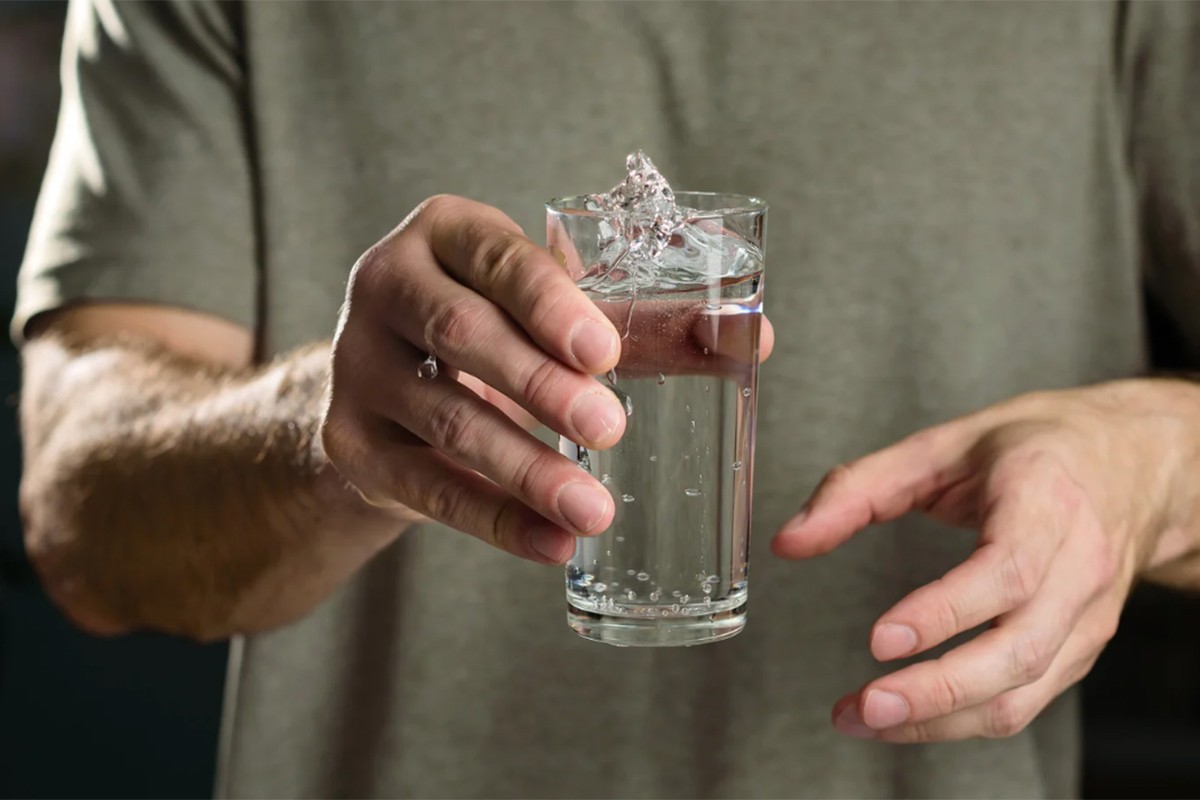
For more than three decades, Neville Waterstorm couldn’t do something most of us never think twice about, drinking from a glass without spilling. Living with essential tremors meant that even basic tasks were an everyday struggle. But a revolutionary new procedure performed at
Gold Coast University Hospital in Australia has changed all that.

Neville’s hands have steadied thanks to a surgery that doesn’t require incisions. The treatment targets the specific brain activity responsible for tremors, using MRI guidance to disrupt the problematic neural patterns non-invasively. And the results? Instant and incredible.

“Neville couldn’t drink a glass of water for 35 years.”


@ShannonFentiman

Shannon Fentiman, a Labor MP, shared the heartwarming moment on X, formerly Twitter. Neville, visibly emotional, was seen lifting a glass without shaking for the first time in decades. “Neville couldn’t drink a glass of water for 35 years. Watch that all change thanks to a groundbreaking incision-less surgery at Gold Coast University Hospital,” she posted.

An emotional moment and overwhelming gratitude

The reaction was overwhelming, not just for Neville, but for everyone who witnessed it. He recalled the moment post-surgery when he was handed a glass of water. Through tears, he said, “That very first moment I came out of the MRI and they put a glass of water in front of me… For 35 years I’ve never ever been able to drink that glass of water.”

“The thanks that I feel… for something that’s changed my life is endless.”

— Neville Waterstorm

He went on to express profound appreciation for the doctors, hospital staff, and government support that made the procedure possible. It wasn’t just about drinking, it was about reclaiming a life he had long lost. “It’s been incredibly difficult to do even simple tasks like feeding myself, and drinking out of a glass was just not a possibility,” he shared. “Now – it’s just amazing.”

More than just water, Neville regains his life

Just an hour after the procedure, Neville was already experiencing dramatic results. He could hold a pen, draw a spiral, and control his movements in a way that hadn’t been possible in decades. The hospital posted a proud update on Instagram showing his progress, calling it a “life-changing transformation.”

“One hour after the procedure… I can drink a glass of water again.”

— Neville Waterstorm

Gold Coast University Hospital is the first public hospital in Australia to offer this type of treatment. Using advanced MRI-focused ultrasound, the technique provides a non-invasive alternative for patients suffering from essential tremors, a condition that can dramatically diminish quality of life.

A community moved

The internet had one collective response to Neville’s story: tears. User @miss_nou82 wrote, “Yes, but can he please wipe my tears away too because now I’m crying, damnit Neville.” Another, @mobiddiction, added, “Truly a miracle!!! God bless all the doctors, nursing, and admin staff who make such miracles come true.”

“Now I’m crying, damnit Neville.”

@miss_nou82

Gold Coast Health shared the joy too, posting, “We are so proud to be supporting treatments and outcomes like this. Helping to change lives and help deliver the best possible patient experiences is what drives us every day.”

@couriermail A Queensland man who has been suffering from severe uncontrollable tremors for the past 30 years can now live a normal life after an innovative brain procedure. The procedure uses ultrasound energy to target and ablate areas of the brain that trigger symptoms of movement disorders such as uncontrollable tremors. Read the full incredible story at The Courier Mail.
♬ original sound – couriermail

What’s routine for many, lifting a mug, writing a note, was a dream come true for Neville. And now, thanks to science, compassion, and public healthcare, that dream is being realized for more people than ever.

The ripple effect of one glass of water

Neville’s story helped ignite a wave of change. Within a month of his July 2024 surgery, Queensland’s government backed the procedure with A$3.5 million in funding. By March 2025, it was added to Australia’s national Medicare Benefits Schedule, making it free to eligible patients instead of costing A$30,000 out of pocket.

“I can drink a glass of water again… just one hour after the procedure.”

— Neville Waterstorm

The impact is global. A JAMA Neurology study showed that treating both sides of the brain nearly doubles the total reduction in tremor severity. Clinics from New York to Scotland have adopted the technique, even treating patients in their 90s. The Focused Ultrasound Foundation now supports expansion into Parkinson’s care and beyond.

From impossible to everyday, lives are changing. Neville’s moment wasn’t just personal, it was a turning point for medicine worldwide.

This article originally appeared last year.

  • Love educator shares how awkward flirting can be turned into a romantic superpower
    A couple flirts on the dance floor.Photo credit: Canva

    In a recent TED Talk, love coach Francesca Hogi shared how even your awkward flirting can be a superpower. Sometimes mistaken as off-putting, flirting actually offers a powerful gateway to real human connection.

    By reframing flirting as an act of curiosity, she explains how anyone can kickstart attraction and open the door to lasting love. In an impassioned presentation, Hogi demystifies flirting and explains why building attraction matters.

    Flirting can be a superpower

    Hogi explains that for 12 years she’s been helping people fall in love as both a matchmaker and a coach. “As a love professional, I can assure you that many dating problems can be solved with flirting,” Hogi says. “If you’re single, it helps you to connect and fall in love. If you’re partnered, it helps you to reignite or maintain the spark of chemistry that brought you together in the first place.”

    Many might have concerns about their ability to flirt. Will they be received well, or are they even doing it right? Hogi explains, “I’ve got good news for the introverts out there. You don’t have to be extroverted to be a magnet for connection. In fact, I believe that introverts have a secret advantage when it comes to flirting because your efforts at being more open feel more genuinely inspired by another person and therefore special.”

    She shares that flirting can give you confidence and courage. She also acknowledges that feeling awkward is normal. “Confidence with flirting comes from knowing yourself, your intentions, reading the room, discerning other people’s reactions, and adapting accordingly,” she says. “Sometimes it’s going to be awkward, sometimes it’s going to be embarrassing, and that’s okay.”

    flirtation, connection, mental health, good vibes, sexuality
    A couple enjoys flirting.
    Photo credit: Canva

    Healthy flirting

    “Flirting gives you more agency over human connection,” says Hogi.

    She then describes the two foundational principles of healthy flirting. The first is presence: being in the moment and avoiding distractions like a phone or the surrounding environment. The second is enthusiasm. Getting the right vibe while being enthusiastic goes a long way toward mastering the art of flirting. These principles have a strong effect on other people.

    Hogi explains that expressing positive intentions has a large impact on outcomes:

    “You have the ability to leave other people feeling good for having interacted with you…Even your unspoken appreciation for a shared moment of connection, no matter how brief, can often be felt. Lean into being the version of you who leaves other people with a smile on their face and notice how much more magnetic you become.”

    community, expression, humor, self-confidence, self-esteem
    A flirtatious interaction.
    Photo credit: Canva

    Hogi inspires the crowd

    People seem quite taken with Hogi’s energy and charisma. Some of the comments expressed admiration for her vibe and flirtatious delivery on stage. Hogi was sharing her own version of flirting as a superpower:

    “Even this presentation feels like shes flirting…especially her laughs”

    “She is such a good public speaker, ten minutes of speech with no filler words whatsoever”

    “Flirting is a way making one feel seen and acknowledged.”

    “Where were you, Francesca, when I needed these words? Like, 40 years ago? Never too late, right?”

    “Had me clapping in the end! She’z good”

    “I feel better about my flirting abilities after watching this now.”

    “She’s good , reading her body language generally teaches me more about flirting than learning it itself”

    gender, attraction, laws of attraction, social skills, personality traits
    A vintage photo of a couple flirting.
    Photo credit: Canva

    The power behind a flirtatious connection

    Flirting can have a powerful effect on both the initiator and the person on the receiving end. It isn’t necessarily about romance or sex. It helps build and strengthen relationships in everyday life.

    A 2025 study on ResearchGate analyzed where and how people flirt. The results suggested that people who flirt can improve with practice. The best flirting involved humor, confidence, and social skills. A 2026 study on ScienceDirect found that flirting can be an effective way for people to express their personality and individual differences. While personality traits and sex were linked to how often and how skillfully people flirted, these influences had only modest effects on overall outcomes.

    Hogi suggests flirting requires nuance and a little bit of courage. Practice prepares you for any occasion. “Attentiveness, compliments, playfulness—there’s nothing complicated about these actions, yet they have the potential to spark and sustain connection over time,” she says. “That’s a true superpower we can all tap into.”

    Hogi and the research suggest flirting isn’t just a trivial social game. It’s a meaningful way to express personality, build connections, and boost self-confidence. Flirting isn’t shallow. It doesn’t need to involve manipulation or outcome-obsessed action. These small everyday acts of courage embolden human connection and reveal individual superpowers in all of us.

  • Retired U.S. Navy chief explains how to end discipline anxiety with wholesome ‘butler’ trick
    (LEFT) A cluttered closet. (RIGHT) Chase Hughes.Photo credit: Canva and YouTube

    During an interview on The Diary of a CEO podcast, retired U.S. Navy chief Chase Hughes explained how to end discipline anxiety. Using a simple perspective shift, often referred to as the “butler” trick, he describes a method of “prioritizing the needs of our future self.”

    Hughes shares that understanding discipline is one of the fastest ways to change everything in our lives. We might wish discipline would arrive like a lightning bolt of motivation. However, Hughes suggests the solution lies in our relationship with discipline and the perspective we take on it, which ultimately relieves our anxiety.

    End discipline anxiety

    Hughes begins by explaining the importance of understanding what discipline actually is: “I define discipline as your ability to prioritize the needs of your future self ahead of your present self.” He goes on to explain that a simple reframing can change the link between discipline and anxiety.

    “If I can start looking backwards with gratitude, [it] is the fastest way to make discipline dopamine-generating,” Hughes says. “I want past-tense me to be a source of dopamine for present-tense me. Cause most of us look back with regret. ‘I shouldn’t have drank that much. I shouldn’t have mouthed off at the family reunion. You know whatever it is, I shouldn’t have overslept.’”

    discipline, butler tick, anxiety, service, community
    A butler ready to be of service.
    Photo credit: Canva

    The butler trick for discipline

    Instead, it’s possible to prioritize long-term endeavors over short-term desires. In the full YouTube video of the interview, Hughes describes the butler trick as a way of treating your future self as someone you can serve today, just like a butler. The concept of looking forward with concerned awareness and backward with gratitude can help release the connection between anxiety and discipline. This reframing and release of negativity help people better motivate themselves and manage their present circumstances.

    A 2025 study in SAGE Journals found that future self-orientation directly impacts discipline-related outcomes. This trick can lead to meaningful behavior change. By reframing our relationship with the past, we directly affect our relationship with discipline and procrastination. A 2023 study published by Springer Nature found that procrastination and self-control significantly influence attitudes toward time. How someone relates to time ultimately shapes whether discipline feels easy or overwhelming.

    Butler trick, discipline, time management, consistency, habit loops
    A woman realizes she is late.
    Photo credit: Canva

    Thoughts on the butler trick

    Viewers seemed universally impressed by the solution Hughes offers in the butler trick for discipline. Here are some of their thoughts:

    “I love it when Past Me has done something great to support Future Me. Sometimes it’s all I got, but it’s enough.”

    “This is the best advice on discipline I’ve ever heard in my life”

    “He’s giving you the blueprint for ultimate self care”

    “Be methodically organized and make your life less complicated and more suitable to your needs.”

    “I’ve heard everything can be looked at as a learning opportunity. Selfless gratitude + learning seems like a strong combo.”

    “Be my own butler. Love this!”

    self-discipline, self-mastery, perseverance, determination, butler trick
    Self-discipline is defined as controlling one’s own desires.
    Photo credit: Canva

    Discipline changes everything

    Hughes underscores the value discipline has in changing our lives:

    “Discipline is kind of the gateway drug to everything else in authority, and it’s the gateway to composure. But getting your discipline modified is one of the fastest ways to make everything else change.”

    Discipline can mistakenly be associated with punishment and rigid routine management. With Hughes’ framing, it might be better described as stewardship. Instead of battling the present, you can serve the future. The butler trick can help us all be more thoughtful toward the person we are becoming.

    You can watch the full interview with Chase Hughes on The Diary of a CEO podcast below:

  • Experts say you can ‘talk’ to someone using your eyebrows regardless of language or culture
    You say more with your eyebrows than you probably realize.Photo credit: Canva

    In order to communicate and read others effectively, people need to pay attention to others’ body language and their words. Of course, it’s not always easy to decipher. People can interpret body language very differently from one another, but some physical signs are universal (like a smile). However, more than just smiles are universal. New research suggests that, regardless of culture or language, understanding can be found in our eyebrows.

    Communication expert Vanessa Van Edwards shared how important eyebrows are for conveying and interpreting curiosity, engagement, and interest. Van Edwards explains that raising our eyebrows comes from humans wanting to widen their eyes to visually get a closer look at something. This behavior has since translated into nonverbally communicating the same thing in conversations. Seeing a person raise both eyebrows indicates that the conversation is in your favor. If their eyebrows are neutral or furrowed, you may want to make pivots or switch topics.

    @vvanedwards

    The Eyebrow Cue You’ve Been Ignoring

    ♬ original sound – Vanessa Van Edwards

    According to psychologist Dane Archer, as quoted by the Los Angeles Times, eyebrows are especially revealing. The eyes, brows, and forehead tend to show more authentic expression and are less performative than the lower half of the face. “If we are trying to mask our feelings, we do it with our lower face,” Archer said. “The upper face is under a little less control.”

    These aren’t the only experts vouching for the importance of eyebrows in human communication. A 2025 study at the Max Planck Institute for Psycholinguistics found that eyebrows were essential for signaling problems of understanding. An audience member raising or furrowing their eyebrows can indicate to a speaker whether listeners understand or need more information.

    A speaker can tell how they’re being received by reading their listeners’ eyebrows. Either the audience is tracking with them, or the speaker needs to elaborate on a point. If a listener furrows their eyebrows and the speaker notices, they can pivot mid-speech to provide a clearer example. Once eyebrows return to a neutral position—or signal understanding—the speaker can move on.

    According to research from the Max Planck Institute for Psycholinguistics, eyebrows are “initiating repair during conversation” to fix any misunderstandings on the fly.

    Researchers say this eyebrow movement isn’t just helpful for verbal communication, it also plays an important role in sign language. In American Sign Language, furrowed eyebrows while signing indicate that someone is requesting information. When asking a question, ASL users rely on brow movement to signal whether the question is genuine or rhetorical.

    While eyebrows primarily help keep sweat out of our eyes, psychologists argue there are other reasons we have them. Eyebrows are key factors in how humans evolved for communication, helping us express emotion to one another without words.

    This helps explain why expressions conveyed through eyebrows are nearly universal, regardless of differences in culture or language—and, in some cases, even species. Domesticated dogs, for example, have evolved prominent inner eyebrows that help them communicate more effectively with humans.

    The next time you’re conversing with someone, it’d be worth looking at their eyebrows to see what they’re truly saying back to you.

Explore More Health Stories

Health

How birdwatching makes your brain stronger and healthier

Health

Oxygenating hydrogel and a tiny battery may heal chronic wounds and transform recovery

Health

Husband discovers his wife’s early-morning alarm habit was secretly ruining his sleep every day

Health

New research says that if you want an entrepreneur to be successful, tell them they will fail