Wildfire incidents have more than doubled across the world due to climate change and other factors, according to NASA. As a result, miles upon miles of heavily forested areas have turned to ash. In response to a wildfire striking close to home, two Portuguese teens have taken it upon themselves to replant forests with the help of a spider robot.
In 2023, college students Marta Bernardino and Sebastião Mendonça wanted to address the forest loss outside their home in Lisbon, Portugal. A major issue with replanting was that the steep terrain where the forest stood made it difficult and dangerous for workers to plant saplings. If a person were to try to plant a replacement tree, they would have to climb steep ledges and risk boulders falling while attempting to reforest the area.
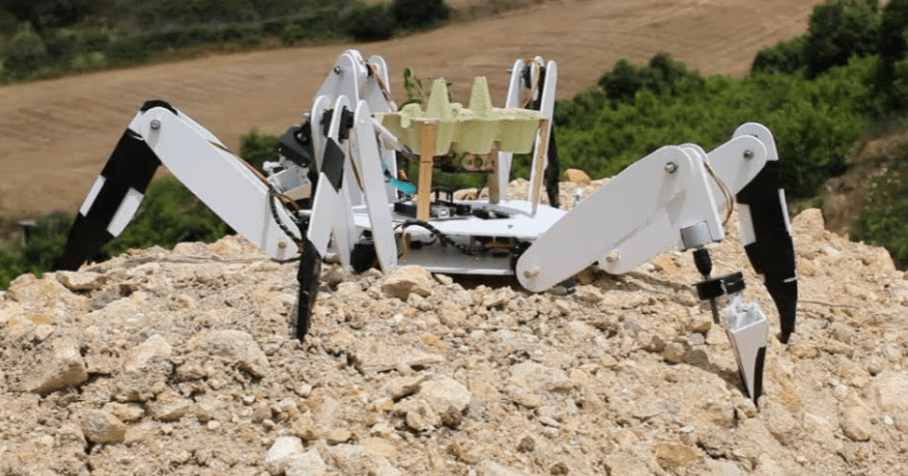
With their ingenuity and a little over $17 worth of recycled materials, the two teens created the prototype of Trovador, a six-legged, spider-like robot that can climb the steep terrain and effectively plant tree saplings without putting humans at risk. The robot’s sensors and AI help it avoid boulders and other hazards while also collecting data about the terrain to identify additional spots for planting saplings. So far, the Trovador spider-bot can plant saplings 28% faster than humans—about 200 per hour—with a 90% survival rate.
That 90% survival rate is a big deal, especially compared with other methods, such as dispersing tree seeds over deforested areas using drones. While spreading tree seeds with drones can work in some places, it’s far less effective in the rocky, steep terrain of Portuguese forests. The method has low precision and a high cost, with thousands of seeds being dropped but failing to take root and grow. Because the teens’ spider-bot can not only climb and safely plant partially grown saplings in those areas, but also use AI to detect the soil’s optimal pH for planting, it offers an effective and economically beneficial alternative to drone seeding.
Since Trovador’s creation, Bernardino and Mendonça have received a lot of attention from the science and climate community, including National Geographic. They even held a crowdfunding campaign to get funds to build a more robust version of their spider-bot. However, rather than selling Trovador as a product for organizations to purchase, the teens plan to offer it as a reforestation service around the world.
“Clients [like] municipalities, insurers, forestry firms or NGOs can open our app, outline a polygon, choose native species and receive a quote,” Bernardino told Smithsonian. “Pricing is expected to be a big step up from the current methods, up to six times cheaper than manual crews and four times more cost‑effective than drones once seed wastage is factored in.”
Will Trovador be the future of reforestation? That answer will come the same way as tall mighty trees do: with time.