





Here is a finding that will probably make you argue with yourself a little: a new peer-reviewed study published in the journal Intelligence found that people with higher cognitive ability consistently rated moral values as less important than those with lower cognitive ability. Not one or two moral values. All of them.
The study, conducted by researchers Michael Zakharin and Timothy C. Bates at the University of Edinburgh and published in July 2025, involved 1,320 adults across two separate experiments. Participants were tested for cognitive ability, measuring verbal reasoning, numerical pattern recognition, and abstract thinking, and then assessed using the Moral Foundations Questionnaire-2, a standard tool that gauges how strongly people endorse six core moral values: care, equality, proportionality, loyalty, authority, and purity.
In both studies, higher intelligence was linked to weaker endorsement of every moral foundation. People with higher scores on verbal, numerical, and abstract reasoning tests rated care, equality, proportionality, loyalty, authority, and purity as less important to their moral identity.
 A student on their phone in classCanva
The researchers tested four competing theories about how intelligence and morality might relate to each other. The one that best fit the data was what they called the Morality Suppression Model, the idea that higher cognitive ability may weaken people's reliance on intuitive moral judgments, with people with stronger reasoning skills being less likely to accept moral values at face value and more inclined to question or reinterpret them.
To be clear about what the study did and didn't find: this is not an argument that smarter people behave worse. It's saying that analytical thinking may cause people to scrutinize and pull apart moral intuitions rather than simply accepting them. Whether that leads to better or worse real-world decisions is a separate question, and one the study doesn't answer. The researchers themselves were careful to note that the causal direction remains uncertain.
intelligence moral foundations study 2025, cognitive ability empathy research, Zakharin Bates University of Edinburgh, smart people less empathetic, moral foundations theory, IQ morality research, analytical thinking moral intuition, intelligence ethics study, journal Intelligence 2025, cognitive ability moral values YouTube
It also found no difference between men and women. While average scores on moral foundations did differ by gender, the connection between higher intelligence and lower moral endorsement held equally for both.
One specific finding worth noting: verbal intelligence in particular was linked to lower endorsement of the purity foundation, which covers things like bodily sanctity and traditional moral norms. People who are better with language, it seems, may be more likely to question inherited standards of what's "pure" or "proper."
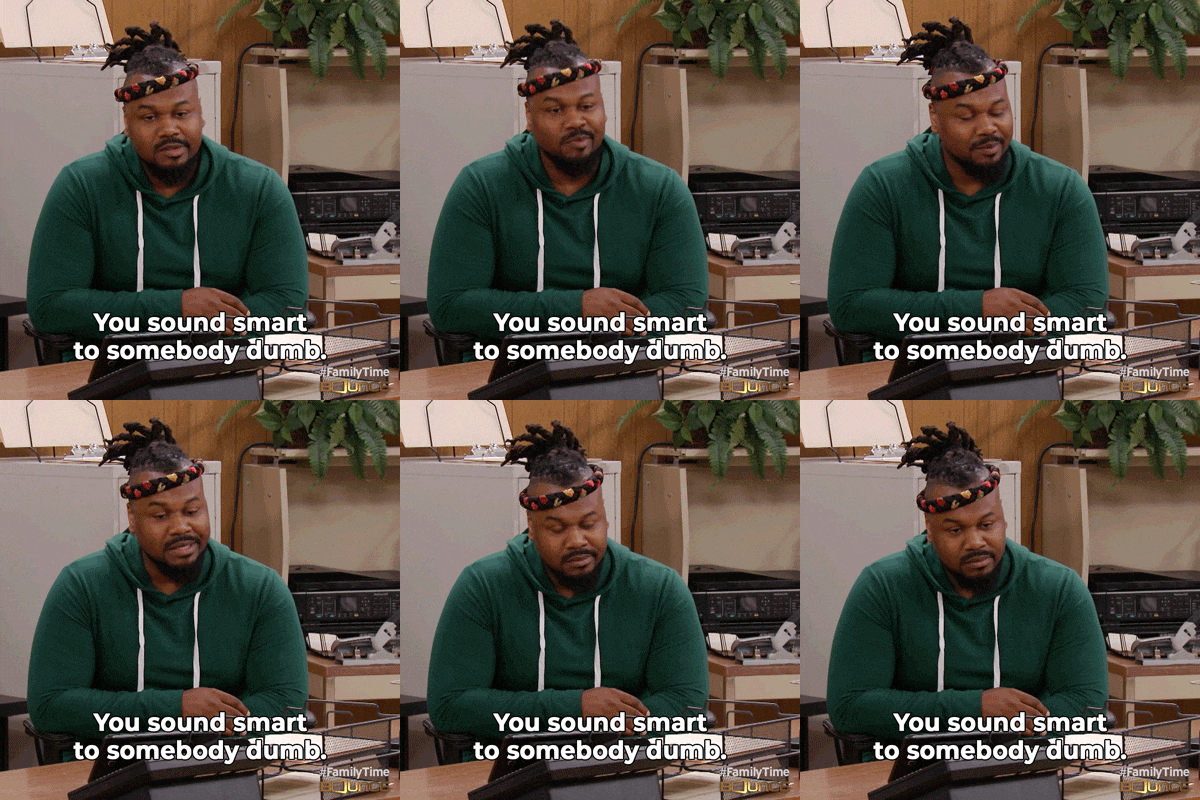 Gif of someone saying "YOu sound smart to somebody dumb" via Giphy
None of this would have surprised Leo Tolstoy, who argued the opposite: that kindness is one of the surest signs of a truly intelligent person. And other research does complicate the picture. Separate studies have linked higher cognitive ability to greater support for anti-racism and socially liberal values, which arguably are moral positions too.
What the study really seems to be measuring is the difference between moral intuition and moral reasoning. People with higher cognitive ability may feel the pull of instinctive moral responses less strongly, not because they're colder as humans, but because they're more likely to stop and pick those responses apart. Whether that's a feature or a flaw probably depends on who's doing the picking, and what they find.
intelligence moral foundations study 2025, cognitive ability empathy research, Zakharin Bates University of Edinburgh, smart people less empathetic, YouTube
This article originally appeared last year.










 A coupe on a romantic dateCanva
 A woman swims in the oceanCanva
 A happy-looking dolphin popping out of the waterCanva
 A labratory mouse checks out a microscopeCanva

 Gif of little dog holding guitar with caption "Time For Tacos" via

 A woman scrolls through a dating appCanva
 A home pregnancy test Canva